Schumer leaves door open to 14th Amendment measure to bar Trump from office
Virginia's Sen. Tim Kaine has been at the forefront of the 14th Amendment push
Senate Majority Leader
Chuck Schumer Thursday did not rule out bringing legislation to bar former President
Donald Trump from office if he is not convicted at the ongoing Senate impeachment trial.
Democratic senators have discussed in recent weeks that if they cannot secure the 67 votes needed to convict Trump -- and bar him from holding office in a subsequent simple-majority vote -- that they might invoke the 14th Amendment of the Constitution to do the same.
Schumer, D-N.Y., was asked about the possibility in a press conference ahead of the impeachment trial proceedings Thursday.
"We're first going to finish the impeachment trial and then Democrats will get together and discuss where we go next," Schumer replied.
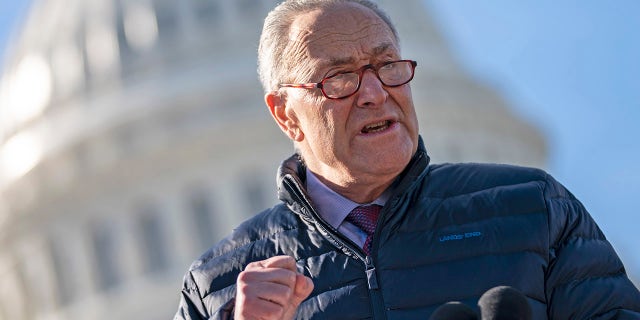
Senate Majority Leader Chuck Schumer (D-NY) speaks during a press conference about student debt outside the U.S. Capitol on February 4, 2021 in Washington, DC. (Photo by Drew Angerer/Getty Images) (Getty Images)
TRUMP STEERS CLEAR OF IMPEACHMENT TRIAL RAPID RESPONSE WITHOUT TWITTER MEGAPHONE
He'd also praised the case made by the House impeachment managers Wednesday and that he is "hopeful it will change minds. It's hard to look at that and not see the gravity of what happened."
Sen. Tim Kaine, D-Va., has been on the forefront of the 14th Amendment push among Democrats, and Sen. Chris Coons, D-Del., late last month called it "intriguing."
"What Senator Kaine is talking about is a censure resolution that would also specifically include the elements of the 14th Amendment that lead to disqualification from future office," Coons said. "That's intriguing to me and something I'm willing to look at the bottom line here is we have to deliver accountability for the events of January 6."
The 14th Amendment to the Constitution says that Congress can bar people who "engaged in insurrection or rebellion" against the U.S. from holding office. It was originally meant to prevent former Confederates from serving in the government after the Civil War.
"No person shall be a Senator or Representative in Congress, or elector of President and Vice President, or hold any office, civil or military, under the United States, or under any state, who, having previously taken an oath, as a member of Congress, or as an officer of the United States, or as a member of any state legislature, or as an executive or judicial officer of any state, to support the Constitution of the United States, shall have engaged in insurrection or rebellion against the same, or given aid or comfort to the enemies thereof," the amendment says.
MIKE LEE'S OBJECTION TO 'FALSE' TRUMP IMPEACHMENT EVIDENCE CAUSES STIR AS DEMS SET FOR CLOSING ARGUMENTS
"The Congress shall have power to enforce, by appropriate legislation, the provisions of this article," it adds.
Sen. Tim Kaine D-Va., speaks during a news conference outside of the Senate chamber, on Capitol Hill in Washington, Tuesday, Jan. 14, 2020. (AP Photo/Jose Luis Magana)
Some interpret this amendment as fundamentally giving Congress the ability to bar a person who "engaged in insurrection" -- what Trump is accused of in the article of impeachment -- from office.
It's almost certain that this action, like an impeachment conviction, does not have the votes to pass.
It would likely raise constitutional questions and slippery slope concerns that it would set a precedent neither party wants when their preferred candidate is in office.