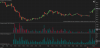
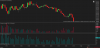
Simples, you trade ES if I understand correctly, and may be (I do not know) for ES it is good timeframe. ES is 100% speculative.
CL is totally different. The volume distribution across time scale is extremely far from uniform. The spikes are sudden and huge, because of hedgers activity. For any 5 min high volume bar 80% of volume are in 15-30 second interval. So
1. 5 min timeframe seems to be 'long term' for intraday short term traders.
2. pro rate volume is totally misleading for CL
BTW, reason for the minute about the activity on CL. Hedgers and big speculators step in when and if they get proper PRICE to activate the trade. Firstly, the proper price level is seen, and than the activity manifests. PRICE first, VOLUME second, RSI&MACD&others are third. Price leads, volume follows. Is the ES differnt? May be...
Thank you for sharing your experience and inspiring investigation.
The JHM method is traditionally for ES 5 min and 30 min, so such chart would probably be best for training. Though other markets and timeframes should follow the same principles - with some natural variations of course. I've trained on QQQ EOD-bars for instance, and not yet fully incorporated ideas from JHM. For intraday/CL/NQ you know your specifics better than me. Factual charts is helpful for differentiation. For differentiating JHM one needs to adjust/shelve some of what one already knows in order to "fill the cup" with additional, different knowledge. It doesn't destroy what you already know, just provide more practical efforts on the differentiation aspects of trading.
There are some misunderstandings floating around. According to my aquired/current understanding of JHM: In JHM
price is definately most important. Price will make or break your account from actual trades. As making money is most important in JHM, price-fluctuations naturally are of utmost importance. SCT is all about staying on the right side of the market, but also sidelining when required to preserve capitals.
Though, if one only analyse price, such can not always lead, and only do so by necessity/proxy. So this is why volume is always part of JHM, as the independent variable, in order to gauge price, the dependent variable, and pace. A start is: With zero volume, there's no more price!
Charts with volume can
assist clearing up the ever-present confusion in price and provide insights into dominance and non-dominance.
Update to
latest post with attachments:
Looking at your newly posted charts, one of them has very much fewer bars. Both TFs / instruments look as expected, with squiggly lines and appropriate volume colors. Now could a manual "Zig Zag" infer insights when looking at the whole chart? Noting that the last Z*g would not be "final" yet, and no need for perfection, just hindsight estimations. For now: The manual differentiation-process itself more valuable than any results and conclusions. So no need for indicators or programming. ATR could be removed for now, just to provide even more focus on price and volume with minimum distraction.