https://www.britannica.com/science/carbon-cycle
http://www.abc.net.au/news/science/2015-11-30/the-carbon-cycle-short-and-long/6973710
https://serc.carleton.edu/eslabs/carbon/index.html
https://www.sciencelearn.org.nz/image_maps/3-carbon-cycle
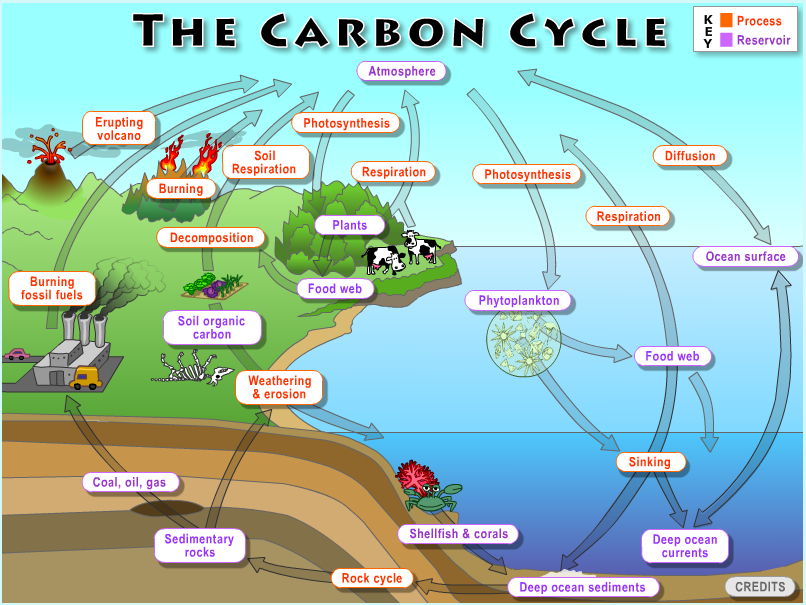
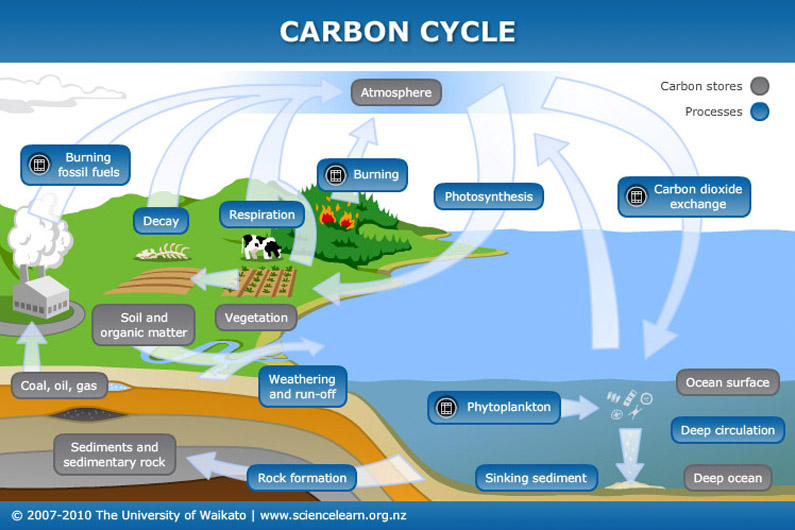
"Explore this interactive diagram to learn more about the carbon cycle. Click on the different labels to view short video clips or images about different parts of the cycle."
Q
Atmosphere
750 billion tonnes of carbon
Carbon in the atmosphere is mostly in the form of carbon dioxide with some methane and hydrofluorocarbons. The amount of carbon dioxide in the atmosphere is increasing.
Acknowledgement: NASA.
Vegetation
600 billion tonnes of carbon
Plants store carbon as carbohydrates made from carbon dioxide from the atmosphere. Land plants take up about a quarter of all carbon dioxide that enters the atmosphere.
Acknowledgement: Public domain.
Soil and organic matter
1,600 billion tonnes of carbon
Soil contains a lot of carbon in the form of dead plant material and in the many bacteria and other small organisms that live there.
Coal, oil, gas
3,300 billion tonnes of carbon
Carbon has been locked up in fossil fuels, built up from once-living things, for millions of years.
Acknowledgement: Public domain.
Sediments and sedimentary rock
1,000,000,000 billion tonnes of carbon
The carbon cycle overlaps the rock cycle. Ocean sediments and the rocks they turn into contain huge amounts of carbon. This is mostly in calcite and limestone.
Ocean surface
1,000 billion tonnes of carbon
Exchange of carbon dioxide between the ocean and the atmosphere takes place at the surface.
Acknowledgement: NASA.
Deep ocean
40,000 billion tonnes of carbon
Most of the carbon entering the ocean ends up in the deep ocean where it can be carried by currents for hundreds of years or be lost in sediments.
UQ