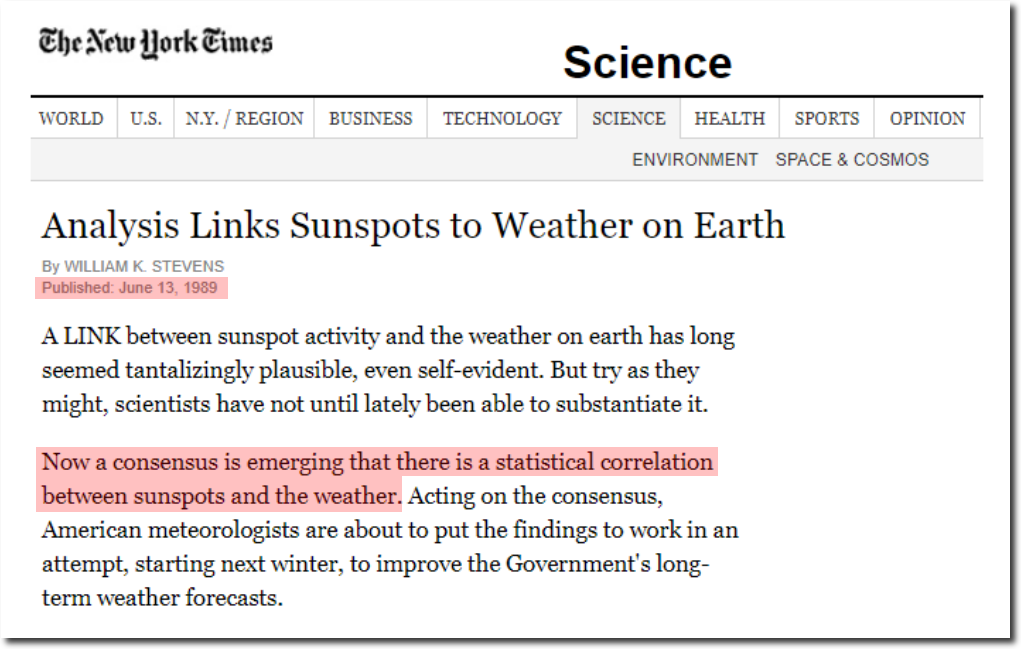

Global Warming: For Experts Only

Consensus!

2017-12-27115529_shadow.png
 
Forecasts of global temperature rises over the past 15 years have proved remarkably accurate, new analysis of scientists' modelling of climate change shows.

The debate around the accuracy of climate modelling and forecasting has been especially intense recently, due to suggestions that forecasts have exaggerated the warming observed so far – and therefore also the level warming that can be expected in the future. But the new research casts serious doubts on these claims, and should give a boost to confidence in scientific predictions of climate change.

The paper, published on Wednesday in the journal Nature Geoscience, explores the performance of a climate forecast based on data up to 1996 by comparing it with the actual temperatures observed since. The results show that scientists accurately predicted the warming experienced in the past decade, relative to the decade to 1996, to within a few hundredths of a degree.

The forecast, published in 1999 by Myles Allen and colleagues at Oxford University, was one of the first to combine complex computer simulations of the climate system with adjustments based on historical observations to produce both a most likely global mean warming and a range of uncertainty. It predicted that the decade ending in December 2012 would be a quarter of degree warmer than the decade ending in August 1996 – and this proved almost precisely correct.

The study is the first of its kind because reviewing a climate forecast meaningfully requires at least 15 years of observations to compare against. Assessments based on shorter periods are prone to being misleading due to natural short-term variability in the climate.

-Climate-forecast-and-obs-001.jpg

The climate forecast published in 1999 is showed by the dashed black line. Actual temperatures are shown by the red line (as a 10-year mean) and yellow diamonds (for individual years). The graph shows that temperatures rose somewhat faster than predicted in the early 2000s before returning to the forecasted trend in the last few years. Photograph: Nature Geoscience
The new research also found that, compared to the forecast, the early years of the new millennium were somewhat warmer than expected. More recently the temperature has matched the level forecasted very closely, but the relative slow-down in warming since the early years of the early 2000s has caused many commentators to assume that warming is now less severe than predicted. The paper shows this is not true.

Allen said: "I think it's interesting because so many people think that recent years have been unexpectedly cool. In fact, what we found was that a few years around the turn of the millennium were slightly warmer than forecast, and that temperatures have now reverted to what we were predicting back in the 1990s."


https://www.theguardian.com/environment/2013/mar/27/climate-change-model-global-warming
 
Leftists like fingercunts don’t know what a good source looks like.
You could provide a great peer reviewed paper written by someone who voted for Trump and Libtards like FC would thumb their nose at it because the scientists didn’t have an adequate degree from a Big 10 school or maybe he filled up his car with gas so he’s clearly in bed with the Oil Industry.

Even more amazing is the hypocrisy of these lying losers. Selling shit that poisons the environment and then pointing the finger at man for ‘poisoning the environment’.


Let's be honest, there's no one writing peer reviewed journals and voting for Trump, no one.
 
Let's be honest, there's no one writing peer reviewed journals and voting for Trump, no one.

That's true, and very true indeed!

Most peer review papers perhaps too theoretical could not get patents, partly due to practicality.

So many published financial trading articles/papers with peer reviewed cannot be viable or profitable systems.

Conceptually the papers are useful, but practitioners/traders know and understand they are simply not practical nor profitable as they show in the papers.

Practitioners in many fields prefer to get patents rather than papers, as they don't need others' review at all.

Or many rejected papers after peer review can be ground breaking ideas/concepts that can be proved useful and brilliant many years after rejection.

However, many patents are good jokes.

Just 2 cents!
 
Let's be honest, there's no one writing peer reviewed journals and voting for Trump, no one.

No, if we really want to be honest, we have to ask why anybody accepts peer review as furnishing the unvarnished facts.

from our own gov't, an article on why peer review is near worthless:

Peer review: a flawed process at the heart of science and journals
https://www.ncbi.nlm.nih.gov/pmc/articles/PMC1420798/by R Smith - ‎2006 - ‎Cited by 457 - ‎Related articles
At the BMJ we did several studies where we inserted major errors into papers that we then sent to many reviewers., Nobody ever spotted all of the errors. Some reviewers did not spot any, and most reviewers spotted only about a quarter. Peer review sometimes picks up fraud by chance, but generally it is not a reliable ..
 
Even the left wing Guardian admits that peer review promotes fake science. And now you know why liberals gravitate towards peer review.

Publish-or-perish: Peer review and the corruption of science | David ...
https://www.theguardian.com › Science › Controversies
Sep 5, 2011 - David Colquhoun: Pressure on scientists to publish has led to a situation where any paper, however bad, can now be printed in a journal that claims to ... Those problems are so very obvious you'd imagine that the journal would apologise for a failure of the peer review process, and for a press release that ...
 
Sometimes alarmists unknowingly push a real issue (temperature warming due to using too many containers) from a bad direction (don't cut tress for bettering CO2 cycle when using less paper containers) to a worse direction (producing plastic micro-beads/micro-fibers/wastes when using degradable plastic containers)!

Perhaps the saving by producing Non-Biodegradable products is not worth the cost of cleaning up the general Degradable products that are now flowing in waters everywhere, especially the oceans causing temperature warming/volatility.

My guess is the Non-Biodegradable plastic micro-beads/micro-fibers/wastes could cause not only long-lasting plastic density/content in ocean waters, but also ever-growing volume of sea waters, concurrently!

Perhaps we need to clean up the existing plastic micro-beads/micro-fibers/wastes (Not easy!);

Greatly slowing down our daily use of any new plastic micro-beads/micro-fibers/wastes (Not easy!) by learning how we can do that (possibly we don't really know how yet from experts!);

Speeding up our development of new technologies for producing Biodegradable plastic products (It's currently very expensive - a few times dearer, while not as durable/reliable!)!

As sooner or later who are going to pay for the clean-up cost (including sometimes properties damages by extreme weathers)? The public, or the manufacturers?

New legislation is needed - For producing not just low-cost Non-Biodegradable plastic products! Or marking and printing bar code of serial numbers and dates from registered manufacturers!

Selling and using any products from Non-registered manufacturers should be prohibited!

Just 2 cents! LOL


f.ashx

When defining a timeline target (by year 2025) without referring to what is the current status, and the adverse change of status during the timeline period, as well as the rate of change in a nonlinear/exponential manner due to its cumulative nature, it's hard to comprehend any urgency at all!

How about clean-up of micro-beads?

Micro-beads (that cannot be filtered by today's technology) in ocean waters may have passed a critical status far before the deadline!

Ocean water would have already become ocean soup by 2025!

Probably irreversible! Together with ocean temperature and sea level!


'Zero tolerance' plan eyed for plastic pollution
By Roger Harrabin BBC environment analyst

1 December 2017

http://www.bbc.co.uk/news/science-environment-42190678

The UN has already committed to substantial reduction of plastic waste by 2025 but a resolution led by Norway says the long-term aim must be for zero plastic waste.

It also wants to clean up of existing plastic from beaches. It says this is better value for money and better for the environment than some of the large-scale clean-up experiments currently in the mid Pacific - which it fears may harm wildlife.

Cleaning up beach plastic is especially important, it says, because abrasion breaks down large plastics into very harmful microplastics.

Norway also favours attempts to clear up "ghost" fishing gear discarded in the seas.

The conference will also hear that stronger leadership and co-ordination is needed - either from a strengthened UN Environment Programme, or perhaps even a new UN plastics agency.
 
Last edited:
Back
Top