https://www.s-cool.co.uk/a-level/ge...evise-it/causes-and-effects-of-global-warming
https://www.bnl.gov/newsroom/news.php?a=26257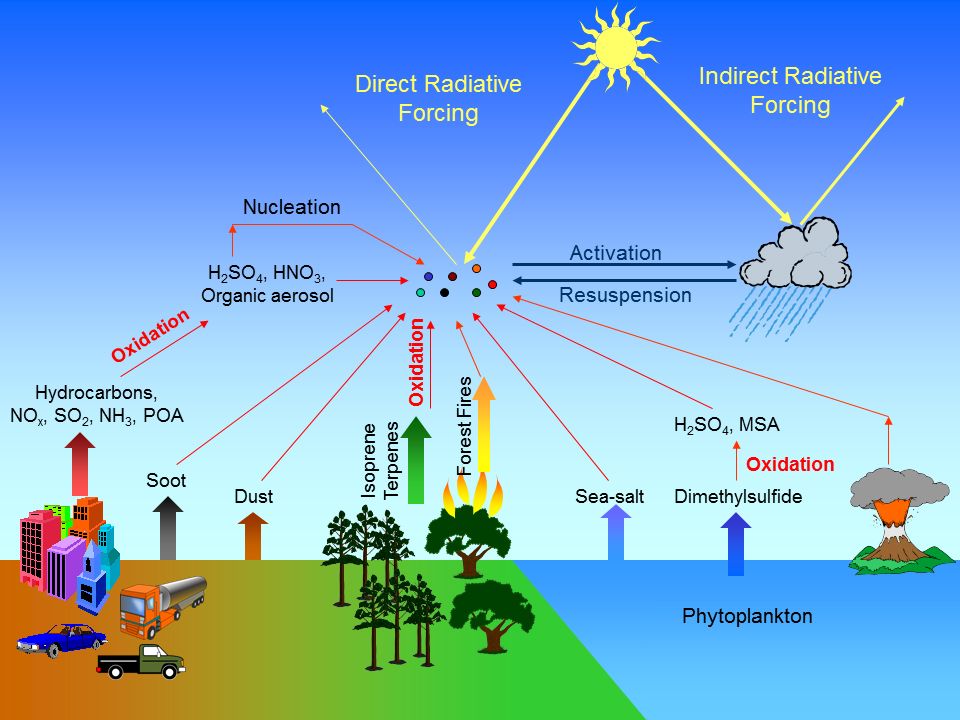
" Aerosols are suspensions of tiny particles in the atmosphere, and have both anthropogenic (i.e., man-made) sources such as industrial processes and car emissions, and natural sources such as forest fires, volcanoes, and wave-breaking in the ocean. Aerosol particles affect Earth's climate, both individually and by serving as the nuclei around which cloud drops form, by influencing how much solar energy is absorbed by Earth (including the oceans, atmosphere, and land) or is reflected back into space. Collecting accurate data and achieving better understanding of the roles in which aerosols participate is thus crucial to understanding their effects on Earth's climate. Graphic courtesy of Pacific Northwest National Laboratory "
Q
Sedlacek’s goal is to understand the impact aerosols have on Earth’s climate system.
“Greenhouse gases like carbon dioxide, methane, and nitrous oxide have a large effect on climate because they trap heat in the atmosphere and warm the planet,” Sedlacek said. “However, when we look at our estimates of how much warming we should be seeing based on the amounts of greenhouse gases in the atmosphere, something is off. The warming should be greater, which leads us to assume that something else is mitigating the effect of these gases on warming.”
How aerosols offset warming from greenhouse gases
What Sedlacek and other scientists at Brookhaven and elsewhere in the atmospheric science community have determined is that aerosols help to resolve this discrepancy. “When we take into account how aerosols interact with incoming solar radiant energy—the dominant source of the energy in Earth's climate system—we can reconcile the less-than-expected warming of our atmosphere.”
Most aerosols in the atmosphere only scatter light from the sun, sending some of the sun's radiant energy back to space and exerting a cooling influence on Earth's climate. Other aerosol particles, termed “black carbon” and “brown carbon”—typically created from wildfires, industrial processes, and car exhaust—can both scatter and absorb light from the sun. Depending on the extent of these two processes, these black and brown carbon aerosols may exert a warming influence or a cooling influence on our atmosphere. Think about what happens when you walk outside on a sunny day wearing a black shirt. You warm up much quicker than when wearing a light-colored shirt because black absorbs the light. With aerosol particles both reflecting and absorbing light, it becomes challenging to quantify their net effect on the climate system.
UQ