
You are using an out of date browser. It may not display this or other websites correctly.
You should upgrade or use an alternative browser.
You should upgrade or use an alternative browser.
Global Warming: For Experts Only
- Thread starter julianVGS
- Start date

It's completely transparent to visible light but also a poor infrared absorber. It has only one active IR absorbing vibrational mode, an asymmetric stretch. The symmetric stretch is IR inactive. And of course it is only present in trace amounts. When its ppm is reported it is always for dry air air that has had all of the water vapor absorbed out of it. It's ppm concentration in natural air is less of course, much less in the case of moist air.relatively opaque to infra-red
All in all , it is an extremely ineffective greenhouse gas because of low concentration combined with weak IR absorbtion properties. Water vapor is an even worse IR absorber for the wavelengths emitted from the Earth's surface than CO2, it does absorb fairly strongly in the near IR region however. Neither Water vapor nor CO2 is a good greenhouse gas. There is usually so much more water vapor than CO2 in the atmosphere, however, that water vapor is the most important green house gas. If you go out in the desert late at night under a cloudless sky you'll note it is surprisingly cold even though the daytime temperature may have been over 100 deg F. That's because there is low humidity and CO2 is such a poor green house gas.If there was low hanging cloud cover you'd be much warmer.
The greenhouse affect has been way overplayed in the media as though it were the only phenomenon moderating temperature on the Earth's surface. Water is far and away the most important moderator of temperature swings. That's because water is effective in all three physical phases -- liquid, solid and gas, and there is so much of it. It is extremely effective as the aerosol that we call clouds.
Hansen had to incorporate positive feedback in every one of his models, because if he didn't, even if he doubled the CO2 concentration, CO2's effect on temperature was negligible. Fortunately for us, the atmospheres response to rising temperature incorporates negative, not positive, feedback, and that, and many other reasons, are why all Hansen's early predictions of catastrophic warming by the early twenty second century were way off the mark. (Had positive feedback been operative for very long, none of us would be here of course; the Earth by now would be unbearably hot. This simple, but obvious, fact seemed to have eluded Hansen. Of course if at some point in our recent history we reached a tipping point from negative to positive feedback we could be in terrible trouble. )
Hansen's hypothesis is that man was contributing enough CO2 to the atmosphere to cause significant warming, and perhaps even catastrophic warming. The hypothesis has taken on changing popular names; first Anthropomorphic Global Warming or AGW, then Global Warming, and now Climate Change. Despite what we hear in the popular media, there is no consensus, none whatsoever, on the Hansen Hypothesis itself, i.e., whether man, through CO2 emission, is adversely affecting climate. An issue of the 2014 Bulletin of the American Meteorology Society has statistics from a poll of both meteorologists and atmospheric physicists working and publishing in the area of 'Climate Change'. Opinions are all over the map. look it up. It's interesting.
Last edited:

Oversimplification is very problematic Piezoe.
I get what your saying I think though dry vs wet air, vibrational mode & asymmetric stretch... sounds good however..
https://www.esrl.noaa.gov/gmd/ccgg/about/co2_measurements.html

So the PPM change is not a great as someone who has not got figures reading your post would imagine.
The atmospheric "greenhouse" effect is really a series of absorption-emission processes rather than just heat trapping as a real greenhouse does. One could explain how EM frequencies change as photons strike materials of different temperatures and a score more things but...
I'm bored writing this, there is little point going on as the right wing boys reading this are just seeking gotchas so they can be 'right'.They are only taking contrarian positions as they perceive this as a 'lefty' holy to piss on. It is just teams.
One might as well talk to the cat about the economics & epidemiology of free range vs farmed chicken.
When I was a kid it was all about acid rain in Europe. That was easy enough for the common man to grasp and huge changes were made for the better of everyone. Make the cause and effect a little more abstract...
Interesting article on which 'wins', water vapor or CO2.
https://www.forbes.com/sites/marsha...e-which-wins-in-climate-warming/#11c302f53238
Here is a great simple experiment I was showing my 11 year old nephew. The number of ways it can be misinterpreted in respect to CC is boggling. Pop science explanations like in the video are a double-edged sword, he uses the word "absorbed" for example. However one can see that pure CO2 is strongly opaque in heat wavelengths. The rabbit hole after that..
Our exponentially growing population is perilously dependent of 20th century temperatures. Disregarding the millions of species being wiped out by us (oceanic acidification.. the evil twin) our ability to adapt lessens as the population grows.
I get what your saying I think though dry vs wet air, vibrational mode & asymmetric stretch... sounds good however..
https://www.esrl.noaa.gov/gmd/ccgg/about/co2_measurements.html
So the PPM change is not a great as someone who has not got figures reading your post would imagine.
The atmospheric "greenhouse" effect is really a series of absorption-emission processes rather than just heat trapping as a real greenhouse does. One could explain how EM frequencies change as photons strike materials of different temperatures and a score more things but...
I'm bored writing this, there is little point going on as the right wing boys reading this are just seeking gotchas so they can be 'right'.They are only taking contrarian positions as they perceive this as a 'lefty' holy to piss on. It is just teams.
One might as well talk to the cat about the economics & epidemiology of free range vs farmed chicken.
When I was a kid it was all about acid rain in Europe. That was easy enough for the common man to grasp and huge changes were made for the better of everyone. Make the cause and effect a little more abstract...
Interesting article on which 'wins', water vapor or CO2.
https://www.forbes.com/sites/marsha...e-which-wins-in-climate-warming/#11c302f53238
Here is a great simple experiment I was showing my 11 year old nephew. The number of ways it can be misinterpreted in respect to CC is boggling. Pop science explanations like in the video are a double-edged sword, he uses the word "absorbed" for example. However one can see that pure CO2 is strongly opaque in heat wavelengths. The rabbit hole after that..
Our exponentially growing population is perilously dependent of 20th century temperatures. Disregarding the millions of species being wiped out by us (oceanic acidification.. the evil twin) our ability to adapt lessens as the population grows.
Last edited:
I apologize for such a wordy response. You won't hurt my feelings if you skip much of it.
There are a couple things I could have better stated. One is that how good a particular gas is as a 'green house' gas depends on two things: 1. its absorptivity at the wavelengths of emr emitted by the Earth's surface; 2. its concentration.
So I should not have said, "Neither Water vapor nor CO2 is a good greenhouse gas." This is technically, if not incorrect, is at least misleading. CO2 is a weak green house gas and water is a somewhat more effective green house gas because of its concentration. Most of the gases in the atmosphere have no green house properties. A gases like methane and 'freons' have move IR active vibrational modes than either water or CO2 and are therefore potentially much better green house gases, but fortunately there is only trace amounts of either in the atmosphere, as your nice table shows.
I really like that kool video though it doesn't do much to explain the green house effect. It beautifully demonstrates that CO2 can absorb infra red, so the signal to his infrared camera goes away. (If he'd have used a camera sensitive to visible light only of course you wouldn't have seen anything because CO2 doesn't absorb in the visible.) Of course what's misleading here is that you get the impression CO2 is a strong absorber of IR, when actually it is a relatively weak absorber! Had he just let air into the tube you'd see no absorbance using his set-up, even though there would then be over 200 ppm CO2 in the tube. You could see the absorbance just fine of course with a regular IR gas spectrometer. But in this
case he's hooked his evacuated cylinder to a tank containing pure CO2 at about 2700-3200 psi. We are now on a planet far different than Earth. But anyway its a cool demonstration, even if a little misleading.
Here is a problem I see. Because this expression 'green house gas' has been so over used in the popular media many people just assume that the 'greenhouse mechanism' is the only mechanism that prevents our planet from plunging into very low temperatures at night like the moon for example. This is not true. The greenhouse mechanism is important. But Liquid water, which covers most of the Earth, is also very important in that regard. Water has a tremendously large specific heat that is greater than that of rock, sand, asphalt etc. This makes the oceans an almost unbelievably large heat sink for storage of thermal energy. Winds driven by differences in air density caused in turn by differences in thermal energy content (i.e., temperature) move the gases in our atmosphere over the Earths surface as well as from the Earth's surface to the upper atmosphere and back down. This convection facilitates transfer of thermal energy from the oceans to the land at night (the sea breeze) and vice versa during the day (the land breeze). Also we experience net IR radiation from the Oceans and land at night and net absorption of IR and visible and uv wavelengths during the day (the visible and uv reappear as longer wavelength IR when they are later emitted by these absorbing surfaces.) So it isn't just the atmosphere, and certainly not just CO2's green house effect that are responsible for moderating the temperature swings on our Earths surface, but a myriad of related phenomena as well , including many I haven't mentioned.
There is a guy here who continually posts that CO2 is a green house gas and therefore we should all be heating up if we continue to pump CO2 into the air. I cringe every time he does this because his over simplified view ignores the dependence of the green house effect on both absorptivities and concentration and pays no attention to the relative role of CO2 in comparison with water and the myriad of mechanisms that are responsible for making our Earth habitable. He shows no understanding of the complexity of our climate mechanisms or the difficulties in modeling climate. He clearly does not understand that modeling is a tool for trying to understand specific mechanisms and how they might effect climate and temperature. So far there are no successful models that can accurately model our Earths climate system. It's chaotic and there is little possibility that the conventional approaches to modeling
will ever be successful in modeling a chaotic and very complex system. In this regard, I think former NASA-GISS physicist Ferenc Miskolczi's innovative approach* based on first principles and energy flow was a promising step forward. As with nearly every truly innovative approach, it may take years to be properly critiqued and vetted. But thank goodness someone is thinking in new directions because we are more or less at a dead end with the current approach. Sadly for sciences sake, GISS administrators tried to suppress publication of his work -- he resigned over it -- not because they could identify fatal flaws, but because it's conclusions did not support mainstream thinking. This is wrong, but scientists are also human and make mistakes for very human, as opposed to scientific, reasons. (*Note: Miskolczi was not attempting to model climate, rather he was addressing whether the assumptions in current models, eg., positive feedback, etc., could be supported from an energy flow perspective.)
You were wondering why we use use mole fraction 'X' to represent CO2 concentration. The reason we don't use a ppm value based on weight in this particular application is that if we are interested in the greenhouse effect, we are interested in the physical number of emr absorbers, not their weight. Thus mole fraction suits our purposes. Recall that a mole is just the name of a number, six times ten to the twenty-third, it has no dimensions and therefore no units. Just as we get % (percent is the same as parts per hundred or pph) by multiplying a dimensionless fraction based on any consistent measure, weight, volume, color, whatever, by 100, we can get ppm by multiplying mole fraction, a dimensionless number based on number of molecules, by one million. Therefore, if the ppm of CO2 is say 400ppm, based on mole fraction, then the mole fraction of CO2 is 400/1,000,000 or 0.0004.
You can interpret 400 ppm CO2 as 400 molecules of CO2 per every million molecules of atmosphere.
I'm not a climate denier, I'm a scientist whose is dismayed by the unprofessional conduct of some of my science colleagues, and one in particular, James Hansen. You can't decide scientific questions with media polls. The evidence is piling up that Hansen's original hypothesis, which proposed runaway catastrophic warming due to man induced rising CO2 is wrong. Other questions remain to be answered, and will be in time. We should not have pulled out of the climate accord, because regardless of Hansen's Hypothesis being dead wrong, there is great value in developing more environmentally friendly methods of energy production.
In my opinion Marshall Shepard is wrong regarding CO2 determining the Earths Temperature. It clearly does not. He is correct that temperature drives changes in atmospheric moisture; an important part of the negative feedback mechanism in response to both increasing and decreasing temperature. Without including positive feedback, the effects of changes in CO2 concentration we have seen in the past hundred years are far to feeble to be responsible for any significant mean change in global temperature, and the assumption of positive feedback which the probity of Shepard's often parroted explanation depends on, has been disproved. (Actually Shepard is parroting an explanation for CO2 driving temperature first advanced by GISS. It's wrong however. Solar irradience and geothermal energy release are vastly larger contributors to the Earths temperature than the very feeble effects of changes in CO2. And all of these contributors are countered by the Earths very effective negative feedback mechanism, featuring mainly water's role. The Earths temperature changes are cyclical rather than linear. The Earth under goes both warming periods and cooling periods but CO2, like water vapor, responds to these changes, rather then driving them. None of these considerations, however, rule out man's activities contributing to total atmospheric CO2 concentration.
By the way we always report the concentration non-condensing gases as the value in dry air, because otherwise the values would very due to relative humidity.
Last edited:
delta your article seems to confirm what I was explaining NASA stated.
a. as you add more co2 it migrates up becoming more of a shield. so in the upper atmosphere co2 acts as a shield and in the lower it warms...
then couple that info with this...
in the lower atmosphere... as you add more co2 its impact diminishes logarithmically. This info has been published in studies which you can find on the net... but here is info that the IPCC even acknowledges this....
"IPCC Published reports, (TAR3), acknowledge that the effective temperature increase caused by growing concentrations of CO2 in the atmosphere radically diminishes with increasing concentrations. This information has been presented in the IPCC reports. It is well disguised for any lay reader, (Chapter 6. Radiative Forcing of Climate Change: section 6.3.4 Total Well-Mixed Greenhouse Gas Forcing Estimate) [1]. It is a crucial fact, but not acknowledged in the IPCC summary for Policy Makers[2]"
The rapid logarithmic diminution effect is an inconvenient fact for Global Warming advocates and alarmists, nonetheless it is well understood within the climate science community. It is certainly not much discussed. This diminution effect is probably the reason there was no runaway greenhouse warming caused by CO2 in earlier eons when CO2 levels were known to be at levels of several thousands ppmv. The following simplifying diagram shows the logarithmic diminution effect using tranches of 100ppmvup to 1000ppmv and the significance of differing CO2 concentrations on the biosphere:
...
https://wattsupwiththat.com/2014/08...-of-increasing-carbon-dioxide-on-temperature/
a. as you add more co2 it migrates up becoming more of a shield. so in the upper atmosphere co2 acts as a shield and in the lower it warms...
then couple that info with this...
in the lower atmosphere... as you add more co2 its impact diminishes logarithmically. This info has been published in studies which you can find on the net... but here is info that the IPCC even acknowledges this....
"IPCC Published reports, (TAR3), acknowledge that the effective temperature increase caused by growing concentrations of CO2 in the atmosphere radically diminishes with increasing concentrations. This information has been presented in the IPCC reports. It is well disguised for any lay reader, (Chapter 6. Radiative Forcing of Climate Change: section 6.3.4 Total Well-Mixed Greenhouse Gas Forcing Estimate) [1]. It is a crucial fact, but not acknowledged in the IPCC summary for Policy Makers[2]"
The rapid logarithmic diminution effect is an inconvenient fact for Global Warming advocates and alarmists, nonetheless it is well understood within the climate science community. It is certainly not much discussed. This diminution effect is probably the reason there was no runaway greenhouse warming caused by CO2 in earlier eons when CO2 levels were known to be at levels of several thousands ppmv. The following simplifying diagram shows the logarithmic diminution effect using tranches of 100ppmvup to 1000ppmv and the significance of differing CO2 concentrations on the biosphere:
...
https://wattsupwiththat.com/2014/08...-of-increasing-carbon-dioxide-on-temperature/
@jem @yabz this article does a good job at explaining CO2's role at different levels in the atmosphere. The article jem posted was about CO2 in the thermosphere, not the troposphere. The important takeaway is that CO2's properties have different affects on the atmosphere at different altitudes.
what the hell is wrong with you? seriously..
I back up my statements with links to science and you call me a liar?
I state we don't know if adding man made co2 creates more warming.
I explain why.
Instead of providing science you go into your no brain game. Then you call me a liar.
Its fools like you who damage your side.
I back up my statements with links to science and you call me a liar?
I state we don't know if adding man made co2 creates more warming.
I explain why.
Instead of providing science you go into your no brain game. Then you call me a liar.
Its fools like you who damage your side.
jerm knows that. He is not interested in the truth. No reason to be respectful of him. He's a fucking liar. The kind that defended big tobacco. The kind that will cost this earth dearly.
There is a lot there but I'll try and get to it. I'm not hung up on CO2, it has to be accounted for but I'm happy that the reasons to not wastefully burn fossil fuels are hugely compelling anyway. I'm conservative regarding preserving that asset for the future.
Not nitpicking but on first read and I'll try and have a clear thought tomorrow.
It is a neat experiment if only for the purpose of getting an empirical sense of selective absorption/re-emission. If you look again at that video you will see that it is just a very thin plastic/saran wrap on the end of the cylinder. The experiment is therefore run at atmospheric pressure I would conclude so about 14.7 PSI at sea level.
At atmospheric pressure just a couple of feet at near-ish 100% concentration, 1M PPM is sufficient to stop/diffuse the IR heat wavelengths, from a candle. At 380-400ppm would look only very, very slightly milky to infrared but miles of air and..
We did equivalents experiments in high-school using a calibrated heat source and receiver + a little dry ice in a tube. Not for climate change talk back then, just basic physics class. From that I can feel happy to accept figures I've read from NASA that CO2 is about 20%? of what stops us freezing to death at night.
Anyway, my single remaining brain cell might die if I don't get to sleep, in England this moment.
Not nitpicking but on first read and I'll try and have a clear thought tomorrow.
It is a neat experiment if only for the purpose of getting an empirical sense of selective absorption/re-emission. If you look again at that video you will see that it is just a very thin plastic/saran wrap on the end of the cylinder. The experiment is therefore run at atmospheric pressure I would conclude so about 14.7 PSI at sea level.
At atmospheric pressure just a couple of feet at near-ish 100% concentration, 1M PPM is sufficient to stop/diffuse the IR heat wavelengths, from a candle. At 380-400ppm would look only very, very slightly milky to infrared but miles of air and..
We did equivalents experiments in high-school using a calibrated heat source and receiver + a little dry ice in a tube. Not for climate change talk back then, just basic physics class. From that I can feel happy to accept figures I've read from NASA that CO2 is about 20%? of what stops us freezing to death at night.
Anyway, my single remaining brain cell might die if I don't get to sleep, in England this moment.
Oh my god. I just read my long post of yesterday above and there are so many grammatical and punctuation errors? Yikes! If you couldn't wade through that mess I don't blame you. We all deserve to be served better English. Unfortunately ET limits the time for editing. And I could not stick around to edit it properly. My sincere apology.There is a lot there but I'll try and get to it. I'm not hung up on CO2, it has to be accounted for but I'm happy that the reasons to not wastefully burn fossil fuels are hugely compelling anyway. I'm conservative regarding preserving that asset for the future.
Not nitpicking but on first read and I'll try and have a clear thought tomorrow.
It is a neat experiment if only for the purpose of getting an empirical sense of selective absorption/re-emission. If you look again at that video you will see that it is just a very thin plastic/saran wrap on the end of the cylinder. The experiment is therefore run at atmospheric pressure I would conclude so about 14.7 PSI at sea level.
At atmospheric pressure just a couple of feet at near-ish 100% concentration, 1M PPM is sufficient to stop/diffuse the IR heat wavelengths, from a candle. At 380-400ppm would look only very, very slightly milky to infrared but miles of air and..
We did equivalents experiments in high-school using a calibrated heat source and receiver + a little dry ice in a tube. Not for climate change talk back then, just basic physics class. From that I can feel happy to accept figures I've read from NASA that CO2 is about 20%? of what stops us freezing to death at night.
Anyway, my single remaining brain cell might die if I don't get to sleep, in England this moment.
Just a couple of comments. It is not that in the Video the experimenter was using pressure above atmospheric, it is that he was using CO2 at a mole fraction of 1, as you pointed out. In other words, pure CO2. That's why he was able to use a path length (length of his tube) that wasn't extraordinarily long. How long was his pathlength, about 18 inches maybe? If he'd used atmospheric air ,he would have needed a tube approximately 2500 ft long to get a similar result. A little impractical in the lab, but nevertheless well shorter than the approximate depth of the troposphere. However these simple calculations aren't going to help us understand why CO2 is an inefficient greenhouse gas. For one thing the concentration of CO2 decreases with altitude whereas in our 2500 ft long tube its concentration would be uniform throughout. But the main considerations would have to be informed by spectroscopy. We would find that the candles IR emission, although spread over a wide band, would be no where near as wide as the Earth's IR emission, which approximates that of a black body, and our spectrum of CO2 absorption, or H2O, would show that these species are capable of absorbing only a fraction of the Earth very wide emission band. You'd indeed have to have that knowledge before you could estimate what fraction of the Earth's emission would be absorbed by atmospheric CO2. Of course, since the CO2 will emit in all directions as it undergoes vibrational relaxation, a fraction of the absorbed IR escapes to the heavens and a fraction returns to Earth. Not an easy problem? But fortunately we have satellites with spectrometers on board. I did like the video very much! Thank you. [Ooops. I just realized that one spectrum is in wavelength and the other in wave numbers, not very helpful. Sorry. If you want to see where the CO2 absorption band falls on the Earths admission spectrum you'll first have to convert micrometers to cm and then take the reciprocal. IR spectroscopists like to use wave numbers (1/cm) because wave numbers are directly proportional to frequency, and they say that's how molecules think! They selected cm to use as wavelengths in the IR region because when you take the reciprocal values, which they call "wave numbers" you get tidy integers. It's all quite arbitrary, and just selected for convenience.]
The spectra are from http://lasp.colorado.edu/~bagenal/3720/CLASS5/5Spectroscopy.html Nice Class! If a person is interested in studying any aspect of Atmospheric Science, the University of Colorado is THE PLACE! the spectra of the individual species are transmittance spectra, and of course the spectra haven't been normalized relative to concentration. These spectra have appeared so often in different places that I guess they may be considered to be in the public domain by now. I have no idea what their original source is.
Last edited:
update for all those who did not believe that some of our warming and ice melt could be coming from below... and not CO2. and for fools like future currents who called me a liar...
This is from
NASA's jet propulsion lab... one of your favorite sources...
https://www.jpl.nasa.gov/news/news.php?release=2017-291#.WgH4u-OBkE8.twitter
Study Bolsters Theory of Heat Source Under West Antarctica
A new NASA study adds evidence that a geothermal heat source called a mantle plume lies deep below Antarctica's Marie Byrd Land, explaining some of the melting that creates lakes and rivers under the ice sheet. Although the heat source isn't a new or increasing threat to the West Antarctic ice sheet, it may help explain why the ice sheet collapsed rapidly in an earlier era of rapid climate change, and why it is so unstable today.
The stability of an ice sheet is closely related to how much water lubricates it from below, allowing glaciers to slide more easily. Understanding the sources and future of the meltwater under West Antarctica is important for estimating the rate at which ice may be lost to the ocean in the future.
Antarctica's bedrock is laced with rivers and lakes, the largest of which is the size of Lake Erie. Many lakes fill and drain rapidly, forcing the ice surface thousands of feet above them to rise and fall by as much as 20 feet (6 meters). The motion allows scientists to estimate where and how much water must exist at the base.
Some 30 years ago, a scientist at the University of Colorado Denver suggested that heat from a mantle plume under Marie Byrd Land might explain regional volcanic activity and a topographic dome feature. Very recent seismic imaging has supported this concept. When Hélène Seroussi of NASA's Jet Propulsion Laboratory in Pasadena, California, first heard the idea, however, "I thought it was crazy," she said. "I didn't see how we could have that amount of heat and still have ice on top of it."
With few direct measurements existing from under the ice, Seroussi and Erik Ivins of JPL concluded the best way to study the mantle plume idea was by numerical modeling. They used the Ice Sheet System Model (ISSM), a numerical depiction of the physics of ice sheets developed by scientists at JPL and the University of California, Irvine. Seroussi enhanced the ISSM to capture natural sources of heating and heat transport from freezing, melting and liquid water; friction; and other processes.
To assure the model was realistic, the scientists drew on observations of changes in the altitude of the ice sheet surface made by NASA's IceSat satellite and airborne Operation IceBridge campaign. "These place a powerful constraint on allowable melt rates -- the very thing we wanted to predict," Ivins said. Since the location and size of the possible mantle plume were unknown, they tested a full range of what was physically possible for multiple parameters, producing dozens of different simulations.
They found that the flux of energy from the mantle plume must be no more than 150 milliwatts per square meter. For comparison, in U.S. regions with no volcanic activity, the heat flux from Earth's mantle is 40 to 60 milliwatts. Under Yellowstone National Park -- a well-known geothermal hot spot -- the heat from below is about 200 milliwatts per square meter averaged over the entire park, though individual geothermal features such as geysers are much hotter.
Seroussi and Ivins' simulations using a heat flow higher than 150 milliwatts per square meter showed too much melting to be compatible with the space-based data, except in one location: an area inland of the Ross Sea known for intense flows of water. This region required a heat flow of at least 150-180 milliwatts per square meter to agree with the observations. However, seismic imaging has shown that mantle heat in this region may reach the ice sheet through a rift, that is, a fracture in Earth's crust such as appears in Africa's Great Rift Valley.
Mantle plumes are thought to be narrow streams of hot rock rising through Earth's mantle and spreading out like a mushroom cap under the crust. The buoyancy of the material, some of it molten, causes the crust to bulge upward. The theory of mantle plumes was proposed in the 1970s to explain geothermal activity that occurs far from the boundary of a tectonic plate, such as Hawaii and Yellowstone.
The Marie Byrd Land mantle plume formed 50 to 110 million years ago, long before the West Antarctic ice sheet came into existence. At the end of the last ice age around 11,000 years ago, the ice sheet went through a period of rapid, sustained ice loss when changes in global weather patterns and rising sea levels pushed warm water closer to the ice sheet -- just as is happening today. Seroussi and Ivins suggest the mantle plume could facilitate this kind of rapid loss.
This is from
NASA's jet propulsion lab... one of your favorite sources...
https://www.jpl.nasa.gov/news/news.php?release=2017-291#.WgH4u-OBkE8.twitter
Study Bolsters Theory of Heat Source Under West Antarctica
A new NASA study adds evidence that a geothermal heat source called a mantle plume lies deep below Antarctica's Marie Byrd Land, explaining some of the melting that creates lakes and rivers under the ice sheet. Although the heat source isn't a new or increasing threat to the West Antarctic ice sheet, it may help explain why the ice sheet collapsed rapidly in an earlier era of rapid climate change, and why it is so unstable today.
The stability of an ice sheet is closely related to how much water lubricates it from below, allowing glaciers to slide more easily. Understanding the sources and future of the meltwater under West Antarctica is important for estimating the rate at which ice may be lost to the ocean in the future.
Antarctica's bedrock is laced with rivers and lakes, the largest of which is the size of Lake Erie. Many lakes fill and drain rapidly, forcing the ice surface thousands of feet above them to rise and fall by as much as 20 feet (6 meters). The motion allows scientists to estimate where and how much water must exist at the base.
Some 30 years ago, a scientist at the University of Colorado Denver suggested that heat from a mantle plume under Marie Byrd Land might explain regional volcanic activity and a topographic dome feature. Very recent seismic imaging has supported this concept. When Hélène Seroussi of NASA's Jet Propulsion Laboratory in Pasadena, California, first heard the idea, however, "I thought it was crazy," she said. "I didn't see how we could have that amount of heat and still have ice on top of it."
With few direct measurements existing from under the ice, Seroussi and Erik Ivins of JPL concluded the best way to study the mantle plume idea was by numerical modeling. They used the Ice Sheet System Model (ISSM), a numerical depiction of the physics of ice sheets developed by scientists at JPL and the University of California, Irvine. Seroussi enhanced the ISSM to capture natural sources of heating and heat transport from freezing, melting and liquid water; friction; and other processes.
To assure the model was realistic, the scientists drew on observations of changes in the altitude of the ice sheet surface made by NASA's IceSat satellite and airborne Operation IceBridge campaign. "These place a powerful constraint on allowable melt rates -- the very thing we wanted to predict," Ivins said. Since the location and size of the possible mantle plume were unknown, they tested a full range of what was physically possible for multiple parameters, producing dozens of different simulations.
They found that the flux of energy from the mantle plume must be no more than 150 milliwatts per square meter. For comparison, in U.S. regions with no volcanic activity, the heat flux from Earth's mantle is 40 to 60 milliwatts. Under Yellowstone National Park -- a well-known geothermal hot spot -- the heat from below is about 200 milliwatts per square meter averaged over the entire park, though individual geothermal features such as geysers are much hotter.
Seroussi and Ivins' simulations using a heat flow higher than 150 milliwatts per square meter showed too much melting to be compatible with the space-based data, except in one location: an area inland of the Ross Sea known for intense flows of water. This region required a heat flow of at least 150-180 milliwatts per square meter to agree with the observations. However, seismic imaging has shown that mantle heat in this region may reach the ice sheet through a rift, that is, a fracture in Earth's crust such as appears in Africa's Great Rift Valley.
Mantle plumes are thought to be narrow streams of hot rock rising through Earth's mantle and spreading out like a mushroom cap under the crust. The buoyancy of the material, some of it molten, causes the crust to bulge upward. The theory of mantle plumes was proposed in the 1970s to explain geothermal activity that occurs far from the boundary of a tectonic plate, such as Hawaii and Yellowstone.
The Marie Byrd Land mantle plume formed 50 to 110 million years ago, long before the West Antarctic ice sheet came into existence. At the end of the last ice age around 11,000 years ago, the ice sheet went through a period of rapid, sustained ice loss when changes in global weather patterns and rising sea levels pushed warm water closer to the ice sheet -- just as is happening today. Seroussi and Ivins suggest the mantle plume could facilitate this kind of rapid loss.
It's not undersea volcanoes like the deranged liar jerm or any of the total bullshit that piehole the libertarian think tank operator, spewed out above.
it's this....CO2....earth's most important greenhouse gas. It must be too obvious for them.
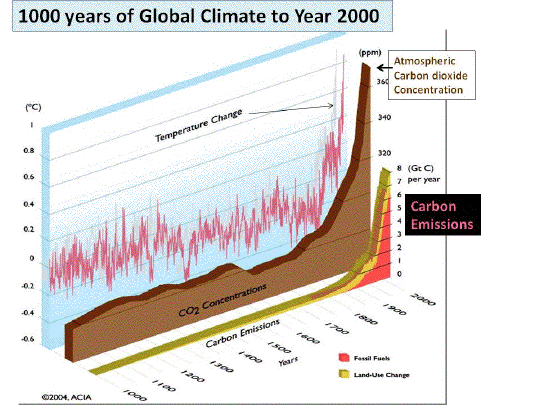
it's this....CO2....earth's most important greenhouse gas. It must be too obvious for them.