OK Stoney,
I did a little research on things.
Here ya go:
++++++++++++++++++++++++++++++
$10 billion in bipartisan infrastructure bill would go to PFAS cleanup
Michigan Radio | By
Caroline Llanes
The bipartisan federal infrastructure bill, that senators finished writing this past weekend, would include $10 billion for PFAS cleanup.
PFAS—or per- and polyfluoroalkyl substances—are a family of chemicals often called "forever chemicals" because they can persist in the environment for centuries. Exposure to certain kinds of PFAS has been linked to impaired immune systems and increased risk of some kinds of cancer.
Of the ten billion dollars, $5 billion is dedicated to help small and disadvantaged communities address PFAS in drinking water. Another $4 billion is for helping drinking water utilities remove PFAS from drinking water supplies, as well as connecting well owners to local water systems. The remaining $1 billion would help wastewater utilities address PFAS in wastewater discharges.
David Andrews is a senior scientist with the Environmental Working Group. He said $10 billion is an incredible investment focused particularly on drinking water.
"This is really a significant amount of funding to make a sizeable dent in terms of addressing what we know are some of the most contaminated sites across the country," he said.
+++++++++++++++++++++++++++++++++++++++++++++++++++++++++++++++++++++++++++
Soooo, what does that mean for us?
It turns out there are very few companies that get rid of this stuff.
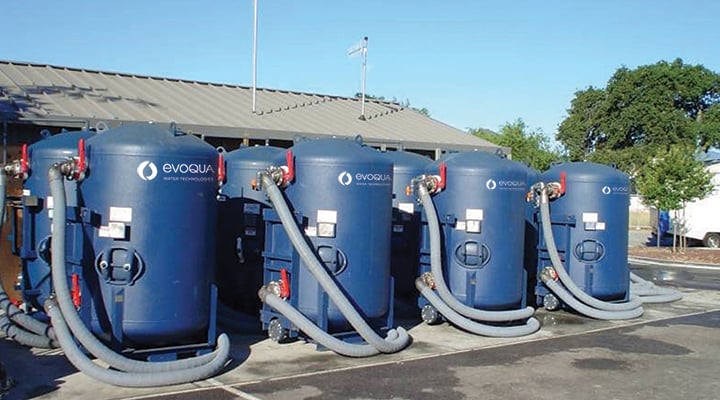
I looked and sure enough... Guess who does.
Right there on their website.
In blue below.
This VZ's first pick for the NEW infrastructure play:
$AQUA---->$43
+++++++++++++++++++++++++++++++++++++++++++++++++
 Ion Exchange (IX) Systems
See All Air & Water Remediation
Ion Exchange (IX) Systems
See All Air & Water Remediation
Mobile and emergency ion exchange solutions to remove organic and inorganic contaminants from water.
Ion Exchange (IX) Systems
Description
Mobile and emergency ion exchange solutions to remove PFAS, metals and other inorganic compounds from water.
Ion exchange (IX) is a tried and true method of removing metals and other inorganic compounds from water. Arsenic, cadmium, chromium, copper, lead, nickel, selenium, radionuclides, and zinc are just a few examples of the compounds that our ion exchange systems have removed from water. Ion exchange systems can also be used to remove non-metallic compounds such as ammonia, nitrate, perchlorate, and silicate.
Electrons and protons are subatomic particles. Protons form the nucleus of the atom, and electrons move around the proton. Electrons and protons are electrically charged. Protons are positively charged. The electron has an electrical charge equal to a proton’s charge, but is negative. The protons attract the negatively-charged electrons to form atoms.
Atoms with a positive charge equal to the negative charge are said to be neutral. Sometimes, an atom will lose or gain an electron, and is then in an “ionic state.” An ion is an atom or molecule that is electrically charged. Cations, having has lost a negatively-charged electron, are positively charged. Anions, having gained an electron, are negatively charged. Cations and anions are attracted by their opposite electrical charge. Ion exchange exploits this tendency to pull ions out of a solution. Ionic compounds from a water or solvent stream are captured on the ion exchange media (“resin”).