
Freeform’s backers are focused on the industrial realm rather than home-based production. “The main thing they will be able to do is get the price of this down to where it’s more like automotive manufacturing costs instead of aerospace costs,” says Tom Mueller, who led SpaceX’s engine development for many years and is an angel investor in Freeform. “They also just get the printing speed up by a huge amount.”
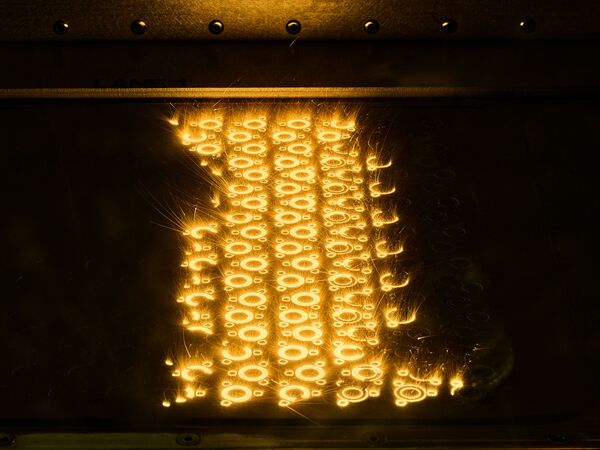
A layer of metal powder being fused.
Photographer: Spencer Lowell for Bloomberg Businessweek
3D printers create objects from a range of materials, including plastics and metal. Freeform specializes in the latter, using a well-known approach where a laser fires onto a bed of metal powder to fuse it into specific shapes. A new layer of powder is then applied, and the laser fires again, and again.
A typical 3D printer today might have two to four lasers and concentrate them on a single metal plate where it builds objects. The lasers hit the metal powder, then cease firing while a new layer of metal powder is placed on the plate before firing again. A limiting factor is the rate at which metal and plastic melt and fuse. Typically, the printer has to take breaks because it also gets too hot. Companies consider it a success if a 3D printer is operating 60% of the time.
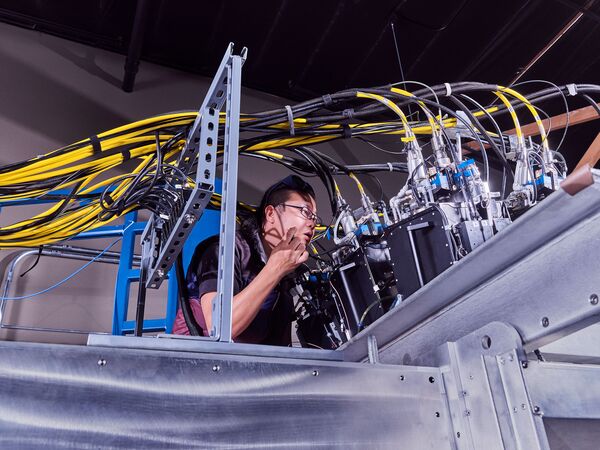
Lead electrical engineer Dennis Ren manages cables connected to the lasers on top of a 3D printer.
Photographer: Spencer Lowell for Bloomberg Businessweek
Freeform looks to significantly reduce downtime. It has two parallel conveyor systems lined up with multiple metal plates traveling along them. Its 18 lasers fire nonstop while conveyors move plates in and out of the beams. Tasks like applying fresh metal powder to a plate or polishing the edges of a part take place in other areas of the machine, leaving the lasers to continue doing their work on other objects. A combination of cameras snap images at more than 70,000 frames per second, feeding the data into computer vision algorithms that orchestrate how the lasers fire. Where a standard machine can fuse about 100 grams (3.5 ounces) of metal powder an hour, Palitsch says Freeform does five kilograms an hour now and will do even more soon with new versions of its technology.
While the extra speed and lower price are bonuses, the real value of Freeform’s system is how it monitors objects during the printing process, according to Nick Doucette, chief operations officer at rocket engine maker Ursa Major Technologies, which has tested Freeform’s technology. 3D-printed parts can have flaws, and customers tend to use antiquated, manual practices to check how strong and solid the final objects are. Freeform uses its host of sensors, scanners and artificial intelligence software to assess quality and can make adjustments while something is being built. “The usual way we do this is a nightmare of testing samples and tweaking things,” says Doucette. “Freeform just prints something and gives it to me.”
A layer of metal powder being fused.
Photographer: Spencer Lowell for Bloomberg Businessweek
3D printers create objects from a range of materials, including plastics and metal. Freeform specializes in the latter, using a well-known approach where a laser fires onto a bed of metal powder to fuse it into specific shapes. A new layer of powder is then applied, and the laser fires again, and again.
A typical 3D printer today might have two to four lasers and concentrate them on a single metal plate where it builds objects. The lasers hit the metal powder, then cease firing while a new layer of metal powder is placed on the plate before firing again. A limiting factor is the rate at which metal and plastic melt and fuse. Typically, the printer has to take breaks because it also gets too hot. Companies consider it a success if a 3D printer is operating 60% of the time.
Lead electrical engineer Dennis Ren manages cables connected to the lasers on top of a 3D printer.
Photographer: Spencer Lowell for Bloomberg Businessweek
Freeform looks to significantly reduce downtime. It has two parallel conveyor systems lined up with multiple metal plates traveling along them. Its 18 lasers fire nonstop while conveyors move plates in and out of the beams. Tasks like applying fresh metal powder to a plate or polishing the edges of a part take place in other areas of the machine, leaving the lasers to continue doing their work on other objects. A combination of cameras snap images at more than 70,000 frames per second, feeding the data into computer vision algorithms that orchestrate how the lasers fire. Where a standard machine can fuse about 100 grams (3.5 ounces) of metal powder an hour, Palitsch says Freeform does five kilograms an hour now and will do even more soon with new versions of its technology.
While the extra speed and lower price are bonuses, the real value of Freeform’s system is how it monitors objects during the printing process, according to Nick Doucette, chief operations officer at rocket engine maker Ursa Major Technologies, which has tested Freeform’s technology. 3D-printed parts can have flaws, and customers tend to use antiquated, manual practices to check how strong and solid the final objects are. Freeform uses its host of sensors, scanners and artificial intelligence software to assess quality and can make adjustments while something is being built. “The usual way we do this is a nightmare of testing samples and tweaking things,” says Doucette. “Freeform just prints something and gives it to me.”

 I said "go to cash for now" and WS listened.