Ford should jump back to January highs in short order, Tigress Financial says-- Who is the Tigress? She sounds sexy.

You are using an out of date browser. It may not display this or other websites correctly.
You should upgrade or use an alternative browser.
You should upgrade or use an alternative browser.
GBA Presents: RADIO SAVANT-!
- Thread starter stonedinvestor
- Start date
Nestlé’s They make baby formula. US is taking formula from Germany.-
RECKITT-- Increases baby formula production 30% <------
U.S. military flies first shipments of baby formula to Indiana from Germany
U.S. military aircraft will deliver 132 pallets of baby formula from Germany to Indianapolis over the weekend, in support of a Biden administration initiative that aims to quickly increase supplies of the food source amid a national shortage.
The flights are part of Operation Fly Formula, which was launched after President Biden authorized the Agriculture Department and the Department of Health and Human Services to request Pentagon-contracted commercial planes to deliver formula from abroad. Military planes will transport the supplies this time, as no commercial aircraft was available, the White House said.
The imports will fill immediate gaps while also buying time for domestic manufacturers to ramp up production. The military’s involvement in transporting baby formula reflects the urgency of the shortage, which is particularly hitting medically-vulnerable babies and some older children who may rely on formula due to life-threatening food allergies.
The White House said it expects the majority of the flights to be conducted with commercial contract aircraft, though the military will evaluate and assign them depending on the requirements.
This weekend’s flights will carry Nestlé’s Alfamino Infant and Alfamino Junior formula. Another 114 pallets of Gerber Good Start Extensive HA formula will be dispatched “in the coming days,” the White House said. The shipments are enough to fill some 1.5 million 8-ounce bottles.
All the formula being shipped are hypoallergenic and can be fed to babies intolerant of protein in cow milk. “They serve a critical medical purpose,” the White House said.
Why Biden is using the Defense Production Act for the baby formula shortage
The formula shortfall comes amid global supply chain disruptions tied to the coronavirus pandemic. But the shortage worsened when Abbott Laboratories recalled products manufactured at a facility in Sturgis, Mich., after a sanitation scare when four infants fell ill, of which two later died. The plant was later shut but the Food and Drug Administration has since reached an agreement with Abbott to reopen the facility.
Abbott is one of four major companies that are responsible for about 90 percent of infant formula supply in the United States. It is also a major supplier to WIC — a food assistance program for women and babies. Caregivers are usually restricted to just one brand of baby formula with WIC vouchers, but the House and Senate recently passed legislation allowing participants to buy whatever brand is available.
Biden has now signed the baby formula bill after the legislation was flown out to Seoul, South Korea, so he could sign it during a trip to Asia that began on Friday, according to a White House official
Indiana, where the initial Operation Fly Formula planes will land, is one of a handful of states that do not have WIC contracts with Abbott. It has already allowed mothers that receive WIC assistance to purchase other brands.
Seung Min Kim contributed to this report.
U.S. military flies first shipments of baby formula to Indiana from Germany
U.S. military aircraft will deliver 132 pallets of baby formula from Germany to Indianapolis over the weekend, in support of a Biden administration initiative that aims to quickly increase supplies of the food source amid a national shortage.
The flights are part of Operation Fly Formula, which was launched after President Biden authorized the Agriculture Department and the Department of Health and Human Services to request Pentagon-contracted commercial planes to deliver formula from abroad. Military planes will transport the supplies this time, as no commercial aircraft was available, the White House said.
The imports will fill immediate gaps while also buying time for domestic manufacturers to ramp up production. The military’s involvement in transporting baby formula reflects the urgency of the shortage, which is particularly hitting medically-vulnerable babies and some older children who may rely on formula due to life-threatening food allergies.
The White House said it expects the majority of the flights to be conducted with commercial contract aircraft, though the military will evaluate and assign them depending on the requirements.
This weekend’s flights will carry Nestlé’s Alfamino Infant and Alfamino Junior formula. Another 114 pallets of Gerber Good Start Extensive HA formula will be dispatched “in the coming days,” the White House said. The shipments are enough to fill some 1.5 million 8-ounce bottles.
All the formula being shipped are hypoallergenic and can be fed to babies intolerant of protein in cow milk. “They serve a critical medical purpose,” the White House said.
Why Biden is using the Defense Production Act for the baby formula shortage
The formula shortfall comes amid global supply chain disruptions tied to the coronavirus pandemic. But the shortage worsened when Abbott Laboratories recalled products manufactured at a facility in Sturgis, Mich., after a sanitation scare when four infants fell ill, of which two later died. The plant was later shut but the Food and Drug Administration has since reached an agreement with Abbott to reopen the facility.
Abbott is one of four major companies that are responsible for about 90 percent of infant formula supply in the United States. It is also a major supplier to WIC — a food assistance program for women and babies. Caregivers are usually restricted to just one brand of baby formula with WIC vouchers, but the House and Senate recently passed legislation allowing participants to buy whatever brand is available.
Biden has now signed the baby formula bill after the legislation was flown out to Seoul, South Korea, so he could sign it during a trip to Asia that began on Friday, according to a White House official
Indiana, where the initial Operation Fly Formula planes will land, is one of a handful of states that do not have WIC contracts with Abbott. It has already allowed mothers that receive WIC assistance to purchase other brands.
Seung Min Kim contributed to this report.
Reckitt Benckiser Group plc (RBGLY)<------------
Other OTC - Other OTC Delayed Price.
15.79+0.34 (+2.17%)
At close: May 20 03:59PM EDT
Other OTC - Other OTC Delayed Price.
15.79+0.34 (+2.17%)
At close: May 20 03:59PM EDT
Danone ramps up baby formula shipments to U.S. after Abbott recall - Reuters
May 20, 2022 9:09 AM ETDanone S.A. (DANOY)GPDNF, ABT, RBGPF, RBGLY, NSRGY, PRGO
May 20, 2022 9:09 AM ETDanone S.A. (DANOY)GPDNF, ABT, RBGPF, RBGLY, NSRGY, PRGO
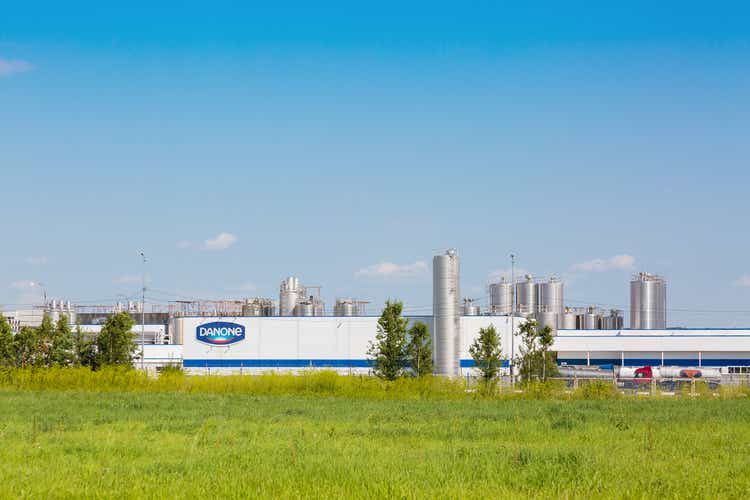
- French food and beverage company Danone S.A. (OTCQX DANOY) (OTCQX:GPDNF) has increased its shipments of infant formula to the U.S. from Europe as the country grapples with a baby formula shortage worsened by a recent product recall of Abbott (ABT), Reuters reported on Friday.
- Early this year, Abbott (ABT) issued a voluntary recall of certain baby formulas manufactured at its Sturgis, Mich. production facility in response to several consumer complaints regarding bacterial infections following their consumption.
- The world’s second biggest baby formula maker, Danone (OTCQX DANOY) trails rivals Abbott (ABT), Mead Johnson Nutrition of Reckitt Benckiser (OTCPK:RBGPF) (OTCPK:RBGLY), Nestle (OTCPK:NSRGY) (OTCPK:NSRGY), and Perrigo (PRGO) in the U.S. market.
BABY FORMULA SOLUTIONS)
RBGLY-
DANOY-
RBGLY-
DANOY-
DIESEL?
What produces more ethanol?
Most ethanol in the United States is produced from starch-based crops by dry- or wet-mill processing. Nearly 90% of ethanol plants are dry mills due to lower capital costs. Dry-milling is a process that grinds corn into flour and ferments it into ethanol with co-products of distillers grains and carbon dioxide.
https://afdc.energy.gov/fuels/ethanol_production.html
What are 4 products used to create ethanol?
Most of the fuel ethanol produced around the world is made by fermenting the sugar in the starches of grains such as corn, sorghum, and barley, and the sugar in sugar cane and sugar beets. Denaturants are added to ethanol to make fuel ethanol undrinkable.
Most ethanol in the United States is produced from starch-based crops by dry- or wet-mill processing. Nearly 90% of ethanol plants are dry mills due to lower capital costs. Dry-milling is a process that grinds corn into flour and ferments it into ethanol with co-products of distillers grains and carbon dioxide.
https://afdc.energy.gov/fuels/ethanol_production.html
What are 4 products used to create ethanol?
Most of the fuel ethanol produced around the world is made by fermenting the sugar in the starches of grains such as corn, sorghum, and barley, and the sugar in sugar cane and sugar beets. Denaturants are added to ethanol to make fuel ethanol undrinkable.
2018!
This start-up turns pollution from factories into fuel that powers cars — and one day planes
Published Fri, Jul 27 2018
Airplanes may soon fly using fuel made from pollution with this company’s...
A bacteria found in the gut of a rabbit can now help cars run in a more eco-friendly way.
The bacteria, identified by biotech start-up LanzaTech, helps turn factory carbon emissions, a.k.a. pollution, into ethanol, an alcohol that is blended with gasoline to reduce the amount of fuel used by cars.
Almost every gallon of gasoline sold in the United States today is 10 percent ethanol, according to the Renewable Fuels Association. But ethanol still has environmental implications. For example, there’s the food versus fuel debate. Ethanol is typically made from corn, sugar cane or grasses, which take a lot of land to grow, acreage that some argue is needed to grow food.
“The world uses 50 million barrels per day of fossil fuels (that’s for cars, planes, boats). If we want to try to substitute a significant portion of that using sugars ... we would end up using all our landmass to make fuels versus growing crops to feed people,” Jennifer Holmgren, CEO of LanzaTech tells CNBC Make It.
“While there are many sustainable sources of sugar-derived ethanol ... it’s not enough to substitute for all the fuel we use today,” says Holmgren. “Enter gas fermentation.”
Holmgren is referring to the revolutionary, and according to LanzaTech, greener, process of producing ethanol developed by the start-up. The Chicago-based company discovered a way to make ethanol from the carbon waste emissions secreted by factories — the exhaust you can see billowing out of their smoke stacks.
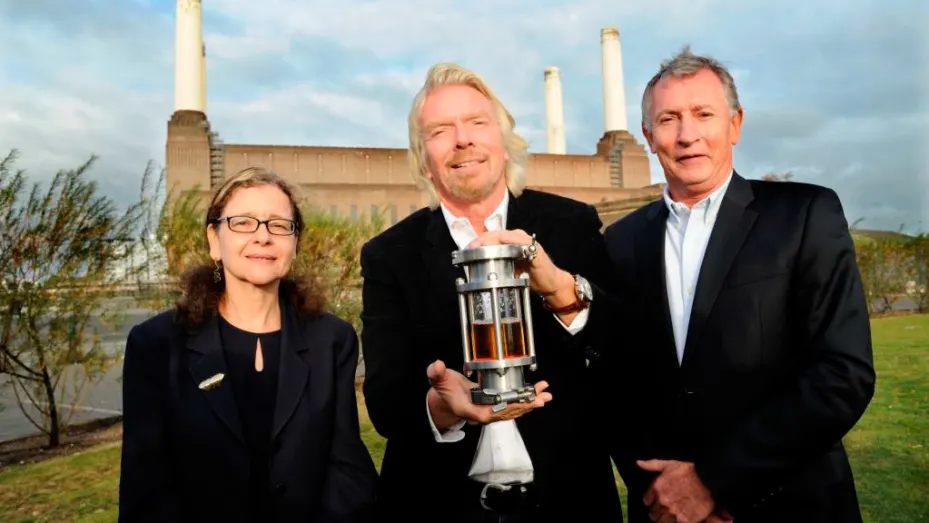
LanzaTech CEO Jennifer Holmgren with Richard Branson and the then CEO of Virgin Atlantic, Steve Ridgway, in front of Battersea Power Station in London in 2011 when LanzaTech and Virgin Atlantic announced their partnership.
Photo courtesy: Virgin Atlantic
The method uses the rabbit-gut bacteria to ferment the waste gas from factories, which then generates ethanol. So gas fermentation to produce ethanol can not only help solve the land issue, according to LanzaTech, it also tackles another problem: pollution.
The process is “a lot like making beer, except that instead of converting sugar to ethanol we convert pollution to ethanol,” Holmgren says. “We are reducing waste gas emissions at the same time, preventing these from becoming pollution.”
The resulting ethanol can currently be mixed with gasoline for use in cars, and eventually, with airplane fuel.
In fact, Virgin Atlantic, the airline arm of the Virgin empire founded by billionaire serial entrepreneur Richard Branson, has been working with LanzaTech since 2011, according to a 2016 blog post written by Branson. The goal of the partnership is to produce jet fuel made from carbon waste gases.
“This is a real game changer for aviation and could significantly reduce the industry’s reliance on oil within our lifetime. … The future potential of this technology is enormous,” says Branson in his blog post.
Virgin Atlantic (of which Branson sold a 31 percent stake to Air France-KLM for 220 million pounds in 2017) will fly a plane with LanzaTech fuel “very soon,” says a spokesperson for the airline.
This start-up turns pollution from factories into fuel that powers cars — and one day planes
Published Fri, Jul 27 2018
Airplanes may soon fly using fuel made from pollution with this company’s...
A bacteria found in the gut of a rabbit can now help cars run in a more eco-friendly way.
The bacteria, identified by biotech start-up LanzaTech, helps turn factory carbon emissions, a.k.a. pollution, into ethanol, an alcohol that is blended with gasoline to reduce the amount of fuel used by cars.
Almost every gallon of gasoline sold in the United States today is 10 percent ethanol, according to the Renewable Fuels Association. But ethanol still has environmental implications. For example, there’s the food versus fuel debate. Ethanol is typically made from corn, sugar cane or grasses, which take a lot of land to grow, acreage that some argue is needed to grow food.
“The world uses 50 million barrels per day of fossil fuels (that’s for cars, planes, boats). If we want to try to substitute a significant portion of that using sugars ... we would end up using all our landmass to make fuels versus growing crops to feed people,” Jennifer Holmgren, CEO of LanzaTech tells CNBC Make It.
“While there are many sustainable sources of sugar-derived ethanol ... it’s not enough to substitute for all the fuel we use today,” says Holmgren. “Enter gas fermentation.”
Holmgren is referring to the revolutionary, and according to LanzaTech, greener, process of producing ethanol developed by the start-up. The Chicago-based company discovered a way to make ethanol from the carbon waste emissions secreted by factories — the exhaust you can see billowing out of their smoke stacks.
LanzaTech CEO Jennifer Holmgren with Richard Branson and the then CEO of Virgin Atlantic, Steve Ridgway, in front of Battersea Power Station in London in 2011 when LanzaTech and Virgin Atlantic announced their partnership.
Photo courtesy: Virgin Atlantic
The method uses the rabbit-gut bacteria to ferment the waste gas from factories, which then generates ethanol. So gas fermentation to produce ethanol can not only help solve the land issue, according to LanzaTech, it also tackles another problem: pollution.
The process is “a lot like making beer, except that instead of converting sugar to ethanol we convert pollution to ethanol,” Holmgren says. “We are reducing waste gas emissions at the same time, preventing these from becoming pollution.”
The resulting ethanol can currently be mixed with gasoline for use in cars, and eventually, with airplane fuel.
In fact, Virgin Atlantic, the airline arm of the Virgin empire founded by billionaire serial entrepreneur Richard Branson, has been working with LanzaTech since 2011, according to a 2016 blog post written by Branson. The goal of the partnership is to produce jet fuel made from carbon waste gases.
“This is a real game changer for aviation and could significantly reduce the industry’s reliance on oil within our lifetime. … The future potential of this technology is enormous,” says Branson in his blog post.
Virgin Atlantic (of which Branson sold a 31 percent stake to Air France-KLM for 220 million pounds in 2017) will fly a plane with LanzaTech fuel “very soon,” says a spokesperson for the airline.
All right hang on to your hats...
News Home
Is Aemetis Inc (AMTX) Stock About to Get Hot Monday?

More About Aemetis Inc
Aemetis Inc is an international renewable fuel and biochemicals company focused on the production of renewable fuels and chemicals through the acquisition, development and commercialization of technologies that replace traditional petroleum-based products through the conversion of first-generation ethanol and biodiesel plants into advanced biorefineries. It owns and operates an approximately 65 million gallon per year ethanol production facility located in Keyes, California. In addition to low carbon renewable fuel ethanol, the Keyes Plant produces Wet Distillers Grains, Distillers Corn Oil, and Condensed Distillers Solubles, all of which are sold to local dairies and feedlots as animal feed. It operates in the reportable geographic segments of North America and India.
News Home
Is Aemetis Inc (AMTX) Stock About to Get Hot Monday?
More About Aemetis Inc
Aemetis Inc is an international renewable fuel and biochemicals company focused on the production of renewable fuels and chemicals through the acquisition, development and commercialization of technologies that replace traditional petroleum-based products through the conversion of first-generation ethanol and biodiesel plants into advanced biorefineries. It owns and operates an approximately 65 million gallon per year ethanol production facility located in Keyes, California. In addition to low carbon renewable fuel ethanol, the Keyes Plant produces Wet Distillers Grains, Distillers Corn Oil, and Condensed Distillers Solubles, all of which are sold to local dairies and feedlots as animal feed. It operates in the reportable geographic segments of North America and India.