
Feminine Feminist

"10 Struggles Of Being A Feminine Feminist
By Brianna Wiest, August 31st 2015
https://thoughtcatalog.com/brianna-wiest/2015/08/10-struggles-of-being-a-feminine-feminist/

1. People assume that to be a good feminist is to embody masculine qualities. ...

2. People tend to define women one-dimensionally, so you sometimes feel as though you have to choose between seeming “intelligent” or “attractive.” ...

3. It’s been suggested that your success is probably the result of you look a certain way, or because you found your way into the bedroom of a certain higher-up. ...

4. You acknowledge society’s warped consumerist-driven beauty standards, but still wear makeup, as you realize the problem is taking too seriously what was made for fun. ...

5. People almost use your love for traditionally “girly things” against you. ...

6. People still (somehow) assume that a sexy selfie indicates a lack of self-respect. ...

7. If you’re in a heterosexual relationship, people just assume you’ve fallen victim to the patriarchy, if you’re in a homosexual relationship, people ask who the “boy” is. ...

8. People claim it’s easier for you to have confidence because you appear a certain way. ...

9. You feel as though you’re almost constantly policing yourself so as not to say anything very gender-stereotypical (“I like when my boyfriend holds a door for me, it’s just a nice gesture.”) ...

10. You find yourself feeling as though you have to justify very basic interests, activities and opinions. ..."
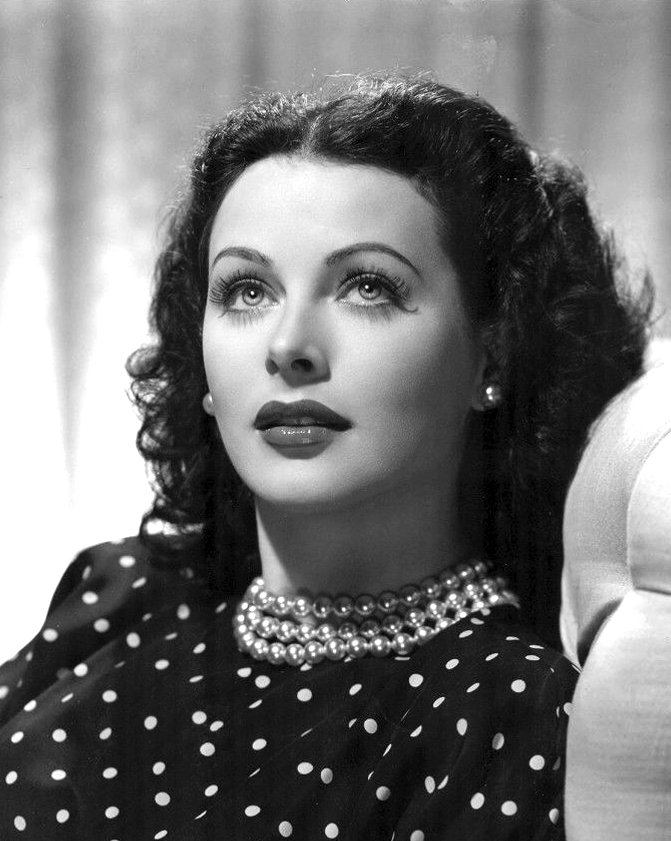
 
Hedy_Lamarr_Publicity_Photo_for_The_Heavenly_Body_1944.jpg


Hedy_lamarr_-_1940.jpg


Hedy Lamarr (/ˈhɛdi/; born Hedwig Eva Maria Kiesler, November 9, 1914 – January 19, 2000)[a] was an Austrian-born American film actress and inventor.[1]

At the beginning of World War II, Lamarr and composer George Antheil developed a radio guidance system for Allied torpedoes, which used spread spectrum and frequency hopping technology to defeat the threat of jamming by the Axis powers.[2] Although the US Navy did not adopt the technology until the 1960s, the principles of their work are arguably incorporated into Bluetooth technology, and are similar to methods used in legacy versions of CDMA and Wi-Fi.[3][4][5] This work led to their induction into the National Inventors Hall of Fame in 2014.[2][6]


https://en.wikipedia.org/wiki/Hedy_Lamarr

Inventor
Main article: Frequency-hopping spread spectrum

Although Lamarr had no formal training and was primarily self-taught, she worked in her spare time on various hobbies and inventions, which included an improved traffic stoplight and a tablet that would dissolve in water to create a carbonated drink. The beverage was unsuccessful; Lamarr herself said it tasted like Alka-Seltzer.[21]
Copy of U.S. patent for "Secret Communication System"

Among the few who knew of Lamarr's inventiveness was aviation tycoon Howard Hughes. Lamarr discussed her relationship with Hughes during an interview, saying that while they dated, he actively supported her "tinkering" hobbies.[23] He put his team of science engineers at her disposal, saying they would do or make anything she asked for.[23]

On one occasion, Hughes was trying to modify his aircraft designs to make planes fly faster. He asked her for ideas; "He relied on me," she said. Lamarr began studying the aerodynamics of birds and the shapes of fish, afterward presenting him with sketched ideas to make wings on planes less square and more efficient. " showed it to Howard Hughes and he said, 'You're a genius.'"[23]


During World War II, Lamarr learned that radio-controlled torpedoes, which could be important in the naval war, could easily be jammed, thereby causing the torpedo to go off course.[24] With the knowledge she had gained about torpedoes from her first husband, she thought of creating a frequency-hopping signal that could not be tracked or jammed. She contacted her friend, composer and pianist George Antheil, to help her develop a device for doing that, and he succeeded by synchronizing a miniaturized player-piano mechanism with radio signals.[22] They drafted designs for the frequency-hopping system, which they patented.[25][26] Antheil recalled:

We began talking about the war, which, in the late summer of 1940, was looking most extremely black. Hedy said that she did not feel very comfortable, sitting there in Hollywood and making lots of money when things were in such a state. She said that she knew a good deal about munitions and various secret weapons ... and that she was thinking seriously of quitting MGM and going to Washington, DC, to offer her services to the newly established Inventors’ Council.[14]

Their invention was granted a patent on August 11, 1942 (filed using her married name Hedy Kiesler Markey).[27] However, it was technologically difficult to implement, and at that time the U.S. Navy was not receptive to considering inventions coming from outside the military.[21]

In 1962 (at the time of the Cuban missile crisis), an updated version of their design at last appeared on Navy ships.[28] Lamarr and Antheil's work with spread spectrum technology led to the development of GPS, Bluetooth, and Wi-Fi.[29]

In 1997, they received the Electronic Frontier Foundation Pioneer Award and the Bulbie Gnass Spirit of Achievement Bronze Award, given to individuals whose creative lifetime achievements in the arts, sciences, business, or invention fields have significantly contributed to society.[30] Lamarr was featured on the Science Channel and the Discovery Channel.[10] In 2014, Lamarr and Antheil were posthumously inducted into the National Inventors Hall of Fame.[31]

Lamarr_patent.png


Color_photograph_of_Victor_Mature_and_Hedy_Lamarr_as_Samson_and_Delilah.jpg
Victor Mature and Lamarr in Samson and Delilah (1949)


John_Hodiak_and_Hedy_Lamarr_in_A_Lady_Without_Passport_trailer.JPG
With John Hodiak in A Lady Without Passport (1950)
 
Last edited:
Nice. One day there should be a Hollywood film about Hedy Lamarr's real life.

I've heard before that women get a far harder time from feminists than men do. Which seems somewhat discriminatory. But then again, men and women are different.....
 
"10 Struggles Of Being A Feminine Feminist
By Brianna Wiest, August 31st 2015
https://thoughtcatalog.com/brianna-wiest/2015/08/10-struggles-of-being-a-feminine-feminist/

1. People assume that to be a good feminist is to embody masculine qualities. ...

2. People tend to define women one-dimensionally, so you sometimes feel as though you have to choose between seeming “intelligent” or “attractive.” ...

3. It’s been suggested that your success is probably the result of you look a certain way, or because you found your way into the bedroom of a certain higher-up. ...

4. You acknowledge society’s warped consumerist-driven beauty standards, but still wear makeup, as you realize the problem is taking too seriously what was made for fun. ...

5. People almost use your love for traditionally “girly things” against you. ...

6. People still (somehow) assume that a sexy selfie indicates a lack of self-respect. ...

7. If you’re in a heterosexual relationship, people just assume you’ve fallen victim to the patriarchy, if you’re in a homosexual relationship, people ask who the “boy” is. ...

8. People claim it’s easier for you to have confidence because you appear a certain way. ...

9. You feel as though you’re almost constantly policing yourself so as not to say anything very gender-stereotypical (“I like when my boyfriend holds a door for me, it’s just a nice gesture.”) ...

10. You find yourself feeling as though you have to justify very basic interests, activities and opinions. ..."

All of the above can be summed up in one thing: "Caring about what other people think". No need to write the same thing 10 times...
The solution is easy: "Don't give a shit about anybody else."
This will do good the woman and everybody else.

:D

 
All of the above can be summed up in one thing: "Caring about what other people think". No need to write the same thing 10 times...
The solution is easy: "Don't give a shit about anybody else."
This will do good the woman and everybody else.

:D


Good question, indeed : when asked where her philosophy came from,


https://en.wikipedia.org/wiki/Ayn_Rand

Rand acknowledged Aristotle as her greatest influence[128] and remarked that in the history of philosophy she could only recommend "three A's"—Aristotle, Aquinas, and Ayn Rand.[129] In a 1959 interview with Mike Wallace, when asked where her philosophy came from, she responded, "Out of my own mind, with the sole acknowledgement of a debt to Aristotle, the only philosopher who ever influenced me. I devised the rest of my philosophy myself."[130] However, she also found early inspiration in Friedrich Nietzsche,[131] and scholars have found indications of his influence in early notes from Rand's journals,[132] in passages from the first edition of We the Living (which Rand later revised),[133] and in her overall writing style.[134] However, by the time she wrote The Fountainhead, Rand had turned against Nietzsche's ideas,[135] and the extent of his influence on her even during her early years is disputed.[136] Among the philosophers Rand held in particular disdain was Immanuel Kant, whom she referred to as a "monster",[137] although philosophers George Walsh[138] and Fred Seddon[139] have argued that she misinterpreted Kant and exaggerated their differences.

Rand said her most important contributions to philosophy were her "theory of concepts, [her] ethics, and [her] discovery in politics that evil—the violation of rights—consists of the initiation of force".[140] She believed epistemology was a foundational branch of philosophy and considered the advocacy of reason to be the single most significant aspect of her philosophy,[141] stating, "I am not primarily an advocate of capitalism, but of egoism; and I am not primarily an advocate of egoism, but of reason. If one recognizes the supremacy of reason and applies it consistently, all the rest follows."[142]
 
My guesses:

1. Probably several levels. I think she's mainly a writer, much more than a philosopher that some other people especially her followers would like to see/call her.

2. I think her concepts during her time did have solid market demand during the economic and political environment, as proved by the development and history of her followers.

Good question, indeed : when asked where her philosophy came from,

... considered the advocacy of reason to be the single most significant aspect of her philosophy,[141] stating, "I am not primarily an advocate of capitalism, but of egoism; and I am not primarily an advocate of egoism, but of reason. If one recognizes the supremacy of reason and applies it consistently, all the rest follows."[142]

3.

A. Why would "Reason" logically or naturally lead to "Egoism"?

B. "Reasoning" is just an analytical tool used to base on an assumption in order to reach a logical conclusion.
e.g. If a person is selfish or poorly educated, (s)he would most likely follow Egoism rather than Altruism.

Rand advocated reason as the only means of acquiring knowledge and rejected faith and religion. She supported rational and ethical egoism and rejected altruism. In politics, she condemned the initiation of force as immoral[3] and opposed collectivism and statism as well as anarchism, instead supporting laissez-faire capitalism, which she defined as the system based on recognizing individual rights, including property rights.[4] In art, Rand promoted romantic realism. She was sharply critical of most philosophers and philosophical traditions known to her, except for Aristotle, Thomas Aquinas, and classical liberals.[5]

4. Perhaps just writing a novel for a repackaging of something already existing. See below.


https://en.wikipedia.org/wiki/Rationalism

History

Rationalist philosophy from antiquity

Because of the complicated nature of rationalist thinking, the nature of philosophy, and the understanding that humans are aware of knowledge available only through the use of rational thought, many of the great philosophers from antiquity laid down the foundation for rationalism though they themselves weren't rationalists as we understand the concept today.

Pythagoras (570–495 BCE)
Main article: Pythagoras

Pythagoras was one of the first Western philosophers to stress rationalist insight.[22] He is often revered as a great mathematician, mystic and scientist, but he is best known for the Pythagorean theorem, which bears his name, and for discovering the mathematical relationship between the length of strings on lute and the pitches of the notes. Pythagoras "believed these harmonies reflected the ultimate nature of reality. He summed up the implied metaphysical rationalism in the words "All is number". It is probable that he had caught the rationalist's vision, later seen by Galileo (1564–1642), of a world governed throughout by mathematically formulable laws".[22] It has been said that he was the first man to call himself a philosopher, or lover of wisdom,[23]

Plato (427–347 BCE)
Main article: Plato

Plato also held rational insight to a very high standard, as is seen in his works such as Meno and The Republic. Plato taught on the Theory of Forms (or the Theory of Ideas)[24][25][26] which asserts that non-material abstract (but substantial) forms (or ideas), and not the material world of change known to us through sensation, possess the highest and most fundamental kind of reality.[27] Plato's forms are accessible only to reason and not to sense.[22] In fact, it is said that Plato admired reason, especially in geometry, so highly that he had the phrase "Let no one ignorant of geometry enter" inscribed over the door to his academy.[28]

Aristotle (384–322 BCE)
Main article: Aristotle

Aristotle has a process of reasoning similar to that of Plato's, though he ultimately disagreed with the specifics of Plato's forms. Aristotle's great contribution to rationalist thinking comes from his use of syllogistic logic. Aristotle defines syllogism as "a discourse in which certain (specific) things having been supposed, something different from the things supposed results of necessity because these things are so."[29] Despite this very general definition, Aristotle limits himself to categorical syllogisms which consist of three categorical propositions in his work Prior Analytics.[30] These included categorical modal syllogisms.[31]

Post-Aristotle

Though the three great Greek philosophers disagreed with one another on specific points, they all agreed that rational thought could bring to light knowledge that was self-evident – information that humans otherwise couldn't know without the use of reason. After Aristotle's death, Western rationalistic thought was generally characterized by its application to theology, such as in the works of the Islamic philosopher Avicenna and Jewish philosopher and theologian Maimonides. One notable event in the Western timelime was the philosophy of St. Thomas Aquinas who attempted to merge Greek rationalism and Christian revelation in the thirteenth-century.[22]
 
Last edited:
My guesses:

1. Probably several levels. I think she's mainly a writer, much more than a philosopher that some other people especially her followers would like to see/call her.
Who cares what she is? Anyone that uses personal remarks to answer an argument is just avoiding the issue, normally for lack of arguments, which seems to be your case. Adress what she said and argue against that, if you can.
2. I think her concepts during her time did have solid market demand during the economic and political environment, as proved by the development and history of her followers.
What she said was true then, just as it is now.
3.

A. Why would "Reason" logically or naturally lead to "Egoism"?

B. "Reasoning" is just an analytical tool used to base on an assumption in order to reach a logical conclusion.
e.g. If a person is selfish or poorly educated, (s)he would most likely follow Egoism rather than Altruism.
Read her books, you`ll get the answers and you might learn something.


4. Perhaps just writing a novel for a repackaging of something already existing. See below.
No, thanks.
 
5. Inconsistency:

A. " She was sharply critical of most philosophers and philosophical traditions known to her, except for Aristotle, Thomas Aquinas, and classical liberals.[5]"

B. "Rand acknowledged Aristotle as her greatest influence[128] and remarked that in the history of philosophy she could only recommend "three A's"—Aristotle, Aquinas, and Ayn Rand.[129] " ( Sciabarra 1995, p. 12 }

C. "In a 1959 interview with Mike Wallace, when asked where her philosophy came from, she responded, "Out of my own mind, with the sole acknowledgement of a debt to Aristotle, the only philosopher who ever influenced me. I devised the rest of my philosophy myself."[130] "

D. "However, she also found early inspiration in Friedrich Nietzsche,[131] and scholars have found indications of his influence in early notes from Rand's journals,[132 "

E. "However, by the time she wrote The Fountainhead, Rand had turned against Nietzsche's ideas,[135] and the extent of his influence on her even during her early years is disputed.[136 "

F. "Among the philosophers Rand held in particular disdain was Immanuel Kant, whom she referred to as a "monster",[137] although philosophers George Walsh[138] and Fred Seddon[139] have argued that she misinterpreted Kant and exaggerated their differences. "

G. She surely studied not only Aristotle, but also many others whose writing must have certain input or impact on her thoughts, whether she accepted any parts/components/ideas, or even completely reject all of them at all.

It'd be not really Reasonable nor Logical to say the influence Only from Aristotle. Not an Objective saying or view, imo.

Actually, I don't know what I am trying to say here. lol
 
Back
Top