The Scientist Who Cracked Iran Has a Plan for Climate Change
U.S. Energy Secretary Ernest Moniz provides an inside look at the role science played in two big Obama victories.
October 18, 2016 — 5:00 AM CDT Updated on October 18, 2016 — 7:49 AM CDT
Share on FacebookShare on Twitter
U.S. Secretary of Energy Ernest Moniz was looking up at a five-feet-tall glass cylinder filled with a turbulent milky white concoction. It was suspended several feet off the ground by a scaffold wound through with tubes and wires. Surrounding him were scientists at the Grove School of Engineering at the City College of New York in Manhattan, where they’d gathered with a commercial development engineer as part of a long-term plan to turn pollution into profits.
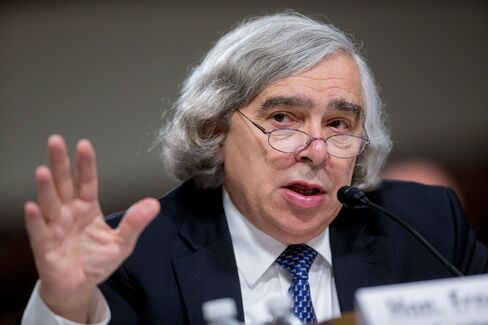
Ernest Moniz
Photographer: Andrew Harrer/Bloomberg
The cylinder contained water and bubbles—oxygen bubbles. The
scientists were testing just how tiny they can make them, and how uniformly they could be distributed. The goal: Building chemical reactors that swallow industrial waste gases, feed them to naturally occurring or genetically engineered microbes, and produce fuels or useful chemicals.
LanzaTech, a company based in Skokie, Ill., hopes to mass-produce fuels and industrial chemicals from waste gases, including methane, carbon monoxide, carbon dioxide, and hydrogen. The technology could be one tool to help people manage dangerous compounds that humanity pumps into the atmosphere.
The research is
funded in part by the Advanced Research Projects Agency-Energy, the arm of a cabinet department that’s seen its share of headlines over the past eight years. Nobel Physics laureate Steven Chu preceded Moniz, 71, at Energy and became a news fixture when the
Deepwater Horizon oil spill in 2010 gave Americans a daily lesson in applied subaquatic petrogeology. Moniz joined the Obama administration from the Massachusetts Institute of Technology three years later, and led the agency’s contributions to the 2015
nuclear deal with Iran and Paris
climate accord reached in December.
In New York last week, Moniz emphasized the need to pursue long-term solutions to climate change that will stretch over many years and administrations—and the expense that will be involved. “We need to keep working on the cost,” he said. “But we also need some of these big, additional breakthroughs that are going to take a long time to scale up. That’s why we’re doing it now.”
Moniz sat down with Bloomberg News to talk about the influential role science plays in diplomacy, as well as the critical role it plays in arresting global warming.
Q: Where does the Iran story begin for you?
...
http://www.bloomberg.com/news/artic...ho-cracked-iran-has-a-plan-for-climate-change