Earth's 6th mass extinction has begun, and there are no signs that humans will be spared

Hello, my name is Futurecurrents and I posted this url 108 times to ET.
Ging_retard.jpg


I should have listened to my dentist about brushing my teeth. Damn.

 
Science climate change
Study: Most Non-Climate Scientists Agree on Global Warming Too
Justin Worland
@justinworland
2:09 PM ET

"Nearly 92% of biophysical scientists surveyed believe that human activity has contributed to global warming

"Supporters of policies to address man-made climate change are quick to cite research showing 97% of climate scientists believe that humans are contributing to global warming. Now, new research suggests that consensus extends to scientists in other fields.

"Published in the journal Environmental Research Letters, the study found that nearly 92% of biophysical scientists surveyed believe that human activity has contributed to global warming. Nearly 94% said they believe global temperatures are rising. Researchers surveyed 2,000 scientists at universities in the Big 10 Conference and received 698 responses. The survey included fields like biology, chemistry and physics.

"The study’s design specifically addresses the belief that scientists who are skeptical of climate change come from fields outside of climate science. The new research weakens that argument.

Read More: Here’s Where People Are Most Concerned About Climate Change

"The consensus among scientists on climate change stands in sharp contrast to the views of the general public in the United States. Less than two-thirds of Americans believe change is happening. And only 40% believe it’s caused by humans, according to a report from the Pew Research Center.

"The study also suggests that role culture and political values play in determining one’s views on climate change. Both of those factors helped predict those who didn’t believe in man-made climate change despite being knowledgeable on the science, according to the study."

http://time.com/4051338/climate-change-scientists/
 
1. about a third of big 10 scientists responded

After excluding invalid addresses (i.e., emails that bounced back), we surveyed a sample of 1868 scientists and received 698 responses (37.4% response rate). This response rate is slightly better than the prior work on climate scientists and climate change (30.7%, Doran and Zimmerman2009). There were no significant differences in response rate between the survey version with the cultural values questions and the survey version without the cultural values questions.

2. they define climate change as we have gotten warmer since pre 1800s.
Duh... we were coming out of a mini ice age. And only 94 percent thought that... the rest realize the proxy data is hard to reconcile with instrument data or they don't know.


The results suggest a broad consensus that climate change is occurring: when asked 'When compared with pre-1800's levels, do you think that mean global temperatures have generally risen, fallen, or remained relatively constant?', 93.6% of respondents across all disciplines indicated that they thought temperatures have risen, 2.1% thought temperatures had remained relatively constant, 0.6% thought temperatures had fallen, and 3.7% indicated they had no opinion or did not know. Belief in climate change was relatively consistent across disciplines (range: 91.2%–100%, figure1).

3. of the those who think its warming... they say man contributed... means only 92% of the 1/3 say man contributed to warming... Which is a far cray from saying man made co2 create all or most of the warming.


4. Noteworthy by its absence is the question... do you think man made co2 has created significant warming. Cause you know damn well they asked the question... They just refuse to report the most germane point. I wonder why.

In short... this is what we have been telling fraudcurrents. His idea of a consensus was and is total bullshit.
 
Last edited:


It is, for our home planet, an extremely warm year.

Indeed, last week we learned from the National Oceanic and Atmospheric Administration that the first eight months of 2015 were the hottest such stretch yet recorded for the globe’s surface land and oceans, based on temperature records going back to 1880. It’s just the latest evidence that we are, indeed, on course for a record-breaking warm year in 2015.

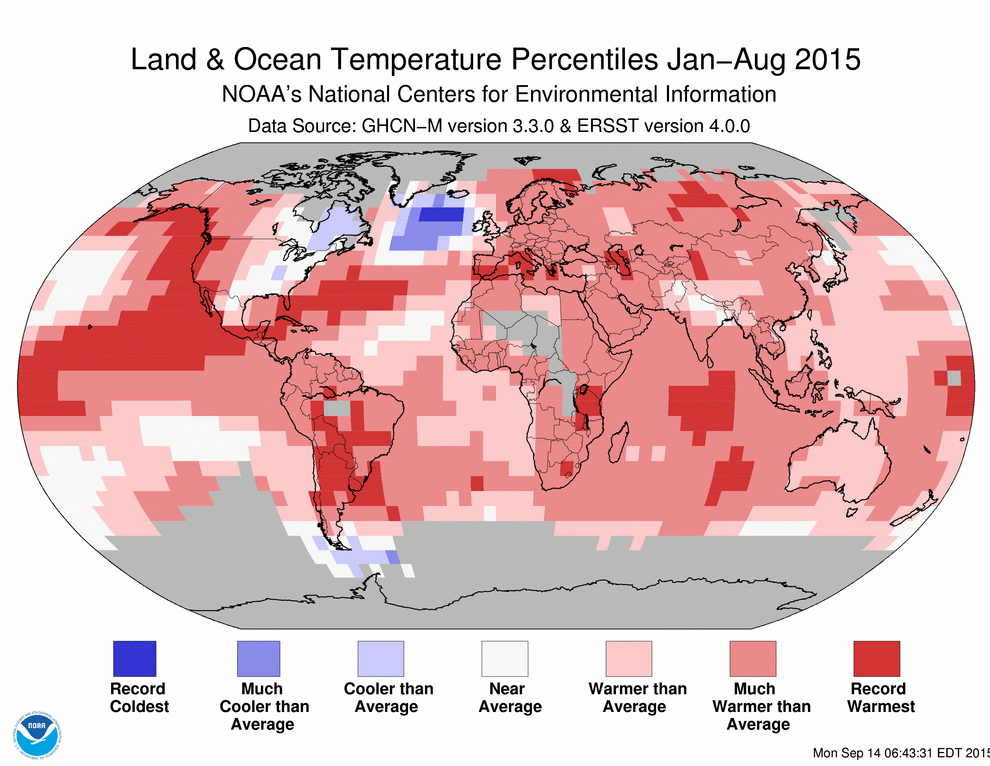
Yet, if you look closely, there’s one part of the planet that is bucking the trend. In the North Atlantic Ocean south of Greenland and Iceland, the ocean surface has seen very cold temperatures for the past eight months:

What’s up with that?

First of all, it’s no error. I checked with Deke Arndt, chief of the climate monitoring branch at NOAA’s National Centers for Environmental Information, who confirmed what the map above suggests — some parts of the North Atlantic Ocean saw record cold in the past eight months. As Arndt put it by email:

For the grid boxes in darkest blue, they had their coldest Jan-Aug on record, and in order for a grid box to be “eligible” for that map, it needs at least 80 years of Jan-Aug values on the record.

Those grid boxes encompass the region from “20W to 40W and from 55N to 60N,” Arndt explained.

And there’s not much reason to doubt the measurements — the region is very well sampled. “It’s pretty densely populated by buoys, and at least parts of that region are really active shipping lanes, so there’s quite a lot of observations in the area,” Arndt said. “So I think it’s pretty robust analysis.”

Thus, the record seems to be a meaningful one — and there is a much larger surrounding area that, although not absolutely the coldest it has been on record, is also unusually cold.

At this point, it’s time to ask what the heck is going on here. And while there may not yet be any scientific consensus on the matter, at least some scientists suspect that the cooling seen in these maps is no fluke but, rather, part of a process that has been long feared by climate researchers — the slowing of Atlantic Ocean circulation.

In March, several top climate scientists, including Stefan Rahmstorf of the Potsdam Institute for Climate Impact Research and Michael Mann of Penn State, published a paper in Nature Climate Change suggesting that the gigantic ocean current known as the Atlantic Meridional Overturning Circulation, or AMOC, is weakening. It’s sometimes confused with the “Gulf Stream,” but, in fact, that’s just a southern branch of it.

[Global warming is now slowing down the circulation of the oceans — with potentially dire consequences]

The current is driven by differences in the temperature and salinity of ocean water (for a more thorough explanation, see here). In essence, cold salty water in the North Atlantic sinks because it is more dense, and warmer water from farther south moves northward to take its place, carrying tremendous heat energy along the way. But a large injection of cold, fresh water can, theoretically, mess it all up — preventing the sinking that would otherwise occur and, thus, weakening the circulation.

In the Nature Climate Change paper, the researchers suggested that this source of freshwater is the melting of Greenland, which is now losing more than a hundred billion tons of ice each year.

The longer the situation continues, the more it is likely to attract attention. But it has already been around for a while. “It’s been really persistent over the last year and a half or so,” NOAA’s Arndt says.

Indeed, I spoke with Rahmstorf previously about the cold patch in the North Atlantic in March, when his study came out — and when a NOAA temperature chart for December 2014 through February 2015 also showed record cold in this area. As Rahmstorf wrote back then, “The North Atlantic between Newfoundland and Ireland is practically the only region of the world that has defied global warming and even cooled.” Since then, the trend appears to have only continued.

So in sum, if Mann and Rahmstorf are right, a slowing of Atlantic Ocean circulation could be beginning, and even leaving a temperature signature for all to see.

This won’t lead to anything remotely like The Day After Tomorrow (which was indeed based — quite loosely — on precisely this climate scenario). But if the trend continues, there could be many consequences, including rising seas for the U.S. East Coast and, possibly, a difference in temperature overall in the North Atlantic and Europe.


http://www.washingtonpost.com/news/...bout-a-cold-blob-in-the-north-atlantic-ocean/

***********************************************************


Tipping point.


In differential calculus, an inflection point, point of inflection, flex, or inflection (inflexion) is a point on a curve at which the curve changes from being concave (concave downward) to convex (concave upward), or vice versa.
 
3. of the those who think its warming... they say man contributed... means only 92% of the 1/3 say man contributed to warming.
You think the other 2/3 who did not respond would have much variance from the 92%? If so, show me the science.


It is, for our home planet, an extremely warm year.

Indeed, last week we learned from the National Oceanic and Atmospheric Administration that the first eight months of 2015 were the hottest such stretch yet recorded for the globe’s surface land and oceans, based on temperature records going back to 1880. It’s just the latest evidence that we are, indeed, on course for a record-breaking warm year in 2015.

Yet, if you look closely, there’s one part of the planet that is bucking the trend. In the North Atlantic Ocean south of Greenland and Iceland, the ocean surface has seen very cold temperatures for the past eight months:

What’s up with that?

First of all, it’s no error. I checked with Deke Arndt, chief of the climate monitoring branch at NOAA’s National Centers for Environmental Information, who confirmed what the map above suggests — some parts of the North Atlantic Ocean saw record cold in the past eight months. As Arndt put it by email:

For the grid boxes in darkest blue, they had their coldest Jan-Aug on record, and in order for a grid box to be “eligible” for that map, it needs at least 80 years of Jan-Aug values on the record.

Those grid boxes encompass the region from “20W to 40W and from 55N to 60N,” Arndt explained.

And there’s not much reason to doubt the measurements — the region is very well sampled. “It’s pretty densely populated by buoys, and at least parts of that region are really active shipping lanes, so there’s quite a lot of observations in the area,” Arndt said. “So I think it’s pretty robust analysis.”

Thus, the record seems to be a meaningful one — and there is a much larger surrounding area that, although not absolutely the coldest it has been on record, is also unusually cold.

At this point, it’s time to ask what the heck is going on here. And while there may not yet be any scientific consensus on the matter, at least some scientists suspect that the cooling seen in these maps is no fluke but, rather, part of a process that has been long feared by climate researchers — the slowing of Atlantic Ocean circulation.

In March, several top climate scientists, including Stefan Rahmstorf of the Potsdam Institute for Climate Impact Research and Michael Mann of Penn State, published a paper in Nature Climate Change suggesting that the gigantic ocean current known as the Atlantic Meridional Overturning Circulation, or AMOC, is weakening. It’s sometimes confused with the “Gulf Stream,” but, in fact, that’s just a southern branch of it.

[Global warming is now slowing down the circulation of the oceans — with potentially dire consequences]

The current is driven by differences in the temperature and salinity of ocean water (for a more thorough explanation, see here). In essence, cold salty water in the North Atlantic sinks because it is more dense, and warmer water from farther south moves northward to take its place, carrying tremendous heat energy along the way. But a large injection of cold, fresh water can, theoretically, mess it all up — preventing the sinking that would otherwise occur and, thus, weakening the circulation.

In the Nature Climate Change paper, the researchers suggested that this source of freshwater is the melting of Greenland, which is now losing more than a hundred billion tons of ice each year.

The longer the situation continues, the more it is likely to attract attention. But it has already been around for a while. “It’s been really persistent over the last year and a half or so,” NOAA’s Arndt says.

Indeed, I spoke with Rahmstorf previously about the cold patch in the North Atlantic in March, when his study came out — and when a NOAA temperature chart for December 2014 through February 2015 also showed record cold in this area. As Rahmstorf wrote back then, “The North Atlantic between Newfoundland and Ireland is practically the only region of the world that has defied global warming and even cooled.” Since then, the trend appears to have only continued.

So in sum, if Mann and Rahmstorf are right, a slowing of Atlantic Ocean circulation could be beginning, and even leaving a temperature signature for all to see.

This won’t lead to anything remotely like The Day After Tomorrow (which was indeed based — quite loosely — on precisely this climate scenario). But if the trend continues, there could be many consequences, including rising seas for the U.S. East Coast and, possibly, a difference in temperature overall in the North Atlantic and Europe.


http://www.washingtonpost.com/news/...bout-a-cold-blob-in-the-north-atlantic-ocean/

***********************************************************


Tipping point.


In differential calculus, an inflection point, point of inflection, flex, or inflection (inflexion) is a point on a curve at which the curve changes from being concave (concave downward) to convex (concave upward), or vice versa.


Wow.... did Futurecurrents just post new information that he has not posted many times previously. The shock may cause ET P&R posters to grab their chests and reach for their heart attack medicine.
 
2/3 didn't respond... that we know.
How many don't respond because they know a lot of their schools funding may depend on govt and there they feel pressure to tow the govt's line?
Show me the science on how to figure that out without them saying it?

Do you know why they did not report the percent that say man made co2 causes most of the warming?


You think the other 2/3 who did not respond would have much variance from the 92%? If so, show me the science.
 
2/3 didn't respond... that we know.
Not stellar, but a fairly typical response rate.

How many don't respond because they know a lot of their schools funding may depend on govt and there they feel pressure to tow the govt's line?
Show me the science on how to figure that out without them saying it?
I assume the survey was anonymous (that's also fairly typical) as it was administered online by a contracted agency. Could be wrong on that. I don't see it mentioned in the methodology section. Chalk this point up to, "what I really really want it to be".

Do you know why they did not report the percent that say man made co2 causes most of the warming?
They reported they think Man is responsible for at least some, if not most, of the warming. What other activity, besides Man's sudden release of CO2 from the ground to the atmosphere, do you think they might think Man could be doing?
 
Last edited:
cutting down rain forests, bringing humidity and clouds to once desert like areas through agriculture and population expansion. Adding crops. Turning over the soil. Putting up cities and subburbs... Cows.... people congregating on Southern California. Creating cities in the middle east and china. We live in a very dynamic and complex system with positive and negative feedbacks.

We impact albedo for sure and I suspect we impact humidity and weather as well. What does adding a billion warm bodies every decade or so do to temperature?

Its almost juvenile to think the agw nutters got lucky and figured it out before all the science came in.
 
Back
Top