
If we are talking about Iran when Obama left office they wernt making nukes,now they are.Yeah. Kim woke up one morning in 2016 and said "I'm going to build an ICBM capable of hitting California". So he rounded up a few engineers and said have at it. Made a call to Moscow. One year later they were testing it.
Just like that.
Of course Iran in 2019 still doesn't have them, even though they have been trying for decades with unlimited wealth and pretty much unlimited trade with the West albeit slightly gray-market. I guess the Ayatollah's engineers aren't quite as bright.
From the Brookings Institute last March:
This is the introduction and executive summary of a new Brookings report—to be released on March 28—on addressing the Iranian missile challenge.
For decades, the United States has sought to constrain Iran’s missile program, both because it poses a conventional military threat to regional stability and because it can provide a delivery capability for nuclear weapons should Iran acquire them. But despite the efforts of the United States and others to impede Iranian procurement of missile-related materials, equipment, and technology and a succession of U.N. Security Council (UNSC) restrictions imposed largely to prevent Iran from acquiring nuclear weapons delivery systems, Iran has managed to acquire the largest and most diverse missile force in the Middle East.
The Iranian missile threat
Relying initially on missiles, components, and technology purchased mainly from North Korea and China, but increasingly making advances through indigenous efforts, Iran maintains a force of hundreds of liquid- and solid-propellant short- and medium-range ballistic missiles (SRBMs and MRBMs), now being augmented by land-attack cruise missiles. Although claiming to limit itself to ballistic missiles with a 2000 km range by order of the supreme leader and not yet launching ballistic missiles above that range, Iran pursues at least four paths that it could use to develop intercontinental ballistic missiles (ICBMs) capable of reaching the United States, including the development of space-launch vehicles (SLVs) based on technologies directly applicable to long-range ballistic missiles. While placing priority on indigenous development, Iran remains dependent on importing key components and materials. It is working on more accurate guidance systems to improve the military utility of its missiles and has fielded road-mobile missile launchers to promote their survivability against attack.
The Iranians see their missile force as an integral and indispensable part of their national defense strategy, fulfilling key strike roles traditionally taken by manned aircraft, but beyond the capabilities of an Iranian air force hobbled by many years of sanctions. The missile program serves key Iranian goals: deterring attacks against Iran, providing warfighting capabilities if deterrence fails or Iran decides to initiate hostilities, supporting military capabilities of regional proxies such as Hezbollah and the Houthis, enhancing national pride and regional influence, and providing a nuclear delivery hedge if Iran decides to acquire nuclear weapons. The use of Iranian ballistic missiles is not just theoretical. Iran has fired ballistic missiles against Iraq during the Iraq-Iran war and against various non-state actor adversaries in neighboring states in recent years. Moreover, Iranian proxies have fired Iranian-supplied missiles and rockets at U.S. regional partners Israel, Saudi Arabia, and the United Arab Emirates (UAE).
Iran’s missile program poses a serious threat to the security interests of the United States and its partners, both in the Middle East and beyond. Key U.S. objectives with respect to that program are to deter attacks and intimidation against the United States and its friends, impede quantitative and qualitative improvement in the regional missile capabilities of Iran and its proxies, maintain military capabilities that can degrade the ability of the missile forces of Iran and its proxies to achieve their objectives, and discourage and delay the development of missile capabilities that can reach beyond the region, including to Western Europe and the U.S. homeland.
Iran's current missile capabilities.

You are using an out of date browser. It may not display this or other websites correctly.
You should upgrade or use an alternative browser.
You should upgrade or use an alternative browser.
Donald
- Thread starter Buy1Sell2
- Start date
Bottom line.... from 2008 to 2016 N. Korea went absolutely ham in their development of ICBM's, SLBM's, and the miniaturization of nuclear warheads. Obama's plan... "let my clock run out and hand it off".
https://www.wsj.com/articles/trump-faces-north-korean-challenge-1479855286
Barack Obama Warns Donald Trump on North Korea Threat
White House says new president’s top foreign priority should be nuclear Pyongyang
By
Gerald F. Seib,
Jay Solomon and
Carol E. Lee
WSJ
Nov. 22, 2016 5:54 pm ET
The Obama administration considers North Korea to be the top national security priority for the incoming administration, a view it has conveyed to President-elect Donald Trump’s transition team, according to people familiar with the conversations.
https://www.wsj.com/articles/trump-faces-north-korean-challenge-1479855286
Barack Obama Warns Donald Trump on North Korea Threat
White House says new president’s top foreign priority should be nuclear Pyongyang
By
Gerald F. Seib,
Jay Solomon and
Carol E. Lee
WSJ
Nov. 22, 2016 5:54 pm ET
The Obama administration considers North Korea to be the top national security priority for the incoming administration, a view it has conveyed to President-elect Donald Trump’s transition team, according to people familiar with the conversations.
Yeah. Kim woke up one morning in 2016 and said "I'm going to build an ICBM capable of hitting California". So he rounded up a few engineers and said have at it. Made a call to Moscow. One year later they were testing it.
Just like that.
Their missles are from Russian engines,which they did not get until 2016.
Bottom line.... from 2008 to 2016 N. Korea went absolutely ham in their development of ICBM's, SLBM's, and the miniaturization of nuclear warheads. Obama's plan... "let my clock run out and hand it off".
https://www.wsj.com/articles/trump-faces-north-korean-challenge-1479855286
Barack Obama Warns Donald Trump on North Korea Threat
White House says new president’s top foreign priority should be nuclear Pyongyang
By
Gerald F. Seib,
Jay Solomon and
Carol E. Lee
WSJ
Nov. 22, 2016 5:54 pm ET
The Obama administration considers North Korea to be the top national security priority for the incoming administration, a view it has conveyed to President-elect Donald Trump’s transition team, according to people familiar with the conversations.
They were not capable of making ICBMs until 2016.
No, we can start another thread for that. And they aren't making nukes, they are enriching Uranium but still a long ways off.If we are talking about Iran when Obama left office they wernt making nukes,now they are.
Their missles are from Russian engines,which they did not get until 2016.
Tony... there's about a million more aspects to ICBM's than just the engine bud. That's 1960's stuff and the easiest part. Their SLBM program however was a little more tricky and they pulled that off engine-wise in 2014 as I recall without looking.
Just like they bought diesel subs from Russia, rocket motors are school.
"Um... Mr President, you might want to read this."
North Korea: Test Stand for Vertical Launch of Sea-Based Ballistic Missiles Spotted
Summary
Recent press reports have raised the possibility that North Korea is developing the capability to launch ballistic missiles from submarines.[1] A review of commercial satellite imagery since 2010 covering submarine bases and submarine shipyards has identified a new test stand at the North’s Sinpo South Shipyard, probably intended to explore the possibility of launching ballistic missiles from submarines or of a shipboard vertical launch ballistic missile capability. The new installation is the right size and design to be used for the research, development, and testing of the process of ejecting a missile out of a launch tube as well as evaluating its compatibility with submarines and surface combatants as well as the missiles themselves.
North Korea: Test Stand for Vertical Launch of Sea-Based Ballistic Missiles Spotted
- By: Joseph S. Bermudez Jr.
- October 28, 2014
- Military Affairs, Satellite Imagery
Summary
Recent press reports have raised the possibility that North Korea is developing the capability to launch ballistic missiles from submarines.[1] A review of commercial satellite imagery since 2010 covering submarine bases and submarine shipyards has identified a new test stand at the North’s Sinpo South Shipyard, probably intended to explore the possibility of launching ballistic missiles from submarines or of a shipboard vertical launch ballistic missile capability. The new installation is the right size and design to be used for the research, development, and testing of the process of ejecting a missile out of a launch tube as well as evaluating its compatibility with submarines and surface combatants as well as the missiles themselves.
No, we can start another thread for that. And they aren't making nukes, they are enriching Uranium but still a long ways off.
Tony... there's about a million more aspects to ICBM's than just the engine bud. That's 1960's stuff and the easiest part. Their SLBM program however was a little more tricky and they pulled that off engine-wise in 2014 as I recall without looking.
Just like they bought diesel subs from Russia, rocket motors are school.
1.You brought up Iran.They were around 1-3 years from nuclear weapons when Obama got them to stop so they are not a long way off .
2.No engine,no ICBMs.
"Nothing to worry about here Mr President... Kim is waiting for 2019".
North Korea test-launches “Polaris-1” ballistic missile from submarine
Analysts say DPRK missile subs could threaten Japan, South Korea in five years.
Sean Gallagher - May 11, 2015 4:35 pm UTC
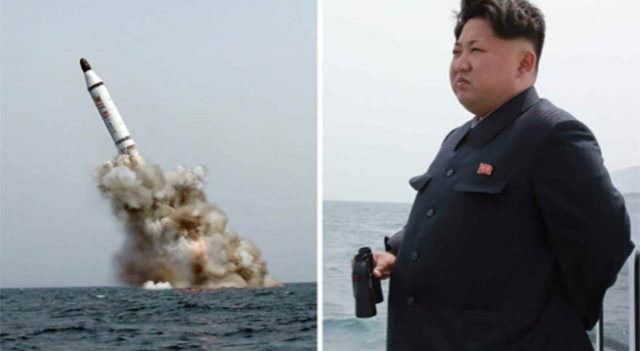
Kim Jong-un watches as North Korea's navy successfully test-launches a ballistic missile from a submarine on May 9.
North Korea test-launches “Polaris-1” ballistic missile from submarine
Analysts say DPRK missile subs could threaten Japan, South Korea in five years.
Sean Gallagher - May 11, 2015 4:35 pm UTC
Kim Jong-un watches as North Korea's navy successfully test-launches a ballistic missile from a submarine on May 9.
1) Brought up Iran to show you how difficult it is and how it requires years to develop these things.1.You brought up Iran.They were around 1-3 years from nuclear weapons when Obama got them to stop so they are not a long way off .
2.No engine,no ICBMs.
2) No miniaturized warheads... no nuke ICBM's.
___________________________________________________________
https://www.nytimes.com/2016/05/07/world/asia/north-korea-nuclear-us-strategy.html
By David E. Sanger and Choe Sang-Hun
- May 6, 2016

A missile test by North Korea on April 23. The missile was apparently launched from a 2,000-ton Sinpo-class submarine and did not travel far.Credit...KCNA, via Agence France-Presse — Getty Images
SEOUL, South Korea — After years of trying to separate fact from propaganda about North Korea’s nuclear program, American and South Korean intelligence officials say they have concluded that the country can now mount a small nuclear warhead on short- and medium-range missiles capable of hitting much of Japan and South Korea.
The United States and its allies have sought for nearly a decade to prevent the North from gaining such capabilities, ever since it detonated its first atomic device a decade ago. Their failure is likely to raise new questions about the effectiveness of the policy toward North Korea, while ushering the long-simmering nuclear standoff with the North into a more perilous phase under its combative young leader, Kim Jong-un.
"Yes Mr President, its ok to let a rogue state develop a miniature nuclear warhead to place on top of an ICBM.... they don't have the motors yet".
"Gee Mr President... I have no idea why they would want to miniaturize a nuclear warhead... they don't have the motors."
"Yes Mr President, those motors are readily available and have been around since the 1960's. Russia has tons they will sell to anyone who has the $'s."
"Yes Mr President, your vacation is all scheduled and the weather there looks beautiful."
"Gee Mr President... I have no idea why they would want to miniaturize a nuclear warhead... they don't have the motors."
"Yes Mr President, those motors are readily available and have been around since the 1960's. Russia has tons they will sell to anyone who has the $'s."
"Yes Mr President, your vacation is all scheduled and the weather there looks beautiful."