DeSantis for the win

Please note "Florida Department of Health" was added to this quote to clarify context on who GWB meant as "them". This was not part of the original quote. But that is who he was referring to in the conversation (which you may verify by following the quote link).

The picture...well. :) No COVID victims were harmed by this posting.
I suspect that this is likely who he is referring to as "The Florida Department of Health"--
giphy.gif
 
Let's see how nursing homes are doing in Florida. After all DeSantis was so critical of the nursing homes in New York.
"Gov. Ron DeSantis’ office did not comment on the AARP information."

AARP Points To Higher Nursing Home COVID Death Rate In Florida
https://miami.cbslocal.com/2020/10/14/aarp-points-higher-nursing-home-death-rate-florida/

A national COVID “dashboard” released Wednesday by AARP shows that the death rate of Florida nursing-home residents over a recent four-week period exceeded the national average.

The AARP online site, which looks at nursing-home data for four weeks ending Sept. 20, shows that 1.38 of every 200 nursing home residents in Florida died from COVID-19. Nationally, about one out of every 200 nursing home residents died from COVID-19.

Also, the rate of infected nursing-home residents in Florida was 4.5 percent, compared to 2.6 percent nationally. Moreover, the rate of infected staff members in Florida nursing homes was 3.9 per 100 residents, exceeding the national average of 2.5 per 100 residents.

AARP Florida spokesman Dave Bruns said Florida is the “grayest” state in the nation. One in five residents is age 65 or older, or 20.4 percent of the population, compared to 13.4 percent nationally.

“If there is any place that should be focusing on this, it should be the Sunshine State.” Bruns told The News Service of Florida.

The AARP dashboard has national and state information and is based on data the nursing home industry reported to the federal Centers for Medicare & Medicaid Services for the four-week period between Aug. 24 and Sept. 20. That period included a Sept. 1 move by Florida to allow visitation to resume at nursing homes, after months of the facilities being locked down to prevent the spread of COVID-19.

The information compiled by AARP underscores continued work that needs to be done, Bruns said. Among other things, AARP Florida has said regular, rapid-result testing of staff members, residents, visitors and vendors should be mandatory at all elder-care facilities to prevent the spread of the virus.

“People are picking this virus up in restaurants, in bars, in social settings, at sporting events and other places. Then, the fear is that they will carry it into these facilities,” Bruns said. “Once it gets into these facilities, it is not uncommon for a quarter, sometimes even as much as half, of the people who are infected to die.”

Gov. Ron DeSantis’ office did not comment on the AARP information. But DeSantis has touted the state’s efforts to keep residents safe at Florida’s 694 nursing homes.

The administration, though, in the last month has reversed policies such as mandatory testing of all long-term care staff members and the use of specific facilities that cared for and isolated nursing-home residents with COVID-19.

The DeSantis administration also lifted the ban on visitors at long-term care facilities last month. While he acknowledged the move would increase COVID-19 cases, DeSantis said the need for visitation could no longer be ignored.

As of Wednesday, 6,136 long-term care residents were positive for COVID-19, according to state data. That figure includes residents of nursing homes, assisted living facilities and intermediate care facilities for people with developmental disabilities. Also, more than 6,300 residents and staff members of long-term care facilities have died from COVID-19. The overwhelming majority of those deaths involved residents, data show.

The AARP dashboard shows that Florida had a higher percentage of nursing homes with active cases of COVID-19 positive residents, 47 percent, than the national rate of 24 percent. And nearly 72 percent of Florida nursing homes reported staff infections from COVID-19, compared to about 48 percent nationwide.

In a statement to the News Service, Florida Health Care Association spokeswoman Kristen Knapp said, “More can always be done to improve our state’s long term services and supports system for our seniors and individuals with disabilities.”

Knapp said the association, which represents nursing homes throughout the state, looks forward to working with AARP, among others, on “continued support to ensure the safety, care and well-being of our nursing home residents, their families and caregivers.”

Knapp also said that “99 percent of nursing home residents are COVID free and 98 percent of staff are COVID free.” She said that is based on state Department of Health information that excludes from consideration the numbers of positive nursing-home residents transferred out of facilities

In addition to increased testing to curb the spread of the virus, AARP has advocated for greater transparency of the public reporting of cases and deaths in facilities and called for increased accountability of how nursing homes spend state and federal Medicaid and Medicare dollars and CARES Act stimulus funding.

The AARP information showed that Florida nursing homes fared better than the national average when it came to personal protective equipment. Nationally, 28 percent of nursing homes reported having less than a week’s worth of so-called PPE on hand during the four-week period. In Florida, 20 percent of the facilities reported having less than a week’s worth of protective gear.
 

EkYG5eMXcAA9LCy


EkYEST7WAAEIpf4


From the author (above):

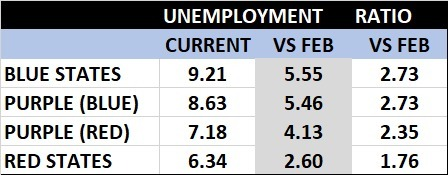
blue states saw a significantly higher rise in unemployment (555 basis points) vs red states (260 basis points) (vs feb column) current unemployment is 287bp higher in blue states than red. and the ratio of current unemployment to pre lockdown is 2.73 vs 1.76. (aug rate/feb)

EkYHAv5XkAAlGHW


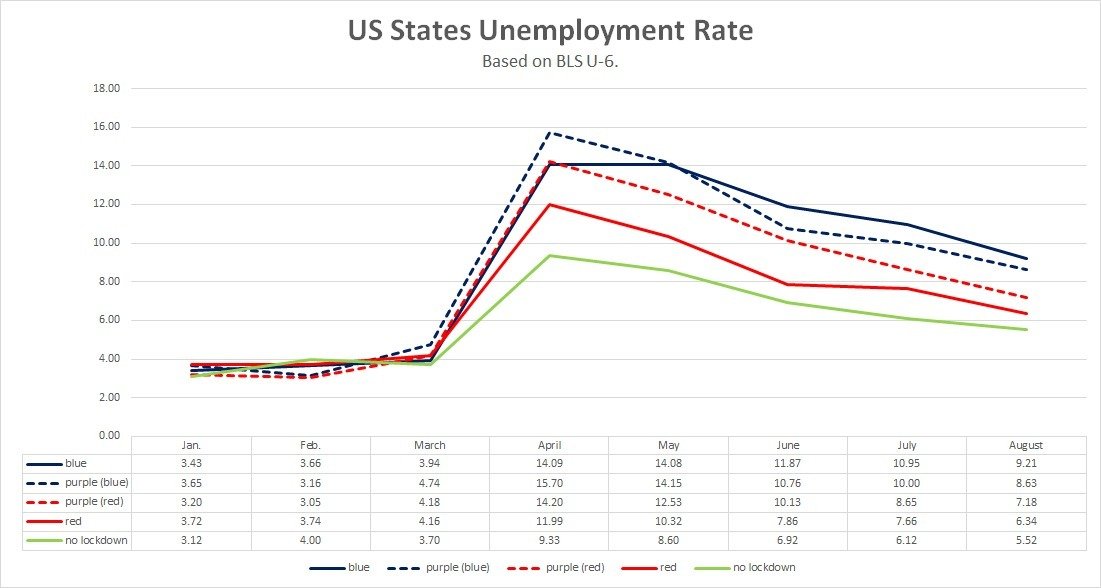
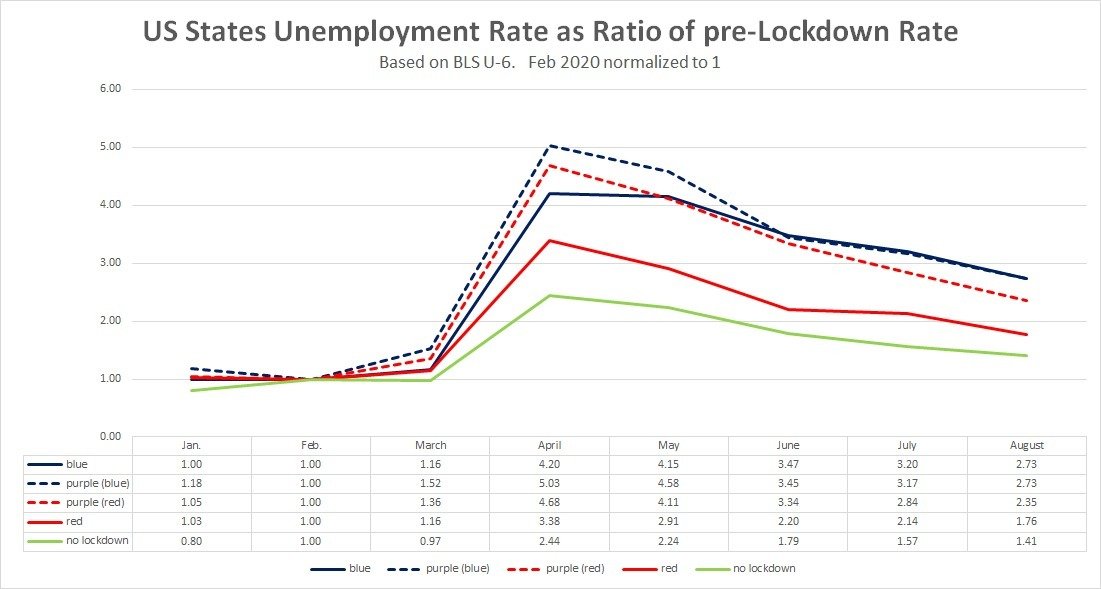
we can normalize this to the feb rate for all states for comparison. the red states saw less rise and are nearer to recovery. the purple states actually fared worst early on, but those with red governors are recovering faster. no lockdown has vastly outperformed.
 
  • Like
Reactions: jem
Data?
Why should we expect a lockdown con artists on this site or the media or in govt... to make or support policy based on data and real science?

Locking down the low risk is good... because they say so, regardless of the data or the harm or even the overall cost benefit.

Excellent post by the way...


EkYG5eMXcAA9LCy


EkYEST7WAAEIpf4


From the author (above):

blue states saw a significantly higher rise in unemployment (555 basis points) vs red states (260 basis points) (vs feb column) current unemployment is 287bp higher in blue states than red. and the ratio of current unemployment to pre lockdown is 2.73 vs 1.76. (aug rate/feb)

EkYHAv5XkAAlGHW


we can normalize this to the feb rate for all states for comparison. the red states saw less rise and are nearer to recovery. the purple states actually fared worst early on, but those with red governors are recovering faster. no lockdown has vastly outperformed.
 
wow was that a bunch of covid doomer bullshit... double speak... yo posted...

look at the main point here...
..

"The only time we believe a lockdown is justified is to buy you time to reorganize, regroup, rebalance your resources, protect your health workers who are exhausted, but by and large, we’d rather not do it.”

Exactly what we have been saying to you stupid lockdown... five points of post lockdown bullshit morons.

There is only one point. Hospital resources...


Once again you are peddling nonsense... let's take a look at what the WHO envoy actually said.

WHO Warning About Covid-19 Coronavirus Lockdowns Is Taken Out Of Context
https://www.forbes.com/sites/brucel...ckdowns-is-taken-out-of-context/#75ed4552158c

The WHO said what?

A number of people are now claiming on social media that the WHO, which in this case is short for the World Health Organization, has just “reversed” its position and now “admits” that Covid-19 coronavirus lockdowns are harmful. For example, Maxime Bernier, a former Member of the Canadian Parliament, tweeted the following on Sunday:


And then on Monday, there was this tweet from U.S. President Donald Trump:


Trump tweeting that he was right about something? Shocking. But the WHO “admitting” that Trump was right? What? From the WHO? When? Where exactly was he getting this stuff?

Well, supposedly it came from what David Nabarro, MS, MBBS, a medical doctor and Special Envoy on Covid-19 for the WHO, said during an interview with the British magazine The Spectator. Take a look at the relevant bits of the interview in the video accompanying the following tweet:


Hmmm. Nabarro did mention lots of words during his response, such as “lockdown”, “holidays”, “ghastly” and “catastrophe.” But at no point did he specifically mention Trump.

As you can see, Nabarro said, “We in the World Health Organization do not advocate lockdowns as the primary means of control of this virus.” Note the word “primary” here. He did not say, “do not advocate lockdowns as a means of control of this virus.” Nabarro continued by saying, “The only time we believe a lockdown is justified is to buy you time to reorganize, regroup, rebalance your resources, protect your health workers who are exhausted, but by and large, we’d rather not do it.” Note the words “rather not do it” as opposed to “should not do it” or “will not do it.”

Nabarro went on to describe how “lockdowns just have one consequence that you must never, ever belittle, and that is making poor people an awful lot poorer.” He added, “Look what’s happened to smallholder farmers all over the world. Look what’s happening to poverty levels. It seems that we may well have a doubling of world poverty by next year. We may well have at least a doubling of child malnutrition.” So basically, Nabarro was pointing out the potentially serious negative consequences of lockdowns. That, of course, makes sense.

So, where exactly was the “reversal” of the WHO’s position? Did Nabarro actually “admit” something new? Not really. Again, pay attention to the words “primary” and “rather not do it.” Nabarro really never said that lockdowns should not be used at all and that everything should be opened now and kept open forever.

Nabarro simply was reemphasizing what the WHO and many public experts have been saying all along: the way to tackle the Covid-19 coronavirus is through layering various policies and interventions in a coordinated, organized way. It’s not as if scientific experts have been claiming that “lockdowns are great” or saying “lockdowns, ooh la la” or “lockdowns, more of this please.” Implementing lockdowns is not like eating avocado toast. They (lockdowns and not avocado toast) can clearly have serious negative consequences. No one really welcomes a lockdown, unless perhaps you are starting an online business that sells toilet paper and is named “Toil Not Paper” or “Don’t Toil, Let Me Give You Paper.” Lockdowns certainly are not the only things that should be done to prevent the spread of the Covid-19 coronavirus.

In fact, no country in the world has really remained under lock down throughout the course of the pandemic. Quite the opposite. Consider the countries that have been most successful at responding to the pandemic to date. New Zealand, for example, opted for the “go hard and go early” route: aggressively closing things up quickly to prevent the Covid-19 coronavirus from getting a foothold (or maybe a spikehold) in the country. Such early action kept the number of cases from low to zero, allowing New Zealand to re-open again and more effectively contain any subsequent outbreaks, as I described previously for Forbes.

Similarly, since the start of pandemic, Taiwan and South Korea have used aggressive testing and coordinated national test-trace-and-isolate programs (along with other measures such as widespread face mask use) to keep the number of new Covid-19 coronavirus infections under control. If you’ll recall, sports like baseball resumed in these countries long before they did in the U.S. And check out pictures of the baseball games, like this one:

Those are real fans in the stands, not the fake fan noise that you are hearing now at NFL games, as you can see in a close up of a game in Taiwan:

Contrast all of this with what has transpired in the U.S. in 2020. The U.S. had plenty of lead time to mount an organized response before things got hairy, or spiky. Prior to 2020, people had already been warning the Trump administration about the possibility of a pandemic, as I wrote for Forbes back in 2017. Then, in late January, the WHO declared the growing Covid-19 coronavirus outbreak in China a global health emergency, well before the virus had really established itself in the U.S. Throughout the month of February, which is over three Scaramuccis in length, things got progressively worse in parts of Europe until the WHO did what everyone at the time knew was coming, officially declaring the Covid-19 coronavirus outbreak a pandemic on March 11.

Did the Trump administration use this lead time to get organized enough to respond appropriately and avoid lengthy shutdowns of the economy? It didn’t seem that way. No coordinated national testing, contact tracing, and surveillance programs were really in place. Many health care professionals didn’t have adequate levels of personal protective equipment (PPE) like face masks, which meant that officials had to actually discourage the public from wearing N95 face masks to save such masks for front line workers. Hospitals and health care systems were about as prepared for the pandemic as bathrooms without any toilet paper would be prepared for a chili and prune festival. Speaking of toilet paper. Toilet paper became seemingly as valuable as BTS tickets and in shorter supply. Every week it seemed like another thing was in short supply, ranging from the big TP to disinfectant to flour. The U.S. essentially was caught with its proverbial pants down. In this case, not just its pants, but its underwear, its Hannah Montana socks, and everything else on its body too.

At the time, many political leaders in the U.S. were behaving like the main characters in the movie Superbad, except that no one was calling any of them McLovin. They had no real clear plan on how to respond to the pandemic. Like virgins trying to buy liquor and get lucky at a party, actions were chaotic and disorganized. Butting the Emma Stone character in the face is not the way to secure a date with her. Similarly, telling everyone that the Covid-19 coronavirus was not that bad and was going to go away on its own was not the way to deal with the pandemic in the Spring.

As cases and deaths began mounting, it felt as if the U.S. were in the Super Bowl, the World Cup, or the NBA Championships and getting hammered. At the time, shutting down businesses and schools seemed to be the only ways of slowing the spread of the virus so that everyone could catch a breather. There was never any intention to keep nearly everything closed forever. That would have been like taking a time out during the NBA Championships and then just sneaking off to the bathroom stall to take a nap for an indefinite length of time. Or simply holding down the cover of a toilet that was overflowing.

Sports teams typically use time outs to regroup, maybe take a potty break, discuss what hasn’t been working, and then come up with a clear game plan to reverse the course of the bleep-storm of a game. Teams shouldn’t use the timeout to say, “oh, our opponents will probably quit soon or go away,” or “this timeout was a bad idea. Let’s stop this time out. We should never ever take a time out again” or “NO MORE TIME OUTS. JUST PLAY THE GAME, SAYS YOUR FAVORITE COACH” in ALL CAPS. Doing so would essentially squander what the time out offered.

Unfortunately, squandering opportunity is what many U.S. leaders seemed to do while schools and many businesses were closed in the Spring. The federal government did not emerge from the “time out” with a clear, coordinated, organized national response that included a nationwide testing, surveillance, and contact tracing program that could have helped better continuously track the virus and guide more focused efforts to box in and contain the virus. If the U.S. had managed to bring the daily case count further down and established a clearer picture of where the virus is spreading, they could as a result better time and select which school and businesses need to be closed when and only when such closures are really needed. Instead, many of the initial problems with the response such as disorganization and lack of proper public health systems, adequate healthcare capacity, and enough PPE remained.

A number of political and business leaders seemed so anxious to get out of the time out that they didn’t really use the time to come up with a coherent plan or enough new approaches. In turn, they may have overlooked the fact that the time out was never the intended final solution or the original problem. As a result, at no point, did the U.S. get ahead or take control of the pandemic. At no point did the daily number of new Covid-19 cases drop to a manageable level.

You know those teams that have to keep taking time-outs because they can’t seem to stop the opponent from scoring and catch up? That’s the current concern with countries like the U.S. that still do not have a real coordinated national response to the pandemic. Indeed, lockdowns should never be the primary response to a pandemic. That would be like going into a championship game and saying that the main strategy is to take a lot of time outs during the game. You are not going to time out your opponents into submission. Opponents don’t say, “watch out for that team, they take time outs really well.”

However, no one is going to say “get rid of timeouts as a possibility” or “never take a time out ever.” Similarly, lockdowns may still be needed, either as a temporary measure to quell an outbreak for example or to put the brakes on when things have gotten out of control.

So before you believe that the WHO has somehow reversed its position, take a time out and look more carefully at the who, what, when, and where something may have been said. In the interview, Nabarro didn’t really seem to say much of anything new. Instead, he simply said what many scientists and pubic health experts have been saying all along.
 
"DeSantis for the win"

Florida puts a positive spin on COVID-19 data, misleading the public on pandemic
https://www.sun-sentinel.com/corona...0201014-tfho3kvw7jaabmlv2d7gwndgii-story.html

Florida has obscured the true extent of its COVID-19 pandemic by using a misleading measure of positive cases to justify reopening schools and businesses, state data indicates.

While Florida has publicized that its “positivity rate” has regularly fallen below 5%, other health organizations are publishing data that shows the rate may be dramatically higher.


Independent experts, including Johns Hopkins University, consistently list Florida’s positivity rate at 10% or higher, twice the recommended level for widespread reopening.

Florida itself calculates another version of the rate — not widely publicized — that shows the pandemic is worse than state officials have championed. Those figures show that the rate has never fallen to the 5% threshold, the South Florida Sun Sentinel discovered.

RELATED: Florida’s hidden data skews COVID-19 test results »

The result: As coronavirus cases again threaten to rise in Florida, with schools and businesses fully open, it is becoming increasingly difficult to answer a simple question: What percentage of people tested positive for COVID-19 on any given day — and are we justified in going about our business without worry? Or did Gov. Ron DeSantis put people at risk when he allowed businesses to return to normal?

“Doing what we’re doing now, I think positivity numbers are just about useless, because it’s completely opaque who is getting tested and why,” said Thomas Hladish, a scientist at the University of Florida’s Emerging Pathogens Institute who has done pandemic modeling for the Florida Department of Health.

“It absolutely does lull people into a false sense of security,”said Rebekah Jones, a former Florida coronavirus data scientist who was fired in early May for alleged insubordination, after claiming the state had encouraged her to fudge statistics. Jones now publishes her own coronavirus statistics.

Measuring the pandemic
In simple terms, “positivity” measures the percentage of coronavirus tests that come back positive. It traditionally has been considered one of the best ways to determine how much the coronavirus has spread through the community.

Data scientists acknowledge that the rate can be determined in at least three different ways, all of which they say are justified. But in two of the three cases, Florida’s positivity rate would not meet the common standard for reopening society: below 5% for 14 consecutive days.

Three ways to measure Florida's COVID-19 positivity

(Chart in article)

Method 1: The rate published by Johns Hopkins University measures how many people tested positive on a given day out of all people tested in the state for the first time. By that measure, the state’s positivity rate has not trended below 10% since the middle of June — twice as high as the state claims.

On Tuesday, Johns Hopkins listed the rate at 11.7%, while Florida was reporting 4.99%.

Method 2: The number of positive tests is compared with the total number of tests on one day. This is the measure recommended by the World Health Organization. The organization says this rate should be below 5% before reopening.

The Florida Department of Health publishes the rate in daily reports posted on the Department of Emergency Management’s website, separate from the Department of Health dashboard that the public commonly monitors. The rate is publicized for the entire state, but it also is available at the county level in the Department of Health’s report archive.

The last time that rate fell below 5% for 14 days was four months ago, according to data from the Florida Department of Health. Over the past two weeks, it has averaged 5.87%.

Method 3: This calculation is similar, but it excludes anyone who has tested positive in the past, even though people with previous negative tests are still included. That makes the method problematic, some experts say, because the number of people retested on a daily basis can be large, thus skewing the rate downward.

Nevertheless, this is the figure that Florida publicizes each day and publishes on a county-by-county level. It’s the one DeSantis continually touts in arguing that it’s safe to reopen schools, restaurants, theme parks, museums and stadiums. The rate has remained below 5% since the second week of September, according to Department of Health data.

The three rates have broadly tracked each other for the duration of the pandemic, rising and falling at similar times. But the state’s preferred rate is consistently lower than the others and far below the rate identified by Johns Hopkins.

Jason Salemi, an associate professor at the University of South Florida’s College of Public Health, said Florida’s preferred positivity rate is “more controversial. You tend to not see it in a lot of other places.”

Other large states do not publish as much raw coronavirus data as Florida, but they appear to present their positivity rates in simpler terms.

New York, for example, publishes a chart showing the percentage of people testing positive, based on the more widely accepted method recommended by the World Health Organization. California shows a 14-day average of positivity and appears to use a similar method.

Salemi said he still finds Florida’s preferred rate useful to determine “what happened today among people who never tested positive before.” But some experts find the statistic faulty because it appears to compare two fundamentally different variables: people who tested positive versus tests that were negative.

“That is not a real percentage, because you’re using non-identical variables,” said Jones. “It’s like dividing ice cream cones by shark attacks.”

Representatives from the governor’s office, the Department of Health and the Florida Department of Emergency Management declined to explain the reason for their continued use of a possibly misleading statistic, saying simply that it was the “best” measure.

Alberto Moscoso, spokesman for the Florida Department of Health, said in July that the state counts multiple negative tests for the same person because “a negative test only reflects the individual’s status at the moment the specimen was collected.”

“Since a person who tested negative previously remains susceptible to the virus, the subsequent test is still included in the denominator of the positivity rate calculation,” he said.

Unreliable results
Some experts are beginning to question whether positivity rates are even a useful measure.

The rate can tell you about the spread of the virus, but only under certain ideal conditions, experts say. Levels of testing must remain constant; the criteria for who gets tested must be relatively random; and you can’t mix different kinds of tests, as Florida does.

The state combines PCR tests, or molecular testing that is considered more reliable, with antigen testing, the rapid-results tests that are less accurate.

Positivity is useful to measure whether the state is doing enough testing, but not so much for measuring spread, said Jennifer Nuzzo, lead epidemiologist for Johns Hopkins' COVID testing initiative.

“It’s often talked about as a measure of how many infections are out there, but you could have a very different number depending on how much testing you are doing,” she said.

Florida’s daily testing numbers have come down sharply from their July peak, when the state was testing between 90,000 to 100,000 people a day. Currently, the state tests between 40,000 to 70,000 people a day.

Days with a lot of testing tend to have lower positivity rates, and days with fewer tests tend to see spikes.

Hladish, the scientist at UF, advocates for randomized testing of individuals in order to figure out a true positivity rate.

“Randomly administer tests to 1,000 people a week, and you report that percentage every week,” he suggested. “It doesn’t matter whether they tested positive before or not, but you’ll have a representative idea of how prevalent the infection is in the population.”

Alexis Madrigal, deputy editor at The Atlantic, and a co-founder of the COVID Tracking Project, notes that wider use of antigen testing, which is becoming more available, will further disrupt the reliability of the measure. Recently, Florida has said it is deploying millions of rapid tests as it opens schools, and antigen tests have been widely used by professional and college sports teams.

“Antigen tests are going to just fry this whole thing. And no one is really sure what to do about that yet,” Madrigal said.

“The metrics that we’ve come to rely on like test positivity are in for a substantial weirding if antigen testing rolls out in a major way without a workable plan for getting that data back to state health departments.”

All of this might leave the public confused about what numbers are most important. Which should you watch to judge whether Florida’s coronavirus outbreak is starting to spiral out of control?

All of them, Nuzzo says.

“Something to realize is that whatever the metric is, there probably won’t be a magic number," she said. "I tend to pay attention to the trends in the numbers, more so than the numbers themselves.”

Where to find the data
Here’s where you can get data about the pandemic.

 
"DeSantis for the win"

Florida puts a positive spin on COVID-19 data, misleading the public on pandemic
https://www.sun-sentinel.com/corona...0201014-tfho3kvw7jaabmlv2d7gwndgii-story.html

Florida has obscured the true extent of its COVID-19 pandemic by using a misleading measure of positive cases to justify reopening schools and businesses, state data indicates.

While Florida has publicized that its “positivity rate” has regularly fallen below 5%, other health organizations are publishing data that shows the rate may be dramatically higher.


Independent experts, including Johns Hopkins University, consistently list Florida’s positivity rate at 10% or higher, twice the recommended level for widespread reopening.

Florida itself calculates another version of the rate — not widely publicized — that shows the pandemic is worse than state officials have championed. Those figures show that the rate has never fallen to the 5% threshold, the South Florida Sun Sentinel discovered.

RELATED: Florida’s hidden data skews COVID-19 test results »

The result: As coronavirus cases again threaten to rise in Florida, with schools and businesses fully open, it is becoming increasingly difficult to answer a simple question: What percentage of people tested positive for COVID-19 on any given day — and are we justified in going about our business without worry? Or did Gov. Ron DeSantis put people at risk when he allowed businesses to return to normal?

“Doing what we’re doing now, I think positivity numbers are just about useless, because it’s completely opaque who is getting tested and why,” said Thomas Hladish, a scientist at the University of Florida’s Emerging Pathogens Institute who has done pandemic modeling for the Florida Department of Health.

“It absolutely does lull people into a false sense of security,”said Rebekah Jones, a former Florida coronavirus data scientist who was fired in early May for alleged insubordination, after claiming the state had encouraged her to fudge statistics. Jones now publishes her own coronavirus statistics.

Measuring the pandemic
In simple terms, “positivity” measures the percentage of coronavirus tests that come back positive. It traditionally has been considered one of the best ways to determine how much the coronavirus has spread through the community.

Data scientists acknowledge that the rate can be determined in at least three different ways, all of which they say are justified. But in two of the three cases, Florida’s positivity rate would not meet the common standard for reopening society: below 5% for 14 consecutive days.

Three ways to measure Florida's COVID-19 positivity

(Chart in article)

Method 1: The rate published by Johns Hopkins University measures how many people tested positive on a given day out of all people tested in the state for the first time. By that measure, the state’s positivity rate has not trended below 10% since the middle of June — twice as high as the state claims.

On Tuesday, Johns Hopkins listed the rate at 11.7%, while Florida was reporting 4.99%.

Method 2: The number of positive tests is compared with the total number of tests on one day. This is the measure recommended by the World Health Organization. The organization says this rate should be below 5% before reopening.

The Florida Department of Health publishes the rate in daily reports posted on the Department of Emergency Management’s website, separate from the Department of Health dashboard that the public commonly monitors. The rate is publicized for the entire state, but it also is available at the county level in the Department of Health’s report archive.

The last time that rate fell below 5% for 14 days was four months ago, according to data from the Florida Department of Health. Over the past two weeks, it has averaged 5.87%.

Method 3: This calculation is similar, but it excludes anyone who has tested positive in the past, even though people with previous negative tests are still included. That makes the method problematic, some experts say, because the number of people retested on a daily basis can be large, thus skewing the rate downward.

Nevertheless, this is the figure that Florida publicizes each day and publishes on a county-by-county level. It’s the one DeSantis continually touts in arguing that it’s safe to reopen schools, restaurants, theme parks, museums and stadiums. The rate has remained below 5% since the second week of September, according to Department of Health data.

The three rates have broadly tracked each other for the duration of the pandemic, rising and falling at similar times. But the state’s preferred rate is consistently lower than the others and far below the rate identified by Johns Hopkins.

Jason Salemi, an associate professor at the University of South Florida’s College of Public Health, said Florida’s preferred positivity rate is “more controversial. You tend to not see it in a lot of other places.”

Other large states do not publish as much raw coronavirus data as Florida, but they appear to present their positivity rates in simpler terms.

New York, for example, publishes a chart showing the percentage of people testing positive, based on the more widely accepted method recommended by the World Health Organization. California shows a 14-day average of positivity and appears to use a similar method.

Salemi said he still finds Florida’s preferred rate useful to determine “what happened today among people who never tested positive before.” But some experts find the statistic faulty because it appears to compare two fundamentally different variables: people who tested positive versus tests that were negative.

“That is not a real percentage, because you’re using non-identical variables,” said Jones. “It’s like dividing ice cream cones by shark attacks.”

Representatives from the governor’s office, the Department of Health and the Florida Department of Emergency Management declined to explain the reason for their continued use of a possibly misleading statistic, saying simply that it was the “best” measure.

Alberto Moscoso, spokesman for the Florida Department of Health, said in July that the state counts multiple negative tests for the same person because “a negative test only reflects the individual’s status at the moment the specimen was collected.”

“Since a person who tested negative previously remains susceptible to the virus, the subsequent test is still included in the denominator of the positivity rate calculation,” he said.

Unreliable results
Some experts are beginning to question whether positivity rates are even a useful measure.

The rate can tell you about the spread of the virus, but only under certain ideal conditions, experts say. Levels of testing must remain constant; the criteria for who gets tested must be relatively random; and you can’t mix different kinds of tests, as Florida does.

The state combines PCR tests, or molecular testing that is considered more reliable, with antigen testing, the rapid-results tests that are less accurate.

Positivity is useful to measure whether the state is doing enough testing, but not so much for measuring spread, said Jennifer Nuzzo, lead epidemiologist for Johns Hopkins' COVID testing initiative.

“It’s often talked about as a measure of how many infections are out there, but you could have a very different number depending on how much testing you are doing,” she said.

Florida’s daily testing numbers have come down sharply from their July peak, when the state was testing between 90,000 to 100,000 people a day. Currently, the state tests between 40,000 to 70,000 people a day.

Days with a lot of testing tend to have lower positivity rates, and days with fewer tests tend to see spikes.

Hladish, the scientist at UF, advocates for randomized testing of individuals in order to figure out a true positivity rate.

“Randomly administer tests to 1,000 people a week, and you report that percentage every week,” he suggested. “It doesn’t matter whether they tested positive before or not, but you’ll have a representative idea of how prevalent the infection is in the population.”

Alexis Madrigal, deputy editor at The Atlantic, and a co-founder of the COVID Tracking Project, notes that wider use of antigen testing, which is becoming more available, will further disrupt the reliability of the measure. Recently, Florida has said it is deploying millions of rapid tests as it opens schools, and antigen tests have been widely used by professional and college sports teams.

“Antigen tests are going to just fry this whole thing. And no one is really sure what to do about that yet,” Madrigal said.

“The metrics that we’ve come to rely on like test positivity are in for a substantial weirding if antigen testing rolls out in a major way without a workable plan for getting that data back to state health departments.”

All of this might leave the public confused about what numbers are most important. Which should you watch to judge whether Florida’s coronavirus outbreak is starting to spiral out of control?

All of them, Nuzzo says.

“Something to realize is that whatever the metric is, there probably won’t be a magic number," she said. "I tend to pay attention to the trends in the numbers, more so than the numbers themselves.”

Where to find the data
Here’s where you can get data about the pandemic.
200.gif
 

It is fundamentally wrong when a political administration deliberately and knowingly pushes scientifically incorrect data to drive a political agenda. This is yet another example of this behavior by the DeSantis administration. In the face of a global pandemic - our worst public health crisis in over 100 years - it is disturbing to see this lack of transparency with data by a government entity.

The very foundation of trust in our government is built on that the information & statistics released by the government are factual and correct. Politicians may propose solutions to resolve the issues shown by the data -- which people may agree or disagree with --- but the very foundation of "trust in government" is built on accurate, transparent data supported by math and science.

I can only surmise that you approve of government agencies fabricating data they release to the public so politicians can drive their political agenda -- free from those pesky facts.
 
Last edited:
Now the DeSantis administration does not even want to release daily COVID reports anymore. ... it would make Florida the only state in the union not to do so.

Florida May Scale Back Daily COVID-19 Reports
https://www.baynews9.com/fl/tampa/news/2020/10/16/florida-may-scale-back-its-covid-19-daily-reports

We’ve been keeping daily track of the COVID-19 numbers put out by the state.

But the Governor’s Office now says with Florida in Phase 3 of the reopening, it’s considering scaling back the frequency of its reporting

Advocates for long-term care residents call the data vital when it comes to policy and decision making in the fight against COVID-19.

“What places are hot spots, what places might need extra staff and extra protective equipment,” said Sam Brooks, with the National Consumer Voice for Quality of Long Term Care.

Brooks said doing away with the daily release of the state’s COVID-19 related data would negatively impact those efforts.

Spectrum News learned of the possibility over the weekend, when we reached out to Gov. Ron DeSantis’s office on Saturday, after the daily COVID-19 numbers weren’t posted for the first time since March. We were told the delay was due to a large number of test results received from a laboratory. While the state resumed its daily reporting on Sunday, the Governor’s spokesperson said talks of staggering the state’s reporting were already underway.

“Part of the discussion is whether to return the Covid reports to the same schedule or a modified schedule like all the other reports of infectious diseases,” said Fred Picollo, spokesperson for the governor.

While Picollo said the discussion was very preliminary, advocates like Brooks believe it’s still too soon to even consider.

“At the state level, that is the most accurate and up to date data that we have,” Brooks said. “And to remove that piece of the puzzle is really going to hamper that response and really have a negative impact on a lot of folks.”

Dr. Lindsay Peterson, a researcher with USF’s School of Aging Studies, says weekly reporting, as opposed to daily, wouldn’t necessarily affect her ability to spot trends and analyze data. However, Peterson agrees now is not the time to scale back.

“Everybody’s talking in other states about a resurgence. We’re kind of beginning to see that in Florida. For the first time yesterday, the positivity rate began to edge up over 5,” Peterson said. “It’s not a time right now to relax and say we’re out of the woods because that is not what the data is showing.”

The Governor’s Office said a decision isn’t imminent, but either way, the full extent of the data will still be made available.
 
Last edited:
Back
Top