Comey the Clown: Lock him up!!

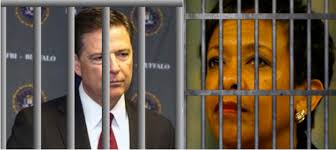
Looks like jail time for Hillary, Comey, Lynch.

.
0uZ1Sci-.jpg


images

Its too bad none of these criminals will end up in prison. Comey, Clinton, and Lynch are simply too big to fail.

 
You keep missing the point that the President of the United States was a party to that meeting and Comey has to submit all information and notes to the Justice Department for others to determine what is classified. Not just decide for himself whether anything in the meeting was classified. Duh.

In addition, Comey the Clown was bound by his non-disclosure agreement with the FBI which covered everything- regardless of whether it was classified or not- until such time as he requested permission from the government to use it for personal purposes.
http://thefederalist.com/2017/06/09/james-comey-violate-fbi-employment-agreement/
You're pulling this crap out of your ass.
 
comey told the world of her crimes
But he didn't tell the world of any crimes that she could be prosecuted for, i.e., in his judgement, a court would determine that she didn't commit a crime -- in other words , it's all in your imagination... He said very plainly that what she had done could not be successfully prosecuted. You want to prosecute me for J-walking, go ahead. J-walking is illegal you know. God I hope you haven't cut any of those labels off your mattresses, you naughty boy.
 
Its too bad none of these criminals will end up in prison. Comey, Clinton, and Lynch are simply too big to fail.
But he didn't tell the world of any crimes that she could be prosecuted for, i.e., in his judgement, a court would determine that she didn't commit a crime -- in other words , it's all in your imagination... He said very plainly that what she had done could not be successfully prosecuted. You want to prosecute me for J-walking, go ahead. J-walking is illegal you know. God I hope you haven't cut any of those labels off your mattresses, you naughty boy.

It was not comey's job to decide whether she should be prosecuted or not. He is an investigator not a prosecutor. Oh I see. Loretta could not participate because she had participated in a corrupt tarmac meeting and gotten caught. Also the fbi had received copies of emails wherein it was alleged that Loretta was softballing the investigation. In addition comey himself stated that a triggering event was the tarmac and the fact that loretta was directly ordering him to downplay it by calling it "a matter." Yeh. What's wrong with that picture class?

Dozens of seasoned prosecutors around the country were stating that there was plenty of evidence there to prosecute her and comey did not even do a full investigation. Comey knew they were right and that he was taking heat. He tried to redeem himself right before the election by erractically stating that he was still looking at Hillary based on new emails. A complete clown show followed.

What a clown. Don't believe me? Ask Hillary.

The chief investigators wife (McCabe) received 720k from the dem party during the investigation and the attorney general was telling the fbi to softball it. And you wonder why Comey the Clown said that he did not see a basis for prosecuting.
 
It was not comey's job to decide whether she should be prosecuted or not. He is an investigator not a prosecutor. Oh I see. Loretta could not participate because she had participated in a corrupt tarmac meeting and gotten caught. Also the fbi had received copies of emails wherein it was alleged that Loretta was softballing the investigation. In addition comey himself stated that a triggering event was the tarmac and the fact that loretta was directly ordering him to downplay it by calling it "a matter." Yeh. What's wrong with that picture class?

Dozens of seasoned prosecutors around the country were stating that there was plenty of evidence there to prosecute her and comey did not even do a full investigation. Comey knew they were right and that he was taking heat. He tried to redeem himself right before the election by erractically stating that he was still looking at Hillary based on new emails. A complete clown show followed.

What a clown. Don't believe me? Ask Hillary.

The chief investigators wife (McCabe) received 720k from the dem party during the investigation and the attorney general was telling the fbi to softball it. And you wonder why Comey the Clown said that he did not see a basis for prosecuting.

This is all factual. Why isn't it enough for a special counsel? There's far more here than in the ludicrous Trump collusion farce.
 
It was not comey's job to decide whether she should be prosecuted or not.
That is exactly correct. Everyone understands this. It is Comey's job to report the FBI's findings to the AGs office. The AG's office decides whether the findings are sufficient to warrant indictment. But do not forget that the FBI is composed of lawyers for a reason, and the AG therefore wants the FBI's recommendation. When Comey reported on the FBIs findings, he included the collective opinion of the FBI with regard to whether or not the findings were sufficient to justify prosecution. The AG is free to attempt to prosecute or not, on the basis of the FBI's findings and recommendation, as they see fit, but prosecuting despite the FBI's recommendation would certainly call into question the judgement of the AG's Office.

Normally the FBI would not make a public announcement of the findings from an investigation. However this instance is different in that the subject was a candidate for President of the United States, and the Public knew she was being investigated! Once Comey believed the investigation was complete, and in the opinion of the FBI the findings did not merit indictment , he made the decision that the cloud of suspicion hovering over the candidate should be lifted. This was the only honorable decision he could have made at that point. However that decision later created a moral dilemma once it was discovered that there was an additional computer that needed to be investigated.

Since Comey had already announced that in the FBI's opinion there was no indictable offense, what does he do now? The second decision can only be assessed in light of the first decision. And one can understand how difficult it would be to decide what to do under the circumstances he was faced with. He apparently thought it was his duty to let the public know that the FBI's previous decision might have to be reversed.

When Comey made his first decision, it was exactly the right decision, since at that point that he only knew there was, in the FBI's opinion, no reason to recommend indictment to the AG's Office. The alternative of remaining silent would have been clearly wrong!

Had the investigation not been concluded before the election, and realistically there must have been great pressure to conclude the investigation!, he would have had no choice but to remain silent. Had Clinton been elected and it was later found by the FBI that there was grounds for indictment, then Congress would have had to deal with the situation.

The last minute discovery that Weiner's computer also contained Clinton emails threw a monkey wrench into the situation. Had Comey earlier made the decision to remain silent despite knowing that the investigation had turned up nothing indictable, a clearly wrong decision in my opinion, he could have and would have I am sure, continued to remain silent after the Wiener discovery, and let Congress deal with any subsequent adverse finding. But that is not the situation he was faced with.

When one considers the political pressures Comey must have felt and the great difficulty of his position under very unusual circumstances, for him to remain above politics and act in the honorable manner in which he did, is a testimony to this man's integrity. We should all be grateful for his extraordinary courage to do the honorable thing in the face of what must have been almost unbearable pressure and criticism from one party or the other.
 
Last edited:
That is exactly correct. Everyone understands this. It is Comey's job to report the FBI's findings to the AGs office. The AG's office decides whether the findings are sufficient to warrant indictment. But do not forget that the FBI is composed of lawyers for a reason, and the AG therefore wants the FBI's recommendation. When Comey reported on the FBIs findings, he included the collective opinion of the FBI with regard to whether or not the findings were sufficient to justify prosecution. The AG is free to attempt to prosecute or not, on the basis of the FBI's findings and recommendation, as they see fit, but prosecuting despite the FBI's recommendation would certainly call into question the judgement of the AG's Office.

Normally the FBI would not make a public announcement of the findings from an investigation. However this instance is different in that the subject was a candidate for President of the United States, and the Public knew she was being investigated! Once Comey believed the investigation was complete, and in the opinion of the FBI the findings did not merit indictment , he made the decision that the cloud of suspicion hovering over the candidate should be lifted. This was the only honorable decision he could have made at that point. However that decision later created a moral dilemma once it was discovered that there was an additional computer that needed to be investigated.

Since Comey had already announced that in the FBI's opinion there was no indictable offense, what does he do now? The second decision can only be assessed in light of the first decision. And one can understand how difficult it would be to decide what to do under the circumstances he was faced with. He apparently thought it was his duty to let the public know that the FBI's previous decision might have to be reversed.

When Comey made his first decision, it was exactly the right decision, since at that point that he only knew there was, in the FBI's opinion, no reason to recommend indictment to the AG's Office. The alternative of remaining silent would have been clearly wrong!

Had the investigation not been concluded before the election, and realistically there must have been great pressure to conclude the investigation!, he would have had no choice but to remain silent. Had Clinton been elected and it was later found by the FBI that there was grounds for indictment, then Congress would have had to deal with the situation.

The last minute discovery that Weiner's computer also contained Clinton emails threw a monkey wrench into the situation. Had Comey earlier made the decision to remain silent despite knowing that the investigation had turned up nothing indictable, a clearly wrong decision in my opinion, he could have and would have I am sure, continued to remain silent after the Wiener discovery, and let Congress deal with any subsequent adverse finding. But that is not the situation he was faced with.

When one considers the political pressures Comey must have felt and the great difficulty of his position under very unusual circumstances, for him to remain above politics and act in the honorable manner in which he did, is a testimony to this man's integrity. We should all be grateful for his extraordinary courage to do the honorable thing in the face of what must have been almost unbearable pressure and criticism from one party or the other.
Not everyone agrees though.

**
http://thefederalist.com/2017/06/12/james-comey-long-history-questionable-obstruction-cases/

One of the few media outlets that has consistently expressed skepticism about Comey is the Wall Street Journal. When he was nominated by President Barack Obama to be FBI director in 2013, they presciently wrote a piece headlined, “The Political Mr. Comey: Obama’s FBI nominee has a record of prosecutorial excess and bad judgment.” The article described even then Comey’s “media admirers” and a “media fan base” that refused to ask him tough questions. But the Journal had concerns:

Any potential FBI director deserves scrutiny, since the position has so much power and is susceptible to ruinous misjudgments and abuse. That goes double with Mr. Comey, a nominee who seems to think the job of the federal bureaucracy is to oversee elected officials, not the other way around, and who had his own hand in some of the worst prosecutorial excesses of the last decade.

Frank Quattrone

Let’s begin with the case of one Frank Quattrone, a banker who Comey pursued relentlessly on banking related charges without fruition. But while he couldn’t find any wrong-doing on criminal conduct, he went after him for supposed “obstruction of justice” because of a single ambiguous email. Sound familiar?

Before he was indicted, Comey made false statements about Quattrone and his intent. The first trial ended in a hung jury but the second one got a conviction.

That conviction was overturned in 2006. Quattrone was so scarred by the harassment, he began funding projects designed to help innocent people who are victims of prosecutorial overreach or other problems. He said his motivation for supporting such projects was that at the very moment he was found guilty in the second trial, he realized there must be innocent people in prisons who lacked the financial resources to fight for justice. He also started the Quattrone Center for the Fair Administration of Justice at the University of Pennsylvania Law School.

Quattrone has noted with interest the disparities in how he was treated by Comey for a single email compared to his handling of the Hillary Clinton email server scandal.

Martha Stewart

You might remember Martha Stewart being sent to jail. You might not remember that James Comey was the man who put her there, and not because he was able to charge her for anything he began investigating her for. The original investigation was into whether Stewart had engaged in insider trading. They didn’t even try to get her on that charge. Gene Healy wrote about it in 2004, warning about federal prosecutorial overreach:

Comey didn’t charge Stewart with insider trading. Instead, he claimed that Stewart’s public protestations of innocence were designed to prop up the stock price of her own company, Martha Stewart Living Omnimedia, and thus constituted securities fraud. Stewart was also charged with making false statements to federal officials investigating the insider trading charge — a charge they never pursued. In essence, Stewart was prosecuted for “having misled people by denying having committed a crime with which she was not charged,” as Cato Institute Senior Fellow Alan Reynolds put it.

The pursuit was described as “vindictive” in the New York Times and “petty and vindictive” in The Daily Beast.

But she still served a five-month prison sentence.

Steven Hatfill
The FBI absolutely bungled its investigation into the Anthrax attacker who struck after the 9/11 terrorist attacks. Carl Cannon goes through this story well, and it’s worth reading for how it involves both Comey and his dear “friend” and current special counsel Robert Mueller. The FBI tried — in the media — its case against Hatfill. Their actual case ended up being thrown out by the courts:

Comey and Mueller badly bungled the biggest case they ever handled. They botched the investigation of the 2001 anthrax letter attacks that took five lives and infected 17 other people, shut down the U.S. Capitol and Washington’s mail system, solidified the Bush administration’s antipathy for Iraq, and eventually, when the facts finally came out, made the FBI look feckless, incompetent, and easily manipulated by outside political pressure.

More from Cannon, recounting how messed up the attempt to convict Steven Hatfill for a crime he didn’t commit was:

In truth, Hatfill was an implausible suspect from the outset. He was a virologist who never handled anthrax, which is a bacterium. (Ivins, by contrast, shared ownership of anthrax patents, was diagnosed as having paranoid personality disorder, and had a habit of stalking and threatening people with anonymous letters – including the woman who provided the long-ignored tip to the FBI). So what evidence did the FBI have against Hatfill? There was none, so the agency did a Hail Mary, importing two bloodhounds from California whose handlers claimed could sniff the scent of the killer on the anthrax-tainted letters. These dogs were shown to Hatfill, who promptly petted them. When the dogs responded favorably, their handlers told the FBI that they’d “alerted” on Hatfill and that he must be the killer.

When Bush administration officials were worried about the quality of the case Mueller and Comey had, the two men assured them. “Comey was ‘absolutely certain’ that it was Hatfill,” Deputy Defense Secretary Paul Wolfowitz said.

“Such certitude seems to be Comey’s default position in his professional life,” Cannon wrote. He shouldn’t have been certain in this case. After the six years the FBI spent destroying his life, they settled a $4.6 million lawsuit he filed and officially exonerated him.

Scooter Libby, Judith Miller
After pressuring John Ashcroft to recuse himself from the responsibility on the grounds of potential conflicts of interest, Comey gave Patrick Fitzgerald, his close personal friend and godfather to one of his children, the role of special counsel into the investigation of the leak of Valerie Plame’s identity as a CIA employee. Some conflicts of interest are more important to Comey than others, apparently.

Fitzgerald immediately discovered that Deputy Secretary of State Richard Armitage was the leaker. Of course, the FBI and Department of Justice had known that all along, so Comey’s push for a special counsel is … intriguing.

Not only did they not shut down the investigation that never needed to begin, Comey expanded its mandate within weeks. The three-year investigation was a cloud over the Bush administration and resulted in nothing but the jailing of a journalist for not giving up a source, and a dubious prosecution of Scooter Libby for, wait for it, obstruction of justice. Comey was unconcerned about the jailing of journalists and never threatened to resign over this infringement on First Amendment freedoms.

Hillary Clinton
Comey treated Hillary Clinton poorly by convicting her in the court of public opinion without giving her the chance to defend herself in a free and fair trial. But it’s interesting to note why Comey didn’t pursue charges against Clinton. He claimed — despite this not being a legal standard of relevance, that he didn’t think Clinton had intent. And while Clinton and her team engaged in massive evidence destruction shortly after subpoenas were issued, Comey — who was near-delirious in his pursuit of others on obstruction charges — didn’t seem to think anyone would be interested in prosecuting here.

Clinton had classified info on a private server, was extremely careless in handling that information, and had caused the destruction of evidence. The notion that “no reasonable prosecutor” would even try to charge her with the misdemeanors or felonies in question is beyond belief.

But there’s so much more to that case, such as upon learning that two Clinton staff members had classified information, the FBI didn’t subpoena those computers but gave the employees immunity in return for giving them up. The FBI severely limited their own searches for data on the computers and then destroyed them. A technician who destroyed evidence lied to FBI investigators even after he received immunity, and Comey did nothing. And after the FBI discovered that President Obama had communicated with Clinton on the non-secure server, Obama said he didn’t think Clinton should be charged with a crime because she hadn’t intended to harm national security. As former Attorney General Michael Mukasey noted, “As indefensible as his legal reasoning may have been, his practical reasoning is apparent: If Mrs. Clinton was at criminal risk for communicating on her nonsecure system, so was he.”

Did Comey pursue the case under the relevant laws or follow Obama’s wish that charges not be filed? In this case, he chose the latter. As a Wall Street Journal editorialist wrote last July, “Mr. Comey wasn’t ready to go it alone and impose accountability on Mrs. Clinton. That would have been tough. That would have been brave. He instead listed her transgressions in detail and left it to the public to pass judgment at the ballot box in November. That isn’t how the system is supposed to work. But Mr. Comey is no John Adams.”

Donald Trump
As the Journal noted in 2013, the media are enamored with Comey. Such blinders make it difficult to see problems with his own testimony. He claimed that his motivation to leak was to achieve the appointing of a special prosecutor. His very close friend — and associate in the bungled Hatfill prosecution — Robert Mueller was, in fact, named as a result of his leak. The immediate cause of the leak was, he said, Donald Trump telling him not to leak. Yet the day before that tweet, the New York Times ran a story headlined, “In a private dinner, Trump demanded loyalty. Comey demurred.” The information, as with the story about the memos Comey leaked, was sourced to associates of Comey. You don’t have to be a brain surgeon to figure out who was pushing this information.

More bizarre was his claim regarding the notes he kept before leaking. He said, inexplicably, that he never kept notes on his meetings with George Bush (he did) or Barack Obama but kept notes on Trump simply because he believed he was a liar. He said he viewed these notes as personal property, despite the fact that they were government work product, produced on classified computers in a government vehicle following a meeting with the President of the United States. We don’t know why the FBI is unable to deliver these memos to the investigative committees, or whether the FBI even has copies of them. But we do know that his claim to have not kept notes about his meeting with President Bush was false.

As John Hinderaker details, Barton Gellman wrote a book against Dick Cheney that used extensive notes from a meeting between Comey and President Bush. And the information contained therein reads very much similar to the Trump memos, down to the gratuitous grandfather clocks that are mentioned and 15 lines of dialogue in which Comey appears to be, however implausibly, the only virtuous man in Washington.

Comey’s case would require his friend Robert Mueller to agree that the president’s actions weren’t bad enough to make Comey do literally anything other than chat with subordinates about it and save notes in case of vengeance, but then somehow bad enough to be obstruction of justice. Mueller has fans within the D.C. establishment, but I’m not sure that’s a case he’d be willing to take on, no matter how many recipients of Comey leaks cheer him on.

There are many other examples of Comey’s poor judgment when it comes to obstruction of justice cases. But the idea that Comey should be trusted to lay out an impartial case for obstruction is going to be hard to swallow.

Mollie Ziegler Hemingway is a senior editor at The Federalist. Follow her on Twitter at @mzhemingway
 
Clintonian Comey Defense Sequence – The Latest: Comey’s Leaked Memos Were “Retroactively Classified”…


The defensive narrative ‘fact pattern’ appears identical in sequencing:

Step 1 – The emails/memos were not classified. √

Step 2 – The emails/memos were not ‘marked’ classified. √

Step 3 – The emails/memos were ‘retroactively classified‘. √

Next up in the logical sequence:

Step 4 – Missing/deleted = Wiped Comey memos: “what, like with a cloth or something?”

Step 5 – Robert Mueller (filling the role of Comey circa 2016) will hold a 2017 presser to say: James Comey didn’t intentionally violate the law with sharing classified information within his leaked memos in 2017. Adding: “we could find no intent” by him to do so.

Step 6 – Mueller will conclude his presser by saying: “no reasonable special counsel would recommend charges“.

Bets?

theconservativetreehouse.com
 
This is all factual. Why isn't it enough for a special counsel? There's far more here than in the ludicrous Trump collusion farce.
Normally a special counsel, in the sense that you mean it, would not be appointed to investigate a private citizen. Special counsels are appointed to investigate someone who has administrative authority over the investigating body; thus creating an interest conflict. The idea is to keep arms length distance between the investigating body and the one being investigated. Normally the AG's Office would appoint a special Counsel, or Special Prosecutor if you will, and at least one President, for example, has tried to subvert such appointment by attempting to fire the Special Counsel. We've seen what that led too! Clinton, on the other hand, had no administrative authority over either the AG's office or the FBI.
 
After pressuring John Ashcroft to recuse himself from the responsibility on the grounds of potential conflicts of interest, Comey gave Patrick Fitzgerald, his close personal friend and godfather to one of his children, the role of special counsel into the investigation of the leak of Valerie Plame’s identity as a CIA employee. Some conflicts of interest are more important to Comey than others, apparently.
Interest Conflicts are created when the one, or those, being investigated have a close, special relationship with the investigative body. That wouldn't apply in the case you have cited because Comey was not the one being investigated.
 
Back
Top