Climate Change... its the sun... again.

Look, either CO2 is GHG, or it's not. Apparently you think it is not. I won't even go into the fact that by some calculations CO2 is responsible for 80% of the earth's GHG effect.

Really, since you don't think that CO2 is a GHG, or even know what that is, you are really too stupid to waste time arguing with.
Why do you deny science from the very sources you quote to try and prove your religion such as the IPCC, APS and NASA?


Are you a cherry picker? You look like a cherry picker. NOW go pick me some cherries. I am hungry.
 
Why do you deny science from the very sources you quote to try and prove your religion such as the IPCC, APS and NASA?

Are you a cherry picker? You look like a cherry picker. NOW go pick me some cherries. I am hungry.
Ok, I had to lol @ that last bit. Hehe...
 
Why do you deny science from the very sources you quote to try and prove your religion such as the IPCC, APS and NASA?


Are you a cherry picker? You look like a cherry picker. NOW go pick me some cherries. I am hungry.

Why is it so hard for you to say whether CO2 is GHG or not? Which is it?
 
Why is it so hard for you to say whether CO2 is GHG or not? Which is it?

Huh. You can't come up with anything else?

XAxaV.gif
 
So how much warmer is the earth because of the GH effect?

PCC said in Section D.1 of the AR5 WG1 SPM:

Bold and underline mine. To paraphrase the quote below - We don't fucking know.

The observed reduction in surface warming trend over the period 1998–2012 as compared to the period 1951–2012, is due in roughly equal measure to a reduced trend in radiative forcing and a cooling contribution from internal variability, which includes a possible redistribution of heat within the ocean (medium confidence). The reduced trend in radiative forcing is primarily due to volcanic eruptions and the timing of the downward phase of the 11-year solar cycle. However, there is low confidence in quantifying the role of changes in radiative forcing in causing the reduced warming trend. There is medium confidence that internal decadal variability causes to a substantial degree the difference between observations and the simulations; the latter are not expected to reproduce the timing of internal variability. There may also be a contribution from forcing inadequacies and, in some models, an overestimate of the response to increasing
greenhouse gas and other anthropogenic forcing (dominated by the effects of aerosols)
. {9.4, Box 9.2, 10.3, Box 10.2, 11.3}

To which the American Physical Society reasonably asked:

  • This IPCC text lists internal variability, forcing inadequacies, and model over-responsiveness as all possibly contributing to the stasis, but without a quantitative resolution. To what would you attribute the stasis?
  • If non-anthropogenic influences are strong enough to counteract the expected effects of increased CO2, why wouldn’t they be strong enough to sometimes enhance warming trends, and in so doing lead to an over-estimate of CO2 influence?
  • What are the implications of this stasis for confidence in the models and their projections?

To which Fraudcurrents will most likely reply something like 97% blablahblah.

  • This IPCC text lists internal variability, forcing inadequacies, and model over-responsiveness as all possibly contributing to the stasis, but without a quantitative resolution. To what would you attribute the stasis?

Paraphrased in regular people talk.

Hey, IPCC, you are making up all kinds of shit to account for the pause in global surface temperatures. You can't even fucking back up any of your bullshit with math. Do you have any fucking idea what has caused global surface temps to pause?

----------------------------------------------------------------------------------------------

The American Physical Society stated:

Bold mine.

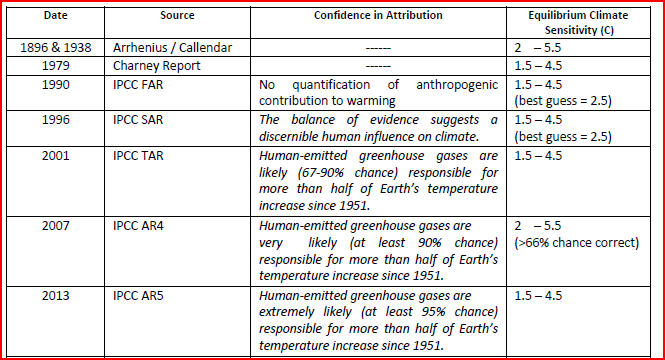
APS1_zps0863ed22.png


The last column of the table above [see Nature Geosciences 1, 735 (2008)] shows successive IPCC estimates of the Equilibrium Climate Sensitivity4, following first estimates more than a century ago. A factor-of-three uncertainty in the global surface temperature response to increased atmospheric CO2 as expressed by ECS has persisted through the last three decades of research despite the significant intellectual effort that has been devoted to climate science.

Then the American Physical Society reasonably asked:

What gives rise to the large uncertainties in this fundamental parameter of the climate system?
• How is the IPCC’s expression of increasing confidence in the detection/ attribution/ projection of anthropogenic influences consistent with this persistent uncertainty? Wouldn’t detection of an anthropogenic signal necessarily improve estimates of the response to anthropogenic perturbations?

NASA said:
  1. AIR TEMPERATURES HAVE STALLED
  2. TEMP IN TOP HALF OF WORLD'S OCEANS ARE NOT CLIMBING FAST ENOUGH TO ACCOUNT FOR STALLED AIR TEMPS
  3. WATER TEMP IN DEEP OCEAN HASN'T RISEN SINCE 2005
 
Yes, both NASA and and the APS are right.

This is what they say....

American Physical Society
"The evidence is incontrovertible: Global warming is occurring. If no mitigating actions are taken, significant disruptions in the Earth’s physical and ecological systems, social systems, security and human health are likely to occur. We must reduce emissions of greenhouse gases beginning now."
 
Back
Top