Becoming an atheist

Nope. I'm trading at the moment. I did screen it a bit though and these folks are full of "couldas" is all. Nothing definitive. It coulda been this or it coulda been that is not evidence. They may have found a few pieces but nothing like what a large group would leave. Here's another fact, from Cairo to the West Bank it's a SIX DAY WALK!
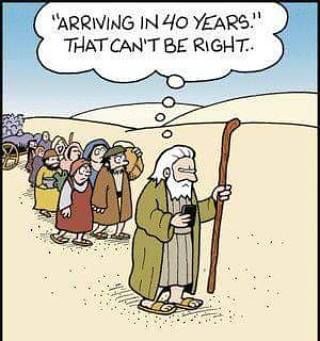
Moses-wandering-in-the-desert-3.jpg
The video is 2 hours long, so I guess I can't blame you for not watching it, since you're mind is already made up. But one thing I really liked was the burial monument for a ruler of Egypt who is wearing a coat of many colors AND the place the body should have been was empty. This is evidence, although you will likely excuse it away. The Biblical account of Joseph is that he once had a coat of many colors, became 2nd to Pharoah and the children of Israel took his body with them when they left Egypt. And there's lots more evidence backing up the Biblical records than just this.
They've searched and searched but not 1 single piece of evidence has been found;, no droppings, broken pottery...nada.
 
Yes, I have made up my mind. I go with the factual evidence that's available and my critical thinking abilities. The bible also says there was a virgin birth, serpents spoke, a donkey spoke, a man sirvived stomach acid for more that a few minutes, and a man gathered every creature on earth in pairs (except the unicorns) and lived on a 500' boat for a year...all without one piece of factual evidence. Why anyone, that is not under the influence of a brain wash could believe this is, especially in this day and age, is quite amazing. Personally, I could give a crap about what or whom people believe as long as you keep it out of our governments, our schools and stop thinking they have the right to control the reproductive system of women...all on just faith...
 
When we trade, most people have some sort of belief.
Some may have huge faith in their trades, others may come from a different angle and not believe anything, they could care less, they just swing with the trees.
Those who have strong beliefs in their trade may buy and hold, even through large retracements.
It's just a fact of life, some beliefs work out, others don't, some spectacularly well, others a total disaster.
Tell me why a loving God rewards or punishes people eternally for their beliefs or lack of beliefs?
 
I breed frogs.
Theyre incredibly clumsy, stupid, dimwitted and have a huge death rate.
Out of a thousand tadpoles I may get 2-3 surviving frogs.
Because of this, should I hate them? Has God perhaps cursed them because he hates them?
 
But one thing I really liked was the burial monument for a ruler of Egypt who is wearing a coat of many colors AND the place the body should have been was empty.

They did show the statue with its coat of many colors.
upload_2022-3-7_16-3-53.png

Holy Sphinxters, that was from a different video.:) The actual video shows it as
upload_2022-3-7_16-6-31.png

And he looks like he'd be a star on the local basketball team. The video also shows part of the actual statue.
upload_2022-3-7_16-10-34.png

It's a little less convincing than the artist's conception. Maybe no body was found because it wasn't a tomb. We have things like that to remember important people today.
upload_2022-3-7_16-18-11.png
 
Maybe no body was found because it wasn't a tomb. We have things like that to remember important people today.
View attachment 279789
But according to the video it was in the type of tomb a high ranking leader would have had because of the small pyramid. Also, it was one of 12 graves in the same garden, only the other 11 were not as spectacular. The palace adjacent to the garden had 12 pillars. David Rohl points out the 12 pillars and 12 tombs could very well have been because there were 12 sons of Jacob. All this was in Goshen, with quite a bit of evidence that aligns with a Semite population when you also consider the work of Manfred Bietak, who was also interviewed in the video about the foreigners that lived in Goshen.

In 2015, Bietak won from the European Research Council an ERC Advanced Grant "The Hyksos Enigma" and is principal investigator and head of this project which is accommodated at the Austrian Academy of Sciences and at the Bournemouth University, UK. This project explores the origins of western Asiatic populations in the Nile Delta during the Middle Kingdom (c. 2000–1800 BC) and the Second Intermediate Period (c. 1800–1530 BC) and how the Hyksos seized power in Lower Egypt. Research also is focused on the reasons for the decline and failure of the Hyksos 15th Dynasty and its lasting impact on the Egyptian culture of the New Kingdom.
https://en.wikipedia.org/wiki/Manfred_Bietak

 
But according to the video it was in the type of tomb a high ranking leader would have had because of the small pyramid. Also, it was one of 12 graves in the same garden, only the other 11 were not as spectacular. The palace adjacent to the garden had 12 pillars. David Rohl points out the 12 pillars and 12 tombs could very well have been because there were 12 sons of Jacob. All this was in Goshen, with quite a bit of evidence that aligns with a Semite population when you also consider the work of Manfred Bietak, who was also interviewed in the video about the foreigners that lived in Goshen.

In 2015, Bietak won from the European Research Council an ERC Advanced Grant "The Hyksos Enigma" and is principal investigator and head of this project which is accommodated at the Austrian Academy of Sciences and at the Bournemouth University, UK. This project explores the origins of western Asiatic populations in the Nile Delta during the Middle Kingdom (c. 2000–1800 BC) and the Second Intermediate Period (c. 1800–1530 BC) and how the Hyksos seized power in Lower Egypt. Research also is focused on the reasons for the decline and failure of the Hyksos 15th Dynasty and its lasting impact on the Egyptian culture of the New Kingdom.
https://en.wikipedia.org/wiki/Manfred_Bietak


https://youtu.be/diwtUuRAHNA?t=4774

The Bible ... gives a date for the Exodus ... 480 years from the building of Soloman's temple back to the tim of the Exodus . ... Soloman began his reighn in 970 BC. ... would place the time of the Exodus around 1450 BC

Most of the rest of the video says it happened in the Middle Kingdom era which ended at 1650 BC.

There seem to be many proposals on when the events in Exodus happened.
https://en.wikipedia.org/wiki/Pharaohs_in_the_Bible#In_the_Book_of_Exodus
In the Book of Exodus[edit]
...
Though scholars generally do not recognize the biblical portrayal of the Exodus as an actual historical event,[1] various historical pharaohs have been proposed as the corresponding ruler:

  • Pepi I (24th - 23rd century BC): Emmanuel Anati has argued that the Exodus should be placed between the 24th and the 21st century BC and that Pepi I should be identified as the pharaoh of the Exodus.[2] This theory has not gained acceptance and has received strong criticism from Israeli archaeologist Israel Finkelstein and American Egyptologist James K. Hoffmeier.[3][4]
  • Dedumose II (died c. 1690 BC): David Rohl's 1995 A Test of Time revised Egyptian history by shortening the Third Intermediate Period of Egypt by almost 300 years. As a result, the synchronisms with the biblical narrative results in the Second Intermediate Period King Dedumose II the pharaoh of the Exodus.[5] Rohl's revision has been turned down by the vast majority of Egyptologists.[6]
  • Ahmose I (1550–1525 BC): Several church fathers identified Ahmose I, who reconquered lower Egypt from the Hyksos, rulers of Asiatic (Semitic) origin, as the pharaoh of the Exodus, based on their interpretations of Manetho, Herodotus, and other classical authors.[7]
  • Hatshepsut (1507–1458 BC). Diodorus Siculus identified the Jews with the Hyksos and identified the Pharaoh of the Exodus with Queen Hatshepsut.[8]
  • Thutmose II (1493–1479 BC). Alfred Edersheim proposes in Old Testament Bible History that Thutmose II is best qualified to be the pharaoh of Exodus based on the fact that he had a brief, prosperous reign and then a sudden collapse with no legitimate son to succeed him. His widow Hatshepsut then became first regent (for Thutmose III, his son by his concubine Iset) before becoming pharaoh herself. Edersheim states that Thutmose II is the only pharaoh's mummy to display cysts, possible evidence of plagues that spread through the Egyptian and Hittite Empires at that time.[9]
  • Akhenaten (1353–1349 BC). In his book Moses and Monotheism, Sigmund Freud argued that Moses had been an Atenist priest of Akhenaten who was forced to leave Egypt, along with his followers, following the pharaoh's death. Eusebius identified the Pharaoh of the Exodus with a king called "Acencheres", who may be identified with Akenhaten.[10]
  • Ramesses II (c. 1279–1213 BC): Ramesses II, or Ramesses The Great, is the most common figure for the Exodus pharaoh as one of the most long-standing rulers at the height of Egyptian power and because Rameses is mentioned in the Bible as a place name (see Genesis 47:11,Exodus 1:11,Numbers 33:3, etc). As such, he is often the pharaoh depicted in popular culture narratives of the event (such as the 1956 film The Ten Commandments and the 1998 Disney-style traditionally animated musical film by Dreamworks Animation The Prince of Egypt). Although Ramesses II's late 13th Century BC stela in Beth Shan mentions two conquered peoples who came to "make obeisance to him" in his city of Raameses or Pi-Ramesses, the text mentions neither the building of the city nor, as some have written, the Israelites or Hapiru.[11]
  • Merneptah (c. 1213–1203 BC): Isaac Asimov in Guide to the Bible makes a case for Merneptah to be the Pharaoh of the Exodus.[12]
  • Setnakhte (c. 1189–1186 BC): Igor P. Lipovsky and Israel Knohl make a case for Setnakhte to be the Pharaoh of the Exodus.[13][14]
  • Ramesses III (c. 1186–1155 BC): Gary A. Rendsburg, Baruch Halpern and Manfred Bietak make a case for Ramesses III as the Pharaoh of the Exodus.[15][16][17]
  • Bakenranef (c. 725-720 BC): Tacitus writes in his Histories that Bakenranef (whom he refers to as "Bocchoris") had expelled the Jews from Egypt because they suffered from a horrible disease and because he was instructed to do so by an oracle of the god Amun.[18] Lysimachus of Alexandria, quoted by Josephus in Against Apion, also identifies the Pharaoh of the Exodus with Bakenranef.[19]
  • Ramses (?-?). Manetho and Chaeremon of Alexandria, both quoted by Josephus in Against Apion, state that the Jews were expelled from Egypt by a pharaoh named "Ramses", son of another pharaoh named "Amenophis". It is unclear which pharaoh this could be, since no pharaoh named Ramses had a predecessor named Amenophis.[20]

And the video acknowledges this.

https://www.youtube.com/watch?v=diwtUuRAHNA&t=6741s

I know there is a lot of disagreement over the dating. But what strikes me, is that if you put all the dates to the side for a moment, what emerges from the archeology is this pattern that matches the Bible every step of the way.
To me, that statement suggests people picked stories and some events from history, and put them into the Bible, even though they can't match any actual timeline.


Most of the rest of the video says it happened in the Middle Kingdom era which ended at 1650 BC.

There seem to be many proposals on when the events in Exodus happened.
https://en.wikipedia.org/wiki/Pharaohs_in_the_Bible#In_the_Book_of_Exodus


And the video acknowledges this.

To me, that statement suggests people picked stories and some events from history, and put them into the Bible, even though they can't match any actual timeline.
I'm more than halfway through re-watching the video. There is a LOT of evidence that matches the Biblical description from an earlier time period. I thought it flowed together very well, especially considering how difficult it is to date physical evidence from that long ago.

The reason most archaeologists don't accept all this evidence is because they somehow have it in their minds that it must have happened during Ramses II and since there is no evidence from that time period, they say it didn't happen. I checked the chronology given in the video, and if I understand it correctly, the earlier places in the video showing very early timelines are where the time corresponds to the time in Egypt before slavery.

Also, the video does seem to adjust the proposed timeline to the time of 1450 B.C. for the Exodus, which is in alignment with the Bible, if Solomon's reign is not adjusted. I'm not even going to attempt to guess if it could be or not, but there does seem like so much of dating is dependent on other dating being accurate, that it wouldn't surprise me if that could be adjusted to an earlier date, although I read that even David Rohl is not attempting to adjust that.

In another interview David Rohl accepted the Biblical Exodus date of 1447 BC:

Looking further back in time, the biblical Exodus date of 1447 BC now falls in what Egyptologists call the Second Intermediate Period, which is the archaeological period known as the Middle Bronze IIA-IIB. It was at this time that we find a huge city, lying underneath the 19th Dynasty capital of Pi Ramesse (biblical Raamses), known in the contemporary texts as Avaris. And this Middle Bronze Age city, located in the land of Goshen, was teaming with Semites who had initially migrated from Canaan into the Egyptian delta. They then abruptly abandon the city and disappear. About half a century later the city of Jericho is violently destroyed, its walls falling down in an apparent earthquake. Jericho is then burnt to the ground and abandoned for nearly 600 years. All the cities described in the Book of Joshua as being ‘placed under the curse of destruction’ are also destroyed at this time.
https://popular-archaeology.com/article/the-exodus-myth-or-history/
 
Most of the rest of the video says it happened in the Middle Kingdom era which ended at 1650 BC.
Towards the end of the video, it's explained even further. I just now was watching it. The Biblical time of 1450 BC the time proposed by the video for the Exodus, so basically, shifting to an earlier time by a couple centuries than currently accepted in secular circles (not many Bible Thumper circles though). Which IS, as you pointed out, just a couple centuries later than the Middle Kingdom era ending in 1650 BC. The video presents some reasons why it would make sense to adjust all of Egyptian history forward by a couple centuries or so. This amazingly lines up perfectly with the Biblical timeline!!!!! So now we can trust it!!!! LOL....just had to put that in here for all you skeptics that might actually read this. :D

This is where the timeline adjustment for Egypt is shown (from 1:49:45 to 1:52:37)
 
Yadda yadda yadda.... abraham, god, jesus, moses, jericho.... who gives a fuck about all this irrelevent religous koolade, is it going to put food on your table?
 
Back
Top