Quote from 4444CJones4444:
I'd like to know what caused the bubble that led to the Great Depression, according to Austrian economics. Since, obviously, it's pretty fucking hard to get out of one once you're already in it.
The Austrian view is that it was expansion of the money supply, which is a consequence of fractional reserve banking.
In my opinion this was a contributory factor, but the main cause was human nature. Note that the USA had bubbles before the Fed ever existed.
In 2000-2003 the USA and much of the west had a huge internet bubble. It did not really cause too much damage to the real economy - a mild and short-lived recession. Thus, not all bubbles have terrible outcomes.
It is also not hard to get out of a post-bubble bust. Look at Asia in 1997-98 - they had a bust even worse than the current one. Yet by 2000 they were fine. Notice that there was little in the way of huge government stimulus - the governments were too broke and weak to be able to do it. Solving a catastrophic recession is easy - just pursue laissez-faire, as Asia unintentionally did in 1998 onwards, and let the markets bust out unproductive activity and poorly managed businesses, and then new ones will arise in their place.
If you try massive government stimulus, then you get what happened in the 1930s, or the 1970s, or 1990s Japan, or Argentina after 2001. Argentina is the best example, because both it and Brazil had massive busts caused by ludicrous fixed-peg exchange rate regimes combined with profligate borrowing and spending by both government and industry (the same thing that caused the Asia crisis - people never learn). Argentina pursued a massive government stimulus plan, restrictions on banks, nationalizations, currency and capital controls, increased taxes etc - the classic Keynesian/socialist recipe. Brazil, in almost identical circumstances, hired a former Soros economist and made him central bank chief, hiked rates into the high teens, and pursued a policy designed to get spending back in line with taxation. Would you care to guess about the relative economic performances of both those countries since then?
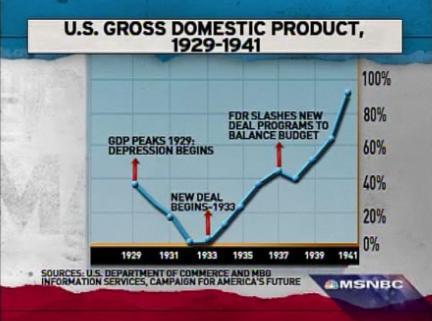
Yet despite all this, despite the economic performance under FDR, despite Japan's 19 year doldrums since the 1990 bust began, despite the success of laissez-faire in Asia and Brazil compared to the disasters of socialism in Argentina, or 1970s Britain and America, people still think that government intervention is the right response to a bad recession. So we'll see the same BS happen again and again - don't count on the outcome being any different this time.