Austrian Economics and the Great Depression

Quote from lrm21:Its the half ass attempts of government intervention that are so destructive, depressing private capital, opressing with high government debt and taxation, creating high uncertainty. And then saying how terrible private markets are and we need a little more government intervention
Saying that government intervention CAUSES crisis is your opinion and nothing else. I could argue in the exact same uneducated manner that a free market financial industry driven by greed caused the crisis and now can't be part of the solution.

The main point however is that (financial) markets are not perfectly efficient at all times, contrary to what free market proponents claim.

A perfectly efficient market would always use perfectly rational prices and buy/sell decisions based on perfectly rational risk/reward analysis. Psychology is not considered in efficient market analysis. The "markets are self-regulating & government intervention is poison" crowd is missing (or willingly ignoring) this point.

Yes, governments suck at running economies. It leads to misallocation of resources. But does this automatically mean the government should stay out of markets when they fail and spiral into chaos?
 
Quote from makloda:

According to the Austrians, 8000 bank failures, millions of homeless and 30% unemployment helped create "a cleared out system and a clean base" to start out from.

In other words, the Austrians argue that when everything turns to sh** at some point it can't get much worse. That's not too long before it starts getting better.

They call this tipping point the "Look we told you so, the free market worked its magic"-point :cool:

Nice impartial explanation there :)
 
Quote from smilingsynic:

Please provide evidence. Facts, figures, statistics. Opinions do not mean squat.

.
you could spend your days posting your words above to no avail, that is an opinion
which is not squat.:D
 
Government intervention is what caused the current crisis.

How?

a. The Fed's monetary central planning, distorted interest rates and caused real estate bubbles, commodities bubbles etc.
b. GSE's Fannie Mae Freddie Mac.
c. The above plus the federal agencies chronism (SEC CFTC) caused moral hazard.
d. When some banks saw their bubble pricked, the government sucked and is sucking trillions and trillions of resources of the real economy to help their friends at the banks. Money down the toilet. That is the equivalent of a terrorist destroying trillions and trillions worth of private property.

So what should have been just a few bankers losing their jobs has been turned into a depression. Only half the banks are insolvent, so the good banks would have remained operative. It's all about saving the connected bankers' arse.
 
Quote from Angrycat:

Allow me to be the second to compliment you on your excellent post.

If I may add....employment is a direct result of wealth creation as investment in wealth creating projects increases demand for labour.

The problem with government is that it doesn't create wealth. Thus, every government employee must be paid with taxes levied on wealth creating enterprises, putting increasing pressure on private enterprise and decreasing the incentive to invest.

The end of that particular cycle can be best summed up by Gorbachev: "Our workers pretend to work and we pretend to pay them."

Employment is the result of wealth creation, not the cause of it.

Government activity can definitely create wealth. Just look at any society that successfully fought a defensive war, or that went from anarchy or rule by warlords to civilised society. The US, UK, and other allied governments prevented huge losses by winning WWII rather than allowing Hilter to take over the world. Police and courts provide immense value by deterring and punishing crime, and taking offenders off the streets. The creation of the European Union stopped centuries of bloodshed in that continent. All of these are government action and they are extremely valuable.
 
Quote from 4444CJones4444:

I'd like to know what caused the bubble that led to the Great Depression, according to Austrian economics. Since, obviously, it's pretty fucking hard to get out of one once you're already in it.

The Austrian view is that it was expansion of the money supply, which is a consequence of fractional reserve banking.

In my opinion this was a contributory factor, but the main cause was human nature. Note that the USA had bubbles before the Fed ever existed.

In 2000-2003 the USA and much of the west had a huge internet bubble. It did not really cause too much damage to the real economy - a mild and short-lived recession. Thus, not all bubbles have terrible outcomes.

It is also not hard to get out of a post-bubble bust. Look at Asia in 1997-98 - they had a bust even worse than the current one. Yet by 2000 they were fine. Notice that there was little in the way of huge government stimulus - the governments were too broke and weak to be able to do it. Solving a catastrophic recession is easy - just pursue laissez-faire, as Asia unintentionally did in 1998 onwards, and let the markets bust out unproductive activity and poorly managed businesses, and then new ones will arise in their place.

If you try massive government stimulus, then you get what happened in the 1930s, or the 1970s, or 1990s Japan, or Argentina after 2001. Argentina is the best example, because both it and Brazil had massive busts caused by ludicrous fixed-peg exchange rate regimes combined with profligate borrowing and spending by both government and industry (the same thing that caused the Asia crisis - people never learn). Argentina pursued a massive government stimulus plan, restrictions on banks, nationalizations, currency and capital controls, increased taxes etc - the classic Keynesian/socialist recipe. Brazil, in almost identical circumstances, hired a former Soros economist and made him central bank chief, hiked rates into the high teens, and pursued a policy designed to get spending back in line with taxation. Would you care to guess about the relative economic performances of both those countries since then?

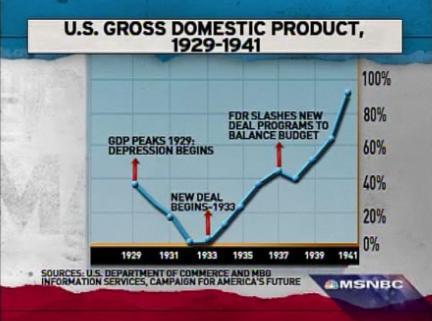
Yet despite all this, despite the economic performance under FDR, despite Japan's 19 year doldrums since the 1990 bust began, despite the success of laissez-faire in Asia and Brazil compared to the disasters of socialism in Argentina, or 1970s Britain and America, people still think that government intervention is the right response to a bad recession. So we'll see the same BS happen again and again - don't count on the outcome being any different this time.

 
americans understand free markets the same way they understand the bills of rights. it could never pass a vote today.
it was the same after world war 2. the UK instituted price and wag controls. the US tried to force the same on Germany.. chancellor Adenauer
said no. the shelves were empty. within a few months everything was available. the rest is history. it was the beginning of the German miracle. the UK eventually became the sick man of europe.
 
I got a kick out of this line:

"Anyone who thinks that the policies of FDR and the congress did not directly contribute to the longest recession in modern history is mindless drone."


original.jpg


Funny thing is how republicans are opposed to stimulus packages even though they accompany many of their tax cuts with such government spending (ie. Reagan spending, Bush's bogus Iraq War). Its a nice way to boost the economy and proclaim it as a result of the tax cut.
 
Quote from smilingsynic:

Please provide evidence. Facts, figures, statistics. Opinions do not mean squat.

Take a look at the GDP, unemployment, stock and bond market data for the 1930s. Unemployment was in double digits for years, an unprecedented situation. Also bear in mind that Hoover implemented a lot of statist policies too.
 
Back
Top