ATM Iron Butterfly - Why is it Delta Negative?

in this sense i was dumbing it down bc he asked about a conder not a strangle

i agree a strangle is a much better vol play than a condor, i think condors are useless

but that is not the point. the point here is that call-put parity per strike isn't even in price and delta if you have vol skew

so if you did a 25d strangle in ES, the put will have a higher price than the calls bc investors are natrual put buyers

Was referring to the strangle as the “wings” portion of the Iron Butterfly which is (I believe) 1 straddle + 1 strangle.

Yup, you made it clear for the volatility skew.
Thanks.

Thus the delta neutral strangle’s two legs won’t have the same “moneyness” due to the bias you’ve just highlighted.
 
Last edited:
I think it's because they use Prob of OTM aka 84% for the standard deviation on each side. They are looking for a Situation were the Put Scew is reversed ("Falling Put Curve and Rising Call Curve").

Normal case:
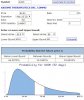
Ppl fear a downward move more and are buying more puts, the Probability distribution (and thus the OTM Probability per Strike) is derived from which Strikes people buy the most/least. A 30 Delta on the Put Side will have a lower OTM Probability than a OTM Probability on the Call Side on the exact same delta (see Picture). Usually you would approximate via a Delta of 16 (16%ITM Prob=84%OTM Prob=1 STDV) but since the probability distribution is scewed to the put side the approximation doesn't work like 16 delta=16%ITM/84% OTM Probability. The Implied Volatility is calculated from the Option Price as well, the higher the price the higher the IV the flatter the Implied Distribution thus Delta doesn't work as a 1:1 approximation of the ITM Probability.

You will have to go to a e.g. Delta of 8 on the Put Side and Delta of 32 on the Call Side (both of them will have to move to the left on the Probability Distribution to capture the 84%) to get a OTM Probability of 84% (or ITM Prob of 16%) on both Sides. You are Selling ATM and Buying the Wings in an Iron Butterfly so:

ATM Call & Put = Put ATM Delta -50 Call ATM Delta-50 =0
Wings= Delta -8 Put Side Delta +32 Call Side

In a normal Put Scew Situation you would be Long Delta

The Authors want that you look for a steep call Curve (and flat Put Curve), so the exact Opposite of the case above. It's the Put Scew in Reverse. You are Buying the Wings at -32 Put Side Delta and +8 Call Side Delta (deltas move to the right to caputure OTM Probability). This is why they want you to buy an extra Call/Shares to isolate Volatility

Imagine the Image Attached (Normal Case with Put Scew) BUT in reverse (Call Side Steep)

I had a very similar problem yesterday: https://www.elitetrader.com/et/threads/abnormal-skew-in-delta-prob-of-otm.343276/

 

Attachments

  • a.JPG
    a.JPG
    46.2 KB · Views: 13
Last edited:
in this sense i was dumbing it down bc he asked about a conder not a strangle

i agree a strangle is a much better vol play than a condor, i think condors are useless

but that is not the point. the point here is that call-put parity per strike isn't even in price and delta if you have vol skew

so if you did a 25d strangle in ES, the put will have a higher price than the calls bc investors are natrual put buyers

In that case he would be Long Delta
 
Hello guys, happy Friday to everyone!

Have a novice question here. In a book by Chen and Sebastian (Option Trader's Hedge Fund) they give a great example of how to structure an ATM Iron Butterfly. One thing that I'm struggling to understand is why the fly ends up being delta negative?

My understanding is that both short ATM call and put will basically offset each other for the delta, while the long OTM call will have a higher positive delta than the negative delta of the long OTM put. The OTMs are of course equidistant from the ATM strikes. So why is this position then net negative in terms of delta? What am I missing?

Many thanks!
ATMF delta is slightly over 50 (best way to think about it is that the stock can go to infinity but can’t fall below zero). As a result, when you are short an ATM straddle and long a strangle, you are going to be gently short delta.
 
Gamma is highest atm, I looked into the book op, where do you see the delta exactly? What page? Might be good if you post the image

Thanks Atikon, I'm referring to the example on page 106, where they give an example of an ATM Butterfly for SPX at 1220/1270/1270/1320. What I see in the screenshots in the same book on the same page is that in this example the short put has the delta of 50.6 while the short call has -49.3 - so about the same. The long call (1320) has the delta of 16.6 while the long put (1220) is -23.7. Yet the say "delta of -28" about this trade.

how do they arrive at this number?
 
I think it's because they use Prob of OTM aka 84% for the standard deviation on each side. They are looking for a Situation were the Put Scew is reversed ("Falling Put Curve and Rising Call Curve").

Normal case:
Ppl fear a downward move more and are buying more puts, the Probability distribution (and thus the OTM Probability per Strike) is derived from which Strikes people buy the most/least. A 30 Delta on the Put Side will have a lower OTM Probability than a OTM Probability on the Call Side on the exact same delta (see Picture). Usually you would approximate via a Delta of 16 (16%ITM Prob=84%OTM Prob=1 STDV) but since the probability distribution is scewed to the put side the approximation doesn't work like 16 delta=16%ITM/84% OTM Probability. The Implied Volatility is calculated from the Option Price as well, the higher the price the higher the IV the flatter the Implied Distribution thus Delta doesn't work as a 1:1 approximation of the ITM Probability.

You will have to go to a e.g. Delta of 8 on the Put Side and Delta of 32 on the Call Side (both of them will have to move to the left on the Probability Distribution to capture the 84%) to get a OTM Probability of 84% (or ITM Prob of 16%) on both Sides. You are Selling ATM and Buying the Wings in an Iron Butterfly so:

ATM Call & Put = Put ATM Delta -50 Call ATM Delta-50 =0
Wings= Delta -8 Put Side Delta +32 Call Side

In a normal Put Scew Situation you would be Long Delta

The Authors want that you look for a steep call Curve (and flat Put Curve), so the exact Opposite of the case above. It's the Put Scew in Reverse. You are Buying the Wings at -32 Put Side Delta and +8 Call Side Delta (deltas move to the right to caputure OTM Probability). This is why they want you to buy an extra Call/Shares to isolate Volatility

Imagine the Image Attached (Normal Case with Put Scew) BUT in reverse (Call Side Steep)

I had a very similar problem yesterday: https://www.elitetrader.com/et/threads/abnormal-skew-in-delta-prob-of-otm.343276/

Thank you very much!

So, if I get this right, if I am buying the wings with the same ITM probability, let's say 16% ITM on the put and 16% on the call, the call strike will *usually* (with the normal skew) be closer to the ATM, therefore higher delta? So the positive delta of the long call will outweight the negative delta of the long put?

If so, should I buy more put "units" as the authors suggest - to flatten out the delta?
 
Back
Top