Anyone use moving average indicators?

I completely agree (if it goes my way afterwards, I can sometimes re-enter, anyway).

Exactly, and that is what usually happens, I re enter at a better price.

I also wanted to further my thought about my Position management, its not some crazy formula that I use to determine what size to trade on each trade, it is actually very Organic.

I run this system on 10 different time frames, so for instance, If I put 1 lot on each time frame, the more the market is aligned, the more time frames that will trigger a setup, therefore more lots will be traded. I literally let the market determine what size I should trade by how well the time frames align, and the more time frames that align the higher the chance of success and the more money I make.
 
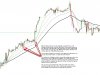
I like to use the direction of one simple moving average and its alignment with three others to help me identify reversals in the intraday trend (yellow arrows). Also, the interplay between the candlesticks and the (slopes of the) two longer-term moving averages helps me identify good entry levels when exchange rates experience pullbacks from their dominant trajectories (orange triangles).

ScreenHunter_7381 Mar. 17 11.59.jpg
 
Last edited:
Thats a Good one expiated, I do something similar in choppy sideways markets. Except I use the lowest Moving average against Price, so one thing I notice is that Price will only go so far away from the lowest average before it reverses. I determined the average price moves against its slowest tracking average by back testing. This is great for Fading highs or lows in chop city.

i-QkcZbMW-XL.jpg
 
I like to use the direction of one simple moving average and its alignment with three others to help me identify reversals in the intraday trend (yellow arrows). Also, the interplay between the candlesticks and the (slopes of the) two longer-term moving averages helps me identify good entry levels when exchange rates experience pullbacks from their dominant trajectories (orange triangles).

View attachment 183794

Have you automated this? With some of my techniques I could build an entire automated system around this idea.
 
Another Idea I have used in the past to build systems on Moving Averages. The amount of things you can do with averages and not use the "Crossover" Technique is plentiful. This looks easy in hindsight, but when you are in the moment getting ready to place this trade it looks like its going to fail, this psychology is what makes trading so hard.

i-GWqWxXj-XL.jpg
 

Attachments

  • elite trader 3.jpg
    elite trader 3.jpg
    192.4 KB · Views: 56
Last edited:
Thanks SimpleMeLike. Do you know of any good (cheap also good, free even better) back-testing software or what not? Thanks!
The MotiveWave Strategy Edition is $595 for a lifetime license. It has full backtesting capabilities. We have 15+ Moving Average studies built-in (see the list under the Moving Averages section: https://www.motivewave.com/studies/studies.htm). There are a lot of settings/customizations you can do on each of them without having to custom program them yourself.
 
Does anyone use these? Anyone know whether any of them produce better results than just a buy and hold? Even if normally buy and hold is better, I would bet moving average systems would produce much lower drawdowns, particularly when the market is sky high like it is now. Seems like with a moving average, once the price starts to dip, you cover, and don't uncover again until maybe many percentage points more to the downside, thus hopefully missing the next bear market in large part.

I'm trying to read up on these, but most don't seem to be all that great off hand. Anyone have any thoughts?

Thanks!

It depends on the markets. Not as trivial to apply as they look. I have seen code for trading commodities with moving averages about 10K lines long. Lazy implementation like golden/death cross is usually not as profitable or unprofitable compared to more advanced implementations using variable moving average periods. A must read good article about the changes in the markets with respect to moving averages.
 
Thats a Good one expiated, I do something similar in choppy sideways markets. Except I use the lowest Moving average against Price, so one thing I notice is that Price will only go so far away from the lowest average before it reverses. I determined the average price moves against its slowest tracking average by back testing. This is great for Fading highs or lows in chop city.

So, so Cool!

Here is an excerpt from my book explaining the system I was using up until two weeks ago. It sounds very similar…

What I ended up with was a system predicated on the following three suppositions:
  1. The best “atmospheric barometer” for predicting the direction in which an exchange rate might ultimately be headed is what’s known as a moving average, with a handful of key moving averages evidencing superior accuracy in this role.
  2. Generally speaking, exchange rates distance themselves only so far from these moving averages before they are compelled to return to more typical deviation levels. I refer to these “maximum degrees of separation” as “statistical support/resistance levels,” which I assume are controlled by market makers and/or automated trading algorithms.
  3. By correctly interpreting the relationships between the above mentioned moving averages and their corresponding statistical support/resistance levels, it is possible to forecast when and where price is likely to reverse direction; enabling traders to enter long and short positions (to buy and sell, respectively) ONLY when the odds are very much in their favor.
 
What I ended up with was a system predicated on the following three suppositions:
  1. The best “atmospheric barometer” for predicting the direction in which an exchange rate might ultimately be headed is what’s known as a moving average, with a handful of key moving averages evidencing superior accuracy in this role.


I'm afraid that one simply isn't true. It's just "wrong".

2. Generally speaking, exchange rates distance themselves only so far from these moving averages before they are compelled to return to more typical deviation levels. I refer to these “maximum degrees of separation” as “statistical support/resistance levels,” which I assume are controlled by market makers and/or automated trading algorithms.


That one rests on a lack of understanding of - or allowance for - the mean reversion fallacy: briefly, the principle of "mean reversion", as many traders (perhaps unwisely) call it, lets them down on the positive-expectancy front because their logic fails to recognise that the mean itself is a moving one.

In other words, the price can be at the bottom of a channel (e.g. lower line of Keltner, or lower Bollinger band, or just "below a moving average to which it will revert": the principle is exactly the same in each case), and then "revert"/"rise" to its "normal level" ("mean-reversion principle") but actually drop further in the process, because the moving average midline is itself also moving (and that's the key concept completely ignored by the statement above), while the price is moving.

So, yes, eventually the price must revert to the midline ... and that's what many people (in practice typically and especially undercapitalised, overleveraged, relatively inexperienced spot forex traders) find attractive about it: superficially, it "looks predictive". Unfortunately, the point they're typically missing is that that reality doesn't actually predicate which way the price will have moved, overall, by the time it's actually done so!
angry-smiley-034.gif


3. By correctly interpreting the relationships between the above mentioned moving averages and their corresponding statistical support/resistance levels, it is possible to forecast when and where price is likely to reverse direction; enabling traders to enter long and short positions (to buy and sell, respectively) ONLY when the odds are very much in their favor.


That one's (unsurprisingly) mistaken because the first of its two premises is false, and second just ignores the "mean reversion fallacy".

Sorry to sound so negative, but what's quoted above is basically nonsense. :(
 
Last edited:
Back
Top