Anyone Heard From BLM Lately?

https://www.washingtonpost.com/news...t-states-in-the-union/?utm_term=.2b1abf7c8c74

This is necessarily hard to figure out, of course, given that "stupid" is inherently contextual and subjective. In order to figure out how smart each state was, we looked at objective measures we had at our disposal. Specifically:

  1. IQ, as estimated by Virginia Commonwealth's Michael McDaniel in 2006
  2. 2015 SAT scores, compiled by The Post
  3. 2015 ACT scores, via the company that administers the tests
  4. The percentage of college graduates in the state, compiled by the Census Bureau
To create an intelligence score, we determined the percentage-point difference between a state's score and the national median score. Then, since IQ seemed to be the most on-the-nose metric, we doubled that value and then added it all up.

The results? Iowa is the eighth-smartest state, behind, in order: Massachusetts, Minnesota, New Hampshire, Connecticut, Wisconsin, Kansas and Vermont. Donald Trump's home state of New York came in 17th. The bottom five states were Florida, Alabama, Mississippi, Nevada and, in the 50th spot, Hawaii.


imrs.php

This data would be relevant (and not just interesting) if you had it broken down by voting district. Otherwise, it really doesn't tell anything about whether republicans or democrats have higher IQ.
 
http://www.huffingtonpost.com/2012/01/27/intelligence-study-links-prejudice_n_1237796.html

SCIENCE
02/01/2012 08:52 am ET | Updated Apr 09, 2013
Intelligence Study Links Low I.Q. To Prejudice, Racism, Conservatism

By Rebecca Searles


Are racists dumb? Do conservatives tend to be less intelligent than liberals? A provocative new study from Brock University in Ontario suggests the answer to both questions may be a qualified yes.

The study, published in
Psychological Science, showed that people who score low on I.Q. tests in childhood are more likely to develop prejudiced beliefs and socially conservative politics in adulthood.

I.Q., or
intelligence quotient, is a score determined by standardized tests, but whether the tests truly reveal intelligence remains a topic of hot debate among psychologists.

Dr. Gordon Hodson, a professor of psychology at the university and the study’s lead author, said the finding represented evidence of a vicious cycle: People of low intelligence gravitate toward socially conservative ideologies, which stress resistance to change and, in turn, prejudice, he told
LiveScience.

Why might less intelligent people be drawn to conservative ideologies? Because such ideologies feature “structure and order” that make it easier to comprehend a complicated world, Dodson said. “Unfortunately, many of these features can also contribute to prejudice,” he added.

Dr. Brian Nosek, a University of Virginia psychologist, echoed those sentiments.

“Reality is complicated and messy,” he told The Huffington Post in an email. “Ideologies get rid of the messiness and impose a simpler solution. So, it may not be surprising that people with less cognitive capacity will be attracted to simplifying ideologies.”

But Nosek said less intelligent types might be attracted to liberal “simplifying ideologies” as well as conservative ones.

In any case, the study has taken the Internet by storm, with some outspoken liberals saying that
it validates their suspicions about conservatives and conservatives arguing that the research has been misinterpreted
.

This biased article from HuffPo is a joke. It appears to be something appropriate for The Onion.
 
http://theconversation.com/do-smart...oesnt-mean-all-conservatives-are-stupid-57713

Do smart people tend to be more liberal? Yes, but it doesn’t mean all conservatives are stupid
May 10, 2016 9.37pm EDT

Over the past decade, several studies have shown that people who tend to hold more conservative views score low on measures of intelligence. However, it now appears that while conservatism and intelligence are negatively correlated, the link is not as strong as first thought.

Origins
Much of the previous work in this area was based on a psychological definition of conservatism, rather than a political one. The term “conservative syndrome” was coined to describe a person who attaches particular importance to respect for tradition, humility, devoutness and moderation.

Such a person tends to hold conformist values like obedience, self-discipline and politeness, and emphasises the need for social order coupled with concerns for family and national security.

A conservative person also subscribes to conventional religious beliefs and has a sense of belonging to and pride in a group with which they identify. The same person is likely to be less open to intellectual challenges and will be seen as a responsible “good citizen” at work and in society, while expressing rather harsh views toward those outside their group.

Up to 16% of “conservative syndrome” is reportedly due to low cognitive ability.

Overall, smart people tend to be socially liberal in their outlook. It was also found that countries whose citizens score low on international tests of mathematics achievement tend to be more conservative in their political outlooks and policies.

Politics versus psychology
Political scientists were quick to point out that conservative syndrome belongs to what they refer to as social conservatism.

Many members of conservative political parties, both in the US and in Australia, undoubtedly subscribe to the values captured by the syndrome. But there is also a distinct group of conservative voters who do not feel strongly about such views. These are the people who are sometimes labelled as economic liberals.

Economic liberals’ beliefs are based on the idea that individuals should be free to engage in voluntary transactions with others and to enjoy the fruits of their own labour. The typical leftist socialist position is opposed to such a view.

It was pointed out that economic liberals as a group tend to be better educated than the rest of, say, Republican Party voters and sympathisers in the US. Therefore, the correlation between intelligence and political behaviour may be essentially zero or even slightly positive.

In other words, intelligence is correlated with socially and economically liberal views.

Psychological world atlas
Several recently reported cross-cultural studies show the correlation between social conservatism and intelligence is lower than previously thought.

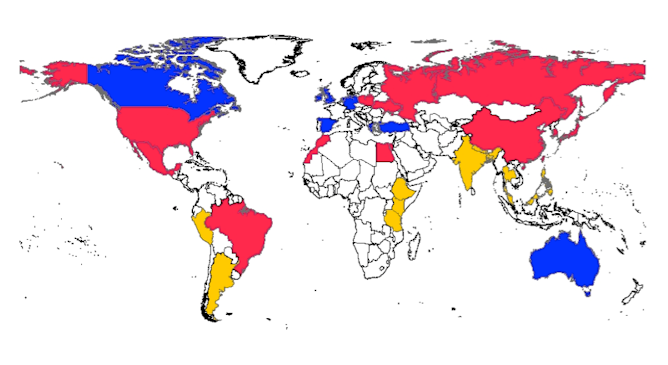
In that work, psychological scales for the assessment of conservatism syndrome were given to people from 33 countries from around the world.

It was reported there are essentially three “psychological continents” in the world today. Liberal countries are those from (mostly Western) Europe, and Australia and Canada. Conservative countries are those from Southeast and South Asia, Africa and South America.

All other countries – including the US, Russia and those from Confucian Asia – are somewhere in the middle.


Psychological atlas of the world for 33 countries. Blue (Liberal); Red (Middle); Yellow (Conservative). Supplied
Conservative countries have a low average IQ
The participants in these studies were also given a short non-verbal test of intelligence. As expected, conservative, below-the-equator countries had the lowest average score.

However, people from the middle range of countries had slightly higher IQ scores than those from the liberal countries. This implies that negative correlation between IQ and conservatism is not as strong as previously reported.

A reason for this finding is the standing of the middle group of countries on IQ tests. For example, East Asian countries that are not very liberal or conservative tend to have high IQ and academic achievement scores.

Another reason may be the use of a non-verbal test of intelligence. Most previous studies were based on verbal IQ tests, which are known to be influenced by the level of education.

This finding at the level of countries has been compared to the correlation at the individual level. Our new ‘in press’ data indicate social conservatism and intelligence do have a negative correlation with each other but only 5%, not 16%, of conservatism can be accounted for by the intelligence test scores.

So, are conservatives less smart?
Yes, slightly less if they are social conservatives.

On the available evidence, the presence of people subscribing to economic liberalism within the ostensibly conservative parties in the US, UK and Australia makes it very unlikely that a substantial correlation – either positive or negative – will be found between political conservatism and intelligence.

Members of the left-wing political parties in these countries are not immune from social conservatism either. So, our politicians have no right to call members of the other party “stupid”.
 
The states with the most diversity don't seem to have fared too well. Shocking.

I propose that when the debate about diversity being our strength is taking place, we show them Tony's chart for perspective.
 
Funny two paragraphs based on the polling aspect of study's someone like Tony would post.

For an inkling of what some social scientists think conservatives believe, parse a 2008 study by the University of Nevada at Reno sociologist Markus Kemmelmeier. To probe the political and social beliefs of nearly 7,000 undergraduates at an elite university, Kemmelmeier devised a set of six questions asking whether abortion, same-sex marriage, and gay sex should be legal, whether handguns and racist/sexist speech on campus should be banned, and whether higher taxes should be imposed on the wealthy. The first three were supposed to measure the students' views of "conservative gender roles," and the second set was supposed to gauge their "anti-regulation" beliefs. Kemmelmeier clearly thought that "liberals" would tend to be OK with legal abortion, same-sex marriage, and gay sex, and would opt to ban handguns and offensive speech and to tax the rich. Conservatives would supposedly hold the opposite views.


Savvy readers may recognize a problem with using these questions to sort people into just two ideological categories. And sure enough, Kemmelmeier got some results that puzzled him. He found that students who held more traditional views on gender and sex roles averaged lower on their verbal SAT and Achievement Test scores. "Surprisingly," he continued, this was not true of students with anti-regulation attitudes. With them, "all else being equal, more conservative respondents scored higher than more liberal respondents." Kemmelmeier ruefully notes that "this result was not anticipated" and "diametrically contradicts" the hypothesis that conservatism is linked to lower cognitive ability. Kemmelmeier is so evidently lost in the intellectual fog of contemporary progressivism that he does not realize that his questionnaire is impeccably designed to identify classical liberals, a.k.a. libertarians, who endorse liberty in both the social and economic realms.
http://reason.com/archives/2014/06/13/are-conservatives-dumber-than-liberals

But hey, no big deal. Just post more huffington post and CNN links. After all, those guys are beacons of truth.
 
http://www.cnn.com/2010/HEALTH/02/26/liberals.atheists.sex.intelligence/

Liberalism, atheism, male sexual exclusivity linked to IQ
By Elizabeth Landau, CNN


(CNN) -- Political, religious and sexual behaviors may be reflections of intelligence, a new study finds.

Evolutionary psychologist Satoshi Kanazawa at the the London School of Economics and Political Science correlated data on these behaviors with IQ from a large national U.S. sample and found that, on average, people who identified as liberal and atheist had higher IQs. This applied also to sexual exclusivity in men, but not in women. The findings will be published in the March 2010 issue of Social Psychology Quarterly.

CNN .... amusing. Is this a satire article. When psychologist Satoshi Kanazawa is not busy apologizing for his black unattractiveness article, he is busy making up nonsense that continually gets him fired for not putting forward factual studies based on real data. BTW Social Psychology Quarterly retracted the article in 2011.
 
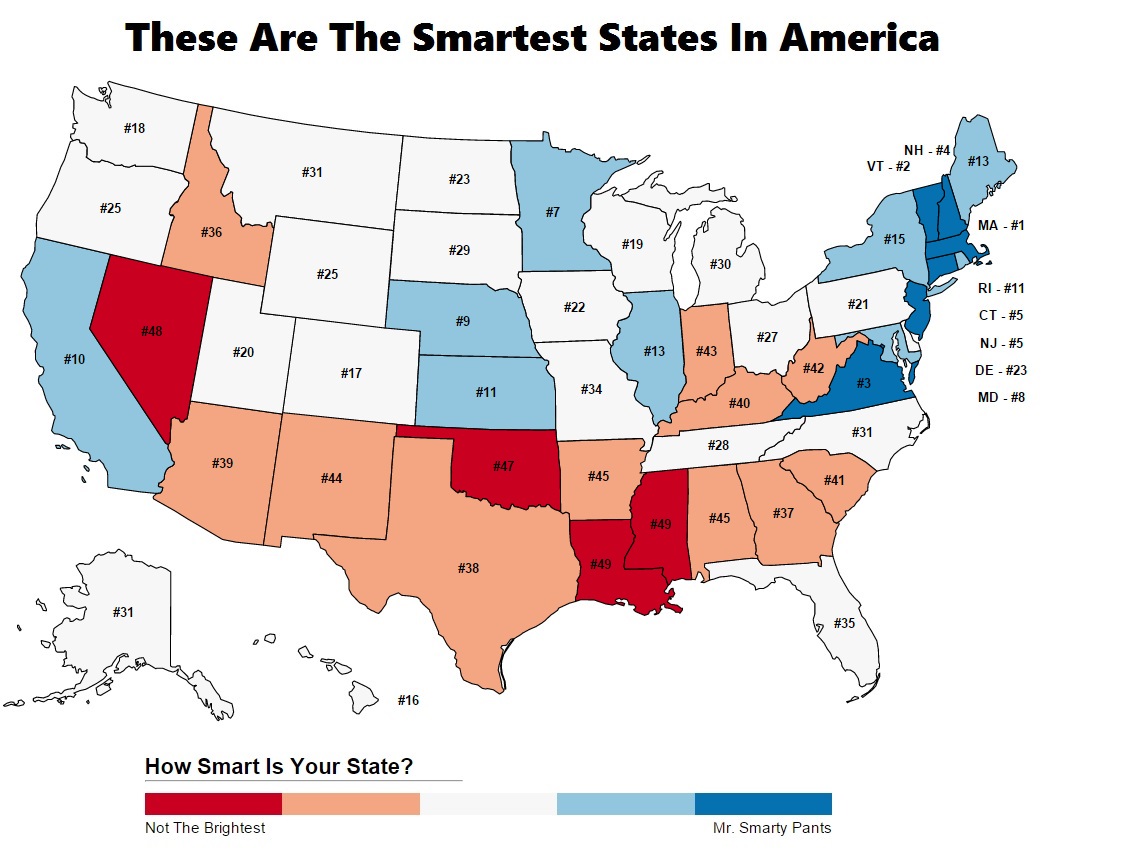
These Are The 10 Smartest States In America
We used data and science to determine the brainiacs around the US.

317cfe6.jpg
by Chris KolmarRankings - 7 months ago


Click to enlarge
One of the many qualities that people look for in a potential location or company is the intelligence of those around them. This factor can play a huge role in one’s experience at a particular company and can make or break an employee’s time there.

So finding a state with an intelligent population makes sense for both companies and employees. That’s where Zippia comes in; to help you identify those places in America that might have skipped a grade…or two.

You may be wondering how does one determine how intelligent a state really is?

Well we went to the source of all things demographic data – the Census – to figure out what criteria about a state would identify it is a smart cookie.

We set upon the percentage of adults (over 25) with at least a college degree and the percentage of current high school dropouts (aged 16-19). We then crunched the numbers and were left with this set of the brightest states America has to offer.

As it turns out, the majority of the smartest Americans have decided that the Northeast is the place to be. Or California, because everyone wants to live in California:

  1. Massachusetts
  2. Vermont
  3. Virginia
  4. New Hampshire
  5. Connecticut
  6. New Jersey
  7. Minnesota
  8. Maryland
  9. Nebraska
  10. California
Read on to see why these states got into a four-year college or skip to the end to see a full chart of all the states.
 
Last edited:
hese Are The 10 Smartest States In America
We used data and science to determine the brainiacs around the US.

317cfe6.jpg
by Chris KolmarRankings - 7 months ago


Click to enlarge
One of the many qualities that people look for in a potential location or company is the intelligence of those around them. This factor can play a huge role in one’s experience at a particular company and can make or break an employee’s time there.

So finding a state with an intelligent population makes sense for both companies and employees. That’s where Zippia comes in; to help you identify those places in America that might have skipped a grade…or two.

You may be wondering how does one determine how intelligent a state really is?

Well we went to the source of all things demographic data – the Census – to figure out what criteria about a state would identify it is a smart cookie.

We set upon the percentage of adults (over 25) with at least a college degree and the percentage of current high school dropouts (aged 16-19). We then crunched the numbers and were left with this set of the brightest states America has to offer.

As it turns out, the majority of the smartest Americans have decided that the Northeast is the place to be. Or California, because everyone wants to live in California:

  1. Massachusetts
  2. Vermont
  3. Virginia
  4. New Hampshire
  5. Connecticut
  6. New Jersey
  7. Minnesota
  8. Maryland
  9. Nebraska
  10. California
Read on to see why these states got into a four-year college or skip to the end to see a full chart of all the states.

I know you're on a googling craze right now, but can you explain why, if states like California, Illinois and New Jersey are so smart, they are in such financial trouble?
 
http://www.foxbusiness.com/features/2012/10/15/americas-best-and-worst-educated-states.html

America’s Best (and Worst) Educated States


Published October 15, 2012 Features 24/7 Wall St. Opens a New Window.

The number of Americans with college degrees has increased steadily in the last decade. According to the latest government data, 28.5% of U.S. residents 25 or older had at least a bachelor’s degree in 2011, up only slightly from 27.2% in 2005. While the number is relatively unchanged, there are substantial differences across the country. In West Virginia, the state with the lowest graduation rate, 18.5% of adults have at least a bachelor’s degree. In Massachusetts, the state with the highest graduation rate, the figure is 39.1%.

This article was originally published by 24/7 Wall St.

Based on education data from the U.S. Census Bureau’s’ American Community Survey, 24/7 Wall St. identified the U.S. states with the largest and smallest percentages of residents 25 or older with a college degree or more.

The difference in median income between those with only a high school diploma and a college degree is dramatic. The median pay for U.S. adults with just a high school diploma was $26,699 in 2011. For those 25 or older with a bachelor’s degree, median annual earnings came to $48,309. Residents with a graduate or professional degree did even better; median annual earnings was $64,322.

Differences in poverty rates related to education are just as dramatic. For U.S. adults with at least bachelor’s degrees, the percentage living in poverty in 2011 was just 4.4%. For adults with only a high school diploma, 14.2% were living below the poverty line.

The effects of wage gap by education becomes clear when comparing the states by graduation rate. Of the 10 states with the largest percentage of college-educated residents, eight are in the top 10 for median income. Among the worst-educated states, eight are among the 10 with the lowest median income.

24/7 Wall St. reviewed the percentage of U.S. residents 25 or older with at least a bachelor’s degree for 2011 from the annual American Community Survey. From that survey, we obtained the percentage of adults that had completed an education at each major level, including high school, graduate and professional schools. We also examined poverty rates and median income for those at different levels of educational attainment.

These are America’s best and worst educated states.

America’s Best-Educated States

10. Minnesota
> Bachelor’s degree or higher: 32.4%
> Median household income: $56,954 (11th highest)
> Pct. below poverty level: 11.9% (11th lowest)

Nearly one in three Minnesota adults aged 25 or older has a bachelor’s degree or higher, the 10th-highest percentage in the country. Minnesota’s educational attainment at the earliest levels is even higher than it is at the college level. Just 4.7% of adults had started — but not completed — high school, compared to the 8.1% of adults who fell into that category nationally. Just 8% of Minnesotans 25 or older do not have a high school diploma, compared to the 14.1% nationwide. However, among states with the most college graduates, Minnesota has fewer adults who go on to the next level of education. Only 10.5% of adults have graduate or professional degrees, the 17th highest nationwide.

9. New York
> Bachelor’s degree or higher: 32.9%
> Median household income: $55,246 (16th highest)
> Pct. below poverty level: 16.0% (21st highest)

More than 14% of New Yorkers have an advanced degree, one of the highest percentages in the U.S. However, while many New Yorkers are highly educated, another large group lacks basic education. Just 85% of New Yorkers have at least a high school diploma, close to 1 percentage point below the national rate. Educational attainment dramatically affects New York residents’ ability to earn a living, where the median annual earnings for someone with only a high school diploma is $28,405, less than half the median earnings of $68,079 for someone with a graduate or professional degree.

8. New Hampshire
> Bachelor’s degree or higher: 33.4%
> Median household income: $62,647 (6th highest)
> Pct. below poverty level: 8.8% (the least)

More New Hampshire adults have at least completed high school than all but five states — 91.4%, compared to the national rate of 85.9%. The benefits for those 33.4% who have at least a bachelor’s degree are quite high. The state poverty rate is 8.8%, which is already the lowest in the country. Meanwhile, just 2.2% of those with at least a bachelor’s degree live below the poverty line, also the lowest rate in the country.

7. Virginia
> Bachelor’s degree or higher: 35.1%
> Median household income: $61,882 (7th highest)
> Pct. below poverty level: 11.5% (tied-8th lowest)

Although Virginia is one of the nation’s most-educated states, with 20.5% of adults with just bachelor’s degrees and another 14.6% with advanced degrees, the state still struggles to graduate many students from high school. According to the Census Bureau, only 87.8% of adult Virginians have high school diplomas — worse than any of the most-educated states, except New York. The median earnings for adults without high school diplomas is just $19,892 a year, compared to the median of $78,532 for residents with advanced degrees.

6. New Jersey
> Bachelor’s degree or higher: 35.3%
> Median household income: $67,458 (3rd highest)
> Pct. below poverty level: 10.4% (3rd lowest)

New Jersey is one of the most well-to-do states in the country, with just 10.4% of residents living below the poverty level, compared to a national rate of 15.9%. It also has the third-highest median household income in the country, at $67,458. Residents with bachelor’s degree also earn more than college graduates of any other state, at $60,107. The national median earnings for bachelor’s degree recipients is $48,309. More than 21% of New Jersey adults without a high school degree were living below the poverty line, compared to the just 3.1% of those with a bachelor’s degree or higher.

5. Vermont
> Bachelor’s degree or higher: 35.4%
> Median household income: $52,776 (19th highest)
> Pct. below poverty level: 11.5% (tied-8th lowest)

In Vermont, 35.4% of adult residents have at least a college degree, with 21.4% of the population holding a bachelor’s and another 14% holding a master’s, doctorate, or professional degree. Median earnings for adults with advanced degrees in Vermont is $50,593 a year — over $13,000 less than the national median. Only 2.8% of residents have less than a ninth grade education, less than half of the 6% nationwide, and another 5.5% finished ninth grade but dropped out of high school, one of the lowest rates in the nation. Among those aged 16 to 19, 97.2% were either in school or had graduated — the third-highest rate in the nation.

4. Connecticut
> Bachelor’s degree or higher: 36.2%
> Median household income: $65,753 (4th highest)
> Pct. below poverty level: 10.9% (5th lowest)

In Connecticut, an estimated 15.7% of the adult population has either a graduate or professional degree, one of the highest percentages in the U.S., behind only Massachusetts and Maryland. The median annual earnings for this group is $75,875, higher than all but a handful of states — twice the median earnings for an adult with only a high school diploma. Residents who don’t earn college also do well; median earnings for the group was $32,869, higher than in any other state.

3. Colorado
> Bachelor’s degree or higher: 36.7%
> Median household income: $55,387 (15th highest)
> Pct. below poverty level: 13.5% (18th lowest)

Colorado residents are among the most-educated people in the country — 23.3% of the adults have completed up to a bachelor’s degrees and another 13.4% have also completed advanced degrees. Colorado’s high school participation and graduation rates below the national average. Only 94.1% of residents aged 16 to 19 are either in high school or have graduated.

2. Maryland
> Bachelor’s degree or higher: 36.9%
> Median household income: $70,004 (the highest)
> Pct. below poverty level: 10.1% (2nd lowest)

In Maryland, 16.5% of the population holds a graduate or professional degree of some kind, behind only Massachusetts. Residents with these degrees are among the highest paid in the country, with median annual earnings of $77,166, behind only New Jersey and Virginia. Only one state — New Hampshire — has a lower poverty rate than Maryland’s 10.1%. This rate is likely driven downwards by the 36.9% of adults who have college degrees, among whom the poverty rate is just 3.2%.

1. Massachusetts
> Bachelor’s degree or higher: 39.1%
> Median household income: $62,859 (5th highest)
> Pct. below poverty level: 11.6% (9th lowest)

In Massachusetts, 39.1% of adults have at least a bachelor’s degree, more than 10 percentage points above the national rate of 28.5%. Additionally, 16.8% of adults have a graduate or professional degree, again the highest percentage in the nation. Although the median annual earnings of $53,765 for those with a bachelor’s degree is very high, adults with either a graduate or a professional degree earn far more. Their median earnings exceed $70,000. Academic success is not limited to adults, as nearly 97% of individuals between the ages of 16 and 19 are either enrolled in high school or have graduated — one of the country’s highest rates.

America’s Worst-Educated States

10. Oklahoma
> Bachelor’s degree or higher: 23.8%
> Median household income: $43,225 (10th lowest)
> Pct. below poverty level: 17.2% (16th highest)

Oklahoma is just one of 15 states in which less than a third of all adults have an associate’s degree or higher. Residents with graduate or professional degrees are also scarce in Oklahoma. Residents who do have an advanced degree in Oklahoma do not earn much — the median earnings for adults with graduate or professional degrees is just $51,631, the fifth-lowest in the nation. Of Oklahoma’s adults with less than a high school degree, 28.5% live below the poverty line, compared to the 4.3% with a bachelor’s degree or higher.

9. Tennessee
> Bachelor’s degree or higher: 23.6%
> Median household income: $41,693 (6th lowest)
> Pct. below poverty level: 18.3% (12th highest)

In Tennessee, the median earnings for an adult with an advanced degree is more than three times higher than that for a high school dropout. Despite the opportunity, just 8.3% of adults have graduate degrees, far below the national rate of 10.6%. Meanwhile 15.8% of adults lack even high school diplomas, well above the 14.1% for the U.S. overall. Residents with only a high school education are far more likely to live in poverty. Of residents with a high school education, 30.6% live in poverty, whereas only 3.8 of those who have at least bachelor’s degree live in poverty. One area in which Tennessee is especially strong: 96.4% of people aged 16 to 19 are either in high school or have their diploma, one of the higher rates in the U.S.

8. Indiana
> Bachelor’s degree or higher: 23.0%
> Median household income: $46,438 (20th lowest)
> Pct. below poverty level: 16.0% (21st highest)

By one measure, Indiana does well providing its residents with an education — the percentage of adults who graduated high school, at 87.3%, exceeds the national rate of 85.9%. For many, however, education ends after high school. Only 30.9% of adults have at least an associate’s degree, while only 23% have at least a bachelor’s degree, both among the lowest rates in the U.S. Additionally, just 94% of current residents between 16 and 19 are either in high school or have graduated, a low compared to the national rate of 95.1%.

7. Nevada
> Bachelor’s degree or higher: 22.5%
> Median household income: $48,927 (24th lowest)
> Pct. below poverty level: 15.9% (23rd highest)

In Nevada, only 29.7% of adults have at least an associate’s degree, while the percentage of adults with a bachelor’s degree is just 22.5%. Both of these figures are among the nation’s worst. Within the state, 6% of adults with bachelor’s degrees still live below the poverty line, one of the worst rates in the country. Having a bachelor’s degree is not as much of an advantage in Nevada as it is in other parts of the country. Median earning for adults with less than a high school degree is well more than the national median. At the same time, those with at least a bachelor’s degree earn less than the median college graduate nationwide.

6. Alabama
> Bachelor’s degree or higher: 22.3%
> Median household income: $41,415 (5th lowest)
> Pct. below poverty level: 19.0% (7th highest)

Alabama has one of the nation’s worst high school attainment rates. Among adults 25 and older, 17.3% do not have high school diploma, the fifth-worst percentage in the U.S. For those aged 16 to 19, just 93.7% were either still in high school or had graduated, among the lowest rates in the nation. Only 22.3% of adults have at least a bachelor’s degree in Alabama. More than one in four Nevada adults have some college education, but have not completed a degree, compared to the 21.2% nationwide.

5. Louisiana
> Bachelor’s degree or higher: 21.1%
> Median household income: $41,734 (7th lowest)
> Pct. below poverty level: 20.4% (3rd highest)

Only 82.5% of adults in Louisiana have high school diplomas, one of the lowest percentages in the country. College education in the state is also low. Just 26.3% of adults have associate degrees or higher and only 21.1% have bachelor’s degrees or higher. Both these rates are well below national averages. Graduate and professional degrees are also low. Only 7.1% of adults have a graduate or professional degree, one of the lowest numbers in the country.

4. Kentucky
> Bachelor’s degree or higher: 21.1%
> Median household income: $41,141 (4th lowest)
> Pct. below poverty level: 19.1% (5th highest)

Kentucky residents are among the least likely to have a bachelor’s degree or high school diploma. Only 83.1% of adults have a high school education, and 7% of adults have not completed the ninth grade — both among the worst rates in the U.S. Residents without a high school education often struggle to earn a living — 32.1% live in poverty — more than twice the 15.5% poverty rate for adults who have finished high school. Despite the state’s many problems, Kentucky residents aged 16 to 19 are more likely to be either in school or to have graduated high school than their peers nationwide, at 95.7% versus 95.1% across the U.S.

3. Arkansas
> Bachelor’s degree or higher: 20.3%
> Median household income: $38,758 (3rd lowest)
> Pct. below poverty level: 19.5% (4th highest)

Not only is Arkansas among the 10 worst states in the nation for high school graduation rates, at 83.8%, but it also has the second-smallest proportion of adults with at least an associate’s degree, at just 26.1%. The poverty rate for adults with less than a high school education is seven times higher than for those with a bachelor’s degree or more.

2. Mississippi
> Bachelor’s degree or higher: 19.8%
> Median household income: $36,919 (the lowest)
> Pct. below poverty level: 22.6% (the highest)

Just 81.1% of adults in Mississippi are high school graduates, tied with Texas and California for the lowest percentage in the nation. Additionally, 6.6% of adults have not completed the ninth grade — especially troubling in a state with a poverty rate of 32.5% for those without a high school diploma. Although the median earnings for an adult with no education past high school is just $24,060 — one of the lowest figures in the nation — more than 80% of adults do not have a bachelor’s degree, while more than 70% have not completed an associate’s degree.

1. West Virginia
> Bachelor’s degree or higher: 18.5%
> Median household income: $38,482 (2nd lowest)
> Pct. below poverty level: 18.6% (10th highest)

Just 18.5% of West Virginians have at least a bachelor’s degree — 10 percentage points lower than the national rate of 28.5% and considerably lower than the next-lowest state, Mississippi. West Virginia is also the only state in the nation where less than 7% of adults have a graduate or professional degree. West Virginia adults are the least likely in the nation to have at least an associate’s degree, at 24.9%, compared to 36.3% nationwide. Median earnings for adults with an advanced degree in West Virginia is $52,308 — more than $12,000 below the national median.

 
LOL, Tony this is pretty Juvenile, if anything, i would be highly suspect of the capability of anyone who spends their entire life getting university degrees as opposed to applying their knowledge in the real world.

On top of that, how many conservatives do you think stick around at places like UC berkley where liberals are literally physically assaulting them en masse for expressing their political opinion.

On top of that people who get degrees end up in biug cities, they dont stay around rural areas where there isnt much industry.

Ive personally met alot of very rich traders(way richer than me) who dropped out of school to pursure trading, I know 2 people who are mid 7 figure traders who dropped out of med school, both very smart, and very conservative, yet I still have yet to meet someoneone who stuck around to get 12 different degrees that dont mean shit in the real world.

In hindsight i wish i had discovered trading earlier instead of going to university, while all my friends/business contacts were making themselves millionaires in the 2008 market, I was stuck making half as much doing the exact same thing cause i didnt have enough trading capital to crush a once in a lifetime market.

http://www.foxbusiness.com/features/2012/10/15/americas-best-and-worst-educated-states.html

America’s Best (and Worst) Educated States


Published October 15, 2012 Features 24/7 Wall St. Opens a New Window.

The number of Americans with college degrees has increased steadily in the last decade. According to the latest government data, 28.5% of U.S. residents 25 or older had at least a bachelor’s degree in 2011, up only slightly from 27.2% in 2005. While the number is relatively unchanged, there are substantial differences across the country. In West Virginia, the state with the lowest graduation rate, 18.5% of adults have at least a bachelor’s degree. In Massachusetts, the state with the highest graduation rate, the figure is 39.1%.

This article was originally published by 24/7 Wall St.

Based on education data from the U.S. Census Bureau’s’ American Community Survey, 24/7 Wall St. identified the U.S. states with the largest and smallest percentages of residents 25 or older with a college degree or more.

The difference in median income between those with only a high school diploma and a college degree is dramatic. The median pay for U.S. adults with just a high school diploma was $26,699 in 2011. For those 25 or older with a bachelor’s degree, median annual earnings came to $48,309. Residents with a graduate or professional degree did even better; median annual earnings was $64,322.

Differences in poverty rates related to education are just as dramatic. For U.S. adults with at least bachelor’s degrees, the percentage living in poverty in 2011 was just 4.4%. For adults with only a high school diploma, 14.2% were living below the poverty line.

The effects of wage gap by education becomes clear when comparing the states by graduation rate. Of the 10 states with the largest percentage of college-educated residents, eight are in the top 10 for median income. Among the worst-educated states, eight are among the 10 with the lowest median income.

24/7 Wall St. reviewed the percentage of U.S. residents 25 or older with at least a bachelor’s degree for 2011 from the annual American Community Survey. From that survey, we obtained the percentage of adults that had completed an education at each major level, including high school, graduate and professional schools. We also examined poverty rates and median income for those at different levels of educational attainment.

These are America’s best and worst educated states.

America’s Best-Educated States

10. Minnesota
> Bachelor’s degree or higher: 32.4%
> Median household income: $56,954 (11th highest)
> Pct. below poverty level: 11.9% (11th lowest)

Nearly one in three Minnesota adults aged 25 or older has a bachelor’s degree or higher, the 10th-highest percentage in the country. Minnesota’s educational attainment at the earliest levels is even higher than it is at the college level. Just 4.7% of adults had started — but not completed — high school, compared to the 8.1% of adults who fell into that category nationally. Just 8% of Minnesotans 25 or older do not have a high school diploma, compared to the 14.1% nationwide. However, among states with the most college graduates, Minnesota has fewer adults who go on to the next level of education. Only 10.5% of adults have graduate or professional degrees, the 17th highest nationwide.

9. New York
> Bachelor’s degree or higher: 32.9%
> Median household income: $55,246 (16th highest)
> Pct. below poverty level: 16.0% (21st highest)

More than 14% of New Yorkers have an advanced degree, one of the highest percentages in the U.S. However, while many New Yorkers are highly educated, another large group lacks basic education. Just 85% of New Yorkers have at least a high school diploma, close to 1 percentage point below the national rate. Educational attainment dramatically affects New York residents’ ability to earn a living, where the median annual earnings for someone with only a high school diploma is $28,405, less than half the median earnings of $68,079 for someone with a graduate or professional degree.

8. New Hampshire
> Bachelor’s degree or higher: 33.4%
> Median household income: $62,647 (6th highest)
> Pct. below poverty level: 8.8% (the least)

More New Hampshire adults have at least completed high school than all but five states — 91.4%, compared to the national rate of 85.9%. The benefits for those 33.4% who have at least a bachelor’s degree are quite high. The state poverty rate is 8.8%, which is already the lowest in the country. Meanwhile, just 2.2% of those with at least a bachelor’s degree live below the poverty line, also the lowest rate in the country.

7. Virginia
> Bachelor’s degree or higher: 35.1%
> Median household income: $61,882 (7th highest)
> Pct. below poverty level: 11.5% (tied-8th lowest)

Although Virginia is one of the nation’s most-educated states, with 20.5% of adults with just bachelor’s degrees and another 14.6% with advanced degrees, the state still struggles to graduate many students from high school. According to the Census Bureau, only 87.8% of adult Virginians have high school diplomas — worse than any of the most-educated states, except New York. The median earnings for adults without high school diplomas is just $19,892 a year, compared to the median of $78,532 for residents with advanced degrees.

6. New Jersey
> Bachelor’s degree or higher: 35.3%
> Median household income: $67,458 (3rd highest)
> Pct. below poverty level: 10.4% (3rd lowest)

New Jersey is one of the most well-to-do states in the country, with just 10.4% of residents living below the poverty level, compared to a national rate of 15.9%. It also has the third-highest median household income in the country, at $67,458. Residents with bachelor’s degree also earn more than college graduates of any other state, at $60,107. The national median earnings for bachelor’s degree recipients is $48,309. More than 21% of New Jersey adults without a high school degree were living below the poverty line, compared to the just 3.1% of those with a bachelor’s degree or higher.

5. Vermont
> Bachelor’s degree or higher: 35.4%
> Median household income: $52,776 (19th highest)
> Pct. below poverty level: 11.5% (tied-8th lowest)

In Vermont, 35.4% of adult residents have at least a college degree, with 21.4% of the population holding a bachelor’s and another 14% holding a master’s, doctorate, or professional degree. Median earnings for adults with advanced degrees in Vermont is $50,593 a year — over $13,000 less than the national median. Only 2.8% of residents have less than a ninth grade education, less than half of the 6% nationwide, and another 5.5% finished ninth grade but dropped out of high school, one of the lowest rates in the nation. Among those aged 16 to 19, 97.2% were either in school or had graduated — the third-highest rate in the nation.

4. Connecticut
> Bachelor’s degree or higher: 36.2%
> Median household income: $65,753 (4th highest)
> Pct. below poverty level: 10.9% (5th lowest)

In Connecticut, an estimated 15.7% of the adult population has either a graduate or professional degree, one of the highest percentages in the U.S., behind only Massachusetts and Maryland. The median annual earnings for this group is $75,875, higher than all but a handful of states — twice the median earnings for an adult with only a high school diploma. Residents who don’t earn college also do well; median earnings for the group was $32,869, higher than in any other state.

3. Colorado
> Bachelor’s degree or higher: 36.7%
> Median household income: $55,387 (15th highest)
> Pct. below poverty level: 13.5% (18th lowest)

Colorado residents are among the most-educated people in the country — 23.3% of the adults have completed up to a bachelor’s degrees and another 13.4% have also completed advanced degrees. Colorado’s high school participation and graduation rates below the national average. Only 94.1% of residents aged 16 to 19 are either in high school or have graduated.

2. Maryland
> Bachelor’s degree or higher: 36.9%
> Median household income: $70,004 (the highest)
> Pct. below poverty level: 10.1% (2nd lowest)

In Maryland, 16.5% of the population holds a graduate or professional degree of some kind, behind only Massachusetts. Residents with these degrees are among the highest paid in the country, with median annual earnings of $77,166, behind only New Jersey and Virginia. Only one state — New Hampshire — has a lower poverty rate than Maryland’s 10.1%. This rate is likely driven downwards by the 36.9% of adults who have college degrees, among whom the poverty rate is just 3.2%.

1. Massachusetts
> Bachelor’s degree or higher: 39.1%
> Median household income: $62,859 (5th highest)
> Pct. below poverty level: 11.6% (9th lowest)

In Massachusetts, 39.1% of adults have at least a bachelor’s degree, more than 10 percentage points above the national rate of 28.5%. Additionally, 16.8% of adults have a graduate or professional degree, again the highest percentage in the nation. Although the median annual earnings of $53,765 for those with a bachelor’s degree is very high, adults with either a graduate or a professional degree earn far more. Their median earnings exceed $70,000. Academic success is not limited to adults, as nearly 97% of individuals between the ages of 16 and 19 are either enrolled in high school or have graduated — one of the country’s highest rates.

America’s Worst-Educated States

10. Oklahoma
> Bachelor’s degree or higher: 23.8%
> Median household income: $43,225 (10th lowest)
> Pct. below poverty level: 17.2% (16th highest)

Oklahoma is just one of 15 states in which less than a third of all adults have an associate’s degree or higher. Residents with graduate or professional degrees are also scarce in Oklahoma. Residents who do have an advanced degree in Oklahoma do not earn much — the median earnings for adults with graduate or professional degrees is just $51,631, the fifth-lowest in the nation. Of Oklahoma’s adults with less than a high school degree, 28.5% live below the poverty line, compared to the 4.3% with a bachelor’s degree or higher.

9. Tennessee
> Bachelor’s degree or higher: 23.6%
> Median household income: $41,693 (6th lowest)
> Pct. below poverty level: 18.3% (12th highest)

In Tennessee, the median earnings for an adult with an advanced degree is more than three times higher than that for a high school dropout. Despite the opportunity, just 8.3% of adults have graduate degrees, far below the national rate of 10.6%. Meanwhile 15.8% of adults lack even high school diplomas, well above the 14.1% for the U.S. overall. Residents with only a high school education are far more likely to live in poverty. Of residents with a high school education, 30.6% live in poverty, whereas only 3.8 of those who have at least bachelor’s degree live in poverty. One area in which Tennessee is especially strong: 96.4% of people aged 16 to 19 are either in high school or have their diploma, one of the higher rates in the U.S.

8. Indiana
> Bachelor’s degree or higher: 23.0%
> Median household income: $46,438 (20th lowest)
> Pct. below poverty level: 16.0% (21st highest)

By one measure, Indiana does well providing its residents with an education — the percentage of adults who graduated high school, at 87.3%, exceeds the national rate of 85.9%. For many, however, education ends after high school. Only 30.9% of adults have at least an associate’s degree, while only 23% have at least a bachelor’s degree, both among the lowest rates in the U.S. Additionally, just 94% of current residents between 16 and 19 are either in high school or have graduated, a low compared to the national rate of 95.1%.

7. Nevada
> Bachelor’s degree or higher: 22.5%
> Median household income: $48,927 (24th lowest)
> Pct. below poverty level: 15.9% (23rd highest)

In Nevada, only 29.7% of adults have at least an associate’s degree, while the percentage of adults with a bachelor’s degree is just 22.5%. Both of these figures are among the nation’s worst. Within the state, 6% of adults with bachelor’s degrees still live below the poverty line, one of the worst rates in the country. Having a bachelor’s degree is not as much of an advantage in Nevada as it is in other parts of the country. Median earning for adults with less than a high school degree is well more than the national median. At the same time, those with at least a bachelor’s degree earn less than the median college graduate nationwide.

6. Alabama
> Bachelor’s degree or higher: 22.3%
> Median household income: $41,415 (5th lowest)
> Pct. below poverty level: 19.0% (7th highest)

Alabama has one of the nation’s worst high school attainment rates. Among adults 25 and older, 17.3% do not have high school diploma, the fifth-worst percentage in the U.S. For those aged 16 to 19, just 93.7% were either still in high school or had graduated, among the lowest rates in the nation. Only 22.3% of adults have at least a bachelor’s degree in Alabama. More than one in four Nevada adults have some college education, but have not completed a degree, compared to the 21.2% nationwide.

5. Louisiana
> Bachelor’s degree or higher: 21.1%
> Median household income: $41,734 (7th lowest)
> Pct. below poverty level: 20.4% (3rd highest)

Only 82.5% of adults in Louisiana have high school diplomas, one of the lowest percentages in the country. College education in the state is also low. Just 26.3% of adults have associate degrees or higher and only 21.1% have bachelor’s degrees or higher. Both these rates are well below national averages. Graduate and professional degrees are also low. Only 7.1% of adults have a graduate or professional degree, one of the lowest numbers in the country.

4. Kentucky
> Bachelor’s degree or higher: 21.1%
> Median household income: $41,141 (4th lowest)
> Pct. below poverty level: 19.1% (5th highest)

Kentucky residents are among the least likely to have a bachelor’s degree or high school diploma. Only 83.1% of adults have a high school education, and 7% of adults have not completed the ninth grade — both among the worst rates in the U.S. Residents without a high school education often struggle to earn a living — 32.1% live in poverty — more than twice the 15.5% poverty rate for adults who have finished high school. Despite the state’s many problems, Kentucky residents aged 16 to 19 are more likely to be either in school or to have graduated high school than their peers nationwide, at 95.7% versus 95.1% across the U.S.

3. Arkansas
> Bachelor’s degree or higher: 20.3%
> Median household income: $38,758 (3rd lowest)
> Pct. below poverty level: 19.5% (4th highest)

Not only is Arkansas among the 10 worst states in the nation for high school graduation rates, at 83.8%, but it also has the second-smallest proportion of adults with at least an associate’s degree, at just 26.1%. The poverty rate for adults with less than a high school education is seven times higher than for those with a bachelor’s degree or more.

2. Mississippi
> Bachelor’s degree or higher: 19.8%
> Median household income: $36,919 (the lowest)
> Pct. below poverty level: 22.6% (the highest)

Just 81.1% of adults in Mississippi are high school graduates, tied with Texas and California for the lowest percentage in the nation. Additionally, 6.6% of adults have not completed the ninth grade — especially troubling in a state with a poverty rate of 32.5% for those without a high school diploma. Although the median earnings for an adult with no education past high school is just $24,060 — one of the lowest figures in the nation — more than 80% of adults do not have a bachelor’s degree, while more than 70% have not completed an associate’s degree.

1. West Virginia
> Bachelor’s degree or higher: 18.5%
> Median household income: $38,482 (2nd lowest)
> Pct. below poverty level: 18.6% (10th highest)

Just 18.5% of West Virginians have at least a bachelor’s degree — 10 percentage points lower than the national rate of 28.5% and considerably lower than the next-lowest state, Mississippi. West Virginia is also the only state in the nation where less than 7% of adults have a graduate or professional degree. West Virginia adults are the least likely in the nation to have at least an associate’s degree, at 24.9%, compared to 36.3% nationwide. Median earnings for adults with an advanced degree in West Virginia is $52,308 — more than $12,000 below the national median.
 
Last edited:
Back
Top