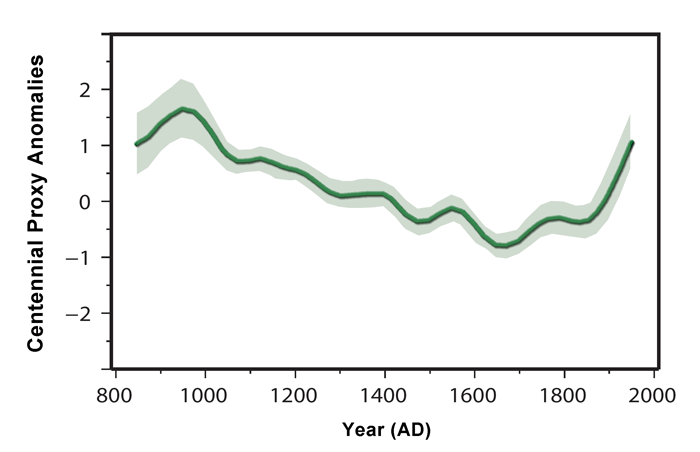
These graphs were publicised to explain the scientific findings ofclimatology, and in addition to scientific debate over the reconstructions, they have been the topic of political dispute. The issue is part of the global warming controversy and has been one focus of political responses to reports by the Intergovernmental Panel on Climate Change (IPCC). Arguments over the reconstructions have been taken up by fossil fuel industry funded lobbying groups attempting to cast doubt on climate science.[1]
A 2010 opinion piece by David Frank, Jan Esper, Eduardo Zorita and Rob Wilson (Frank et al. 2010) noted that by then over two dozen large-scale climate reconstructions had been published, showing a broad consensus that there had been exceptional 20th century warming after earlier climatic phases, notably the Medieval Warm Period and Little Ice Age. There were still issues of large-scale natural variability to be resolved, especially for the lowest frequency variations, and they called for further research to improve expert assessment of proxies and to develop reconstruction methods explicitly allowing for structural uncertainties in the process.[13]
New studies using different methods continued to extend the period covered by reconstructions, and agreed well with Mann et al. 2008, as in the Ljungqvist 2010 2,000 year extratropical Northern Hemisphere reconstruction. Studies by Christiansen and Ljungqvist investigated previous underestimation of low-frequency variability, and reaffirmed Mann et al.'s conclusions about the Little Ice Age and the Medieval Warm Period.[213] as did Ljungqvist et al. 2012 which used a larger network of proxies than previous studies. The hockey stick graph was further extended and confirmed by Marcott et al. 2013 which used seafloor and lake bed sediment proxies to reconstruct global temperatures over the past 11,300 years.[214]
http://en.wikipedia.org/wiki/Hockey_stick_controversy
A 2010 opinion piece by David Frank, Jan Esper, Eduardo Zorita and Rob Wilson (Frank et al. 2010) noted that by then over two dozen large-scale climate reconstructions had been published, showing a broad consensus that there had been exceptional 20th century warming after earlier climatic phases, notably the Medieval Warm Period and Little Ice Age. There were still issues of large-scale natural variability to be resolved, especially for the lowest frequency variations, and they called for further research to improve expert assessment of proxies and to develop reconstruction methods explicitly allowing for structural uncertainties in the process.[13]
New studies using different methods continued to extend the period covered by reconstructions, and agreed well with Mann et al. 2008, as in the Ljungqvist 2010 2,000 year extratropical Northern Hemisphere reconstruction. Studies by Christiansen and Ljungqvist investigated previous underestimation of low-frequency variability, and reaffirmed Mann et al.'s conclusions about the Little Ice Age and the Medieval Warm Period.[213] as did Ljungqvist et al. 2012 which used a larger network of proxies than previous studies. The hockey stick graph was further extended and confirmed by Marcott et al. 2013 which used seafloor and lake bed sediment proxies to reconstruct global temperatures over the past 11,300 years.[214]
http://en.wikipedia.org/wiki/Hockey_stick_controversy