
You are using an out of date browser. It may not display this or other websites correctly.
You should upgrade or use an alternative browser.
You should upgrade or use an alternative browser.
A message to some day traders.
- Thread starter Amahrix
- Start date
then why the book
you admitted being a fool ....
if you were not fooled then you admit you are writing about something you know nothing about
Are you talking about this post?
From: https://www.priceactionlab.com/Blog/2015/09/jim-simons-trend-following-broken/
(Michael Harris, the author, is very nice and generous about the subject; I am not).
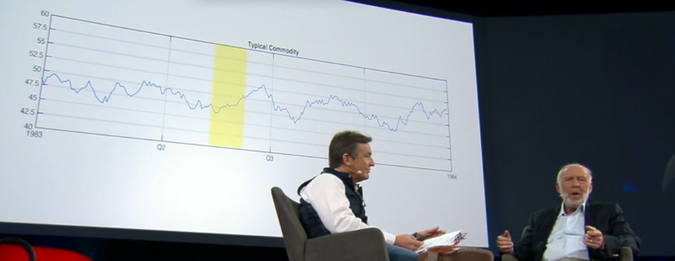
Jim Simons has expressed his views about trend-following during a TED interview.
Revised February 21, 2019.
During a Ted interview, Jim Simons showed a commodity chart and talked about how in the past traders were able to use 20 days of prices (and their average) as a predictor of future prices (about 13:00 minutes from start).
Jim Simons called that trend-following and argued that it no longer works. But some academic papers base the efficacy of trend-following on t-statistics derived from long-term data series and very slow moving averages .
In my book, Fooled by Technical Analysis, I discuss the perils of using the t-statistic and hypothesis testing in trading system development. Using a t-statistic is really a rudimentary mistake. If you have 100 years of data, even a horrible Sharpe ratio in the order of 0.30 will generate a high t-statistic, as follows
t-statistic = Sharpe ratio × SQRT(number of years)
For Sharpe ratio of 0.30 in the course of 100 years, the t-statistic is 3.00. Does this mean that a trading system is significant? What about if the drawdown is -50%? Do fund managers like a -50% drawdown? Some close shop after a -10% drawdown.
Thus, the first problem is that long-term backtests can be misleading. Especially problematic are backtests on a basket of commodities because of hindsight bias.
Then, another problem is that when one tests many choices of parameters, data-mining bias is introduced due to multiple comparisons. Actually, the whole procedure usually followed is based on multiple comparisons of different moving average crossover values and testing periods. In this case, the t-statistic must be adjusted and significance is lost, as Harvey and Liu showed in their paper.
More importantly…
The argument is not whether someone today can or cannot find a trend-following system that will work. This is possible and such systems may exist. The argument is about changing market conditions that render short-term trend following unprofitable.
I did not test a basket of commodities because that can introduce a lot of hindsight bias. The more instruments there are, the higher the bias. I just used the most popular index, the S&P 500, to show that Jim Simons is right and fast trend-following stopped working in the early 1990s. This is also confirmed by my Momersion indicator.
Longer-term trend-following appears to work only for those that underestimate risks. Below is the performance of a 50-200 moving average crossover in SPY since inception:
The maximum drawdown is -35%. This system has a t-statistic of about 2.06, which is borderline significant depending on assumptions. The question is:
Would anyone trust life savings or client funds on this system or on a similar system? I would not. I think Jim Simons would not either and this is why he claimed that trend-following is broken.


It clearly says in the post, at the top: FROM https://www.priceactionlab.com/Blog/2015/09/jim-simons-trend-following-broken/
so you can see the trend being broken
you would have got fooled not me
i am going to post in my journal all such trades
you would have got fooled not me
i am going to post in my journal all such trades
so what i am doing is impossible
see me do that in my journal
https://www.elitetrader.com/et/threads/not-fooled-by-random-market-and-by-technical-analysis.336198/
see me do that in my journal
https://www.elitetrader.com/et/threads/not-fooled-by-random-market-and-by-technical-analysis.336198/
so what i am doing is impossible
see me do that in my journal
https://www.elitetrader.com/et/threads/not-fooled-by-random-market-and-by-technical-analysis.336198/
Padutrader, I feel kinda bad going back and forth with you bro. I think you need to relax.
I believe you take your knowledge a little too seriously, nevertheless, good luck!
i make moneyPadutrader, I feel kinda bad going back and forth with you bro. I think you need to relax.
I believe you take your knowledge a little too seriously, nevertheless, good luck!
are you going to make money selling your book?
\
What book? I'm so confused what the f*ck you're talking about. I don't have a book! What the heck are you saying? Are you delusional? (Serious question)i make money
are you going to make money selling your book?
\
When did I say you did not make money?i make money
@padutrader Stop engaging in a conversation with me. You clearly read nothing I say. You take yourself way too seriously. You strawman me every post. You are highly emotional. You need to take a step back and f*cking relax. You're a grown guy, I just realized. I don't like talking like this to grown men like you. Please stop. I don't want to continue. I kinda feel bad bro, but you make it too hard.
Nothing personal bro. No ill will. All the best and good luck. No more engaging with me, for the best. Make your point or whatever but this back and forth is getting us nowhere. It's filled 10 pages so far and the only beneficiaries are the people witnessing this sh*tshow whilst munching on popcorn.
Nothing personal bro. No ill will. All the best and good luck. No more engaging with me, for the best. Make your point or whatever but this back and forth is getting us nowhere. It's filled 10 pages so far and the only beneficiaries are the people witnessing this sh*tshow whilst munching on popcorn.
this book WHO THE FU*K IS DELUSIONALWhat book? I'm so confused what the f*ck you're talking about. I don't have a book! What the heck are you saying? Are you delusional? (Serious question)
In my book, Fooled by Technical Analysis, I discuss the perils of using the t-statistic and hypothesis testing in trading system development. Using a t-statistic is really a rudimentary mistake. If you have 100 years of data, even a horrible Sharpe ratio in the order of 0.30 will generate a high t-statistic, as follows
I REST MY CASE