China is building a massive solar power plant in space to power a death-ray that will be able to eliminate any target on Earth with gigawatts of focused microwave energy.
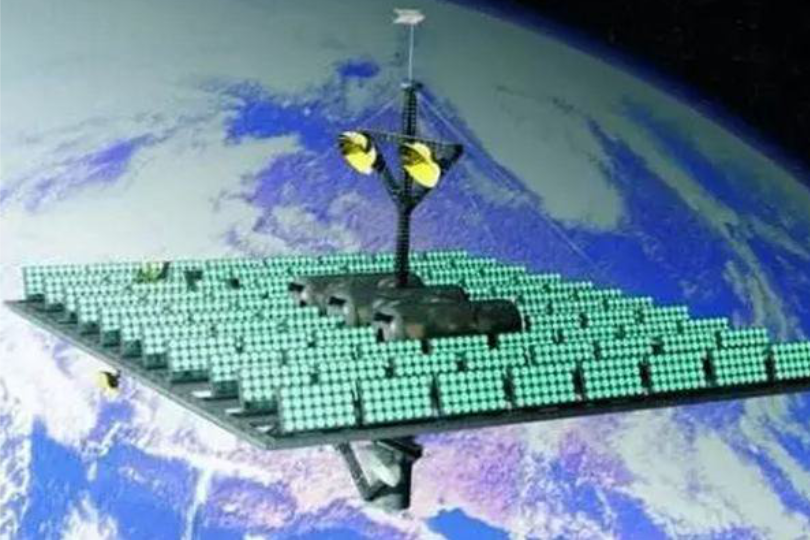
Artist's conception of the Solar Power Array system China envisions as being part of the Space Solar Power System (SPSS). It will provide up to 2 gigawatts of concentrated microwave power Beijing can use either to power its nation or destroy its enemies. Image:
People's Daily, China -- State-Run National Media
The race to rule Earth with space-based weapons has been underway for decades and will soon reach the point of no-return.
Tyrannical governments and megalomaniacs have been dreaming of putting weapons into space not long after the first real rocket was launched in the 1800s. The Nazis had detailed plans to colonize Earth's moon and Mars in the 1930s. Russia made plans to weaponize space before the launch of Sputnik. Starting in the 1970s with Ronald Reagan's Star Wars program, the U.S. started putting advanced energy weapons into space.
China's Space Solar Power Station (SSPS) is a massive space-based power generation system that converts the energy of the sun into microwave energy that can be beamed to satellites or to Earth. The microwave energy that the platform will emit will ultimately be in the gigawatt range.
Microwave energy is dangerous to all living things.
Even at milliwatt levels used by cell phones it irreversibly damages DNA, heats tissue and disrupts cellular function. At slightly higher levels it can cause cancer within a few years, sometimes quicker. At kilowatt levels it quickly cooks tissue, just like in a microwave oven.
At higher
frequencies and low wattage it can cause extreme pain, such as those used by the U.S. military's
Active Denial pain rays used to break up protests.
At the frequencies commonly used for communications, microwaves can easily be used for mind control as a carrier wave for lower frequencies matching those generated by the human brain.
All that is about to be a reality soon, controlled solely by the People's Republic of China, and with no realistic defense available to stop it.
A Brief History of the Space Solar Power Station
As with many important innovations made since the mid-20th century, this one began in the United States, only to see it mostly ignored and now completely overtaken by the Chinese.
In the 1960s, long before solar power was the relatively inexpensive and reliable technology we know today, science fiction writers were already intrigued by arranging some means of accessing the virtually limitless power source of the sun, for use as an alternative to conventional power supply means on the planet.
Scientists soon picked up the idea to reshape it into more practical form. Leading the charge for this technology was Peter Edward Glaser, an aerospace engineer who was at the time better known as project manager for the Apollo 11 Laser Ranging Retroreflector Array. While thinking about that innovation and what being in space might make possible, he proposed an idea for gathering solar energy in outer space, where there were no clouds or atmosphere to absorb any of the energy, convert it into electrical power and then beam that energy back to Earth.
He documented the innovation first in an article published on November 22,1968, in the journal
Science.
Five years later he was granted U.S. patent #US3781647A covering his idea, under the title “
Method and Apparatus for Converting Solar Radiation to Electrical Power”. The patent was awarded on December 25, 1973.
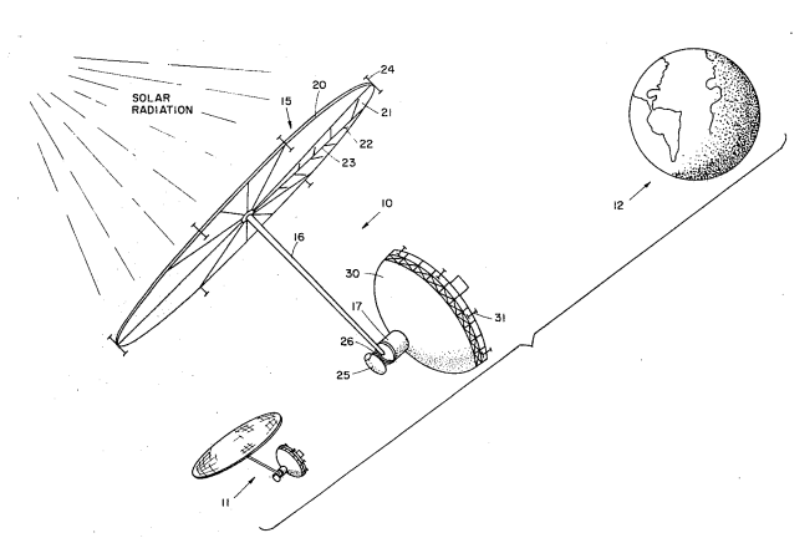
Main concept drawing for Peter Glaser's Space Solar Energy gathering system, and the microwave electrical relays to send that power to the Earth. Though the invention was documented 50 years ago, it is only now becoming reality. Image: U.S. Patent Office/Public Domain
The patent included many of the ideas now being put into practice in the Chinese system currently under development. As the abstract of the patent discloses, “By the method and apparatus of this invention, the radiation energy derived from the sun is converted to microwave energy in equipment maintained in outer space, then it is transmitted as microwave energy to suitable collectors on earth.”
The patent goes on to provide considerable detail on the design considerations and requirements for virtually every part of the system current under development by China today, both in space and at their ground-based Bishan facility. In the patent, Glaser even anticipated the value of using supercooling technologies available at relatively low cost in space to manage the intense electrical power production available in space while easily dissipating heat away from the collectors, cables, and even microwave transmission systems.
Almost forty years later, in 2012 John C. Mankins, another former NASA engineer, proposed the first practical implantation of Glaser’s idea in more detailed form. He called it the Solar Power Satellite via Arbitrarily Large Phased Array project, or SPS-ALPHA as the acronym for the project. After further planning, this project, which became known as the Space Solar Power Initiative (SSPI), was greenlit for Northrup Grumman to develop further. The work began in 2015, had a budget of $17.5 million, and ran three years.
The U.S. has done little since then in terms of converting all that research into any practical reality.
In contrast, Chinese researchers moved quickly soon after Mankins’ proposal came to light and began on a ten-year sprint to make it a reality.
In 2013, Duan Baoyan, a then 57-year-old antenna expert and researcher at Xidian University, an engineering school located in Xian, Shaanxi, and specializing in optical engineering, materials science, and electronic devices, proposed the basic idea behind their approach to a Space Solar Power Station.
Although the details were not disclosed in detail at the time, there were two important differences between Duan’s project and the one the United States had been pursuing.
One was scientific in nature. It was built upon the People’s Republic of China’s having already taken a global majority market share and technology leadership position in the field of solar collecting and solar panel engineering. It is a market the United States “owned” when first developed, but which the Chinese captured for themselves long ago after American corporations ignored its promise.
That innovation was called OMEGA, an acronym for “Orb-shape Membrane Energy Gathering Array”, an innovation developed by researchers at Xidian University using what they referred to as “arbitrary axisymmetric ‘spherical-line focusing’ to provide more focused energy gathering while avoiding the precision alignment requirements of other approaches. Those other approaches, though not named explicitly, included Mankin’s SPS-ALPHA approach.
“Compared with [Mankin’s SPS-ALPHA approach],” Duan said about what his team was proposing, “OMEGA's power-generating efficiency […is...] about 24 percent [higher], and it is easily controlled and has a better heat dissipation.”
The second difference between this and the United States attempts to develop its own Space Solar Power Project was more fundamental. The U.S. treated it as an experimental idea of little strategic military importance and hard to justify based on the narrow perspective American policymakers had towards its commercial possibilities. Besides, there were other wars to fight and aircraft to build, and this space solar collector idea was seen as mostly a distraction. This is why for the most part work on the idea appears to have mostly stopped after the Northrup Grumman phase.
For the Chinese, however, it became a strategic imperative at the highest levels of the government, with the potential not just to provide relayed inexpensive intense electrical power virtually everywhere and from outer space, but for use to power aircraft and drones, and for other uses of that focused microwave power, including for military applications.
The Chinese name of the entire range of initiatives covered by its SSPS activities has also been upgraded. It is now called Zhuri, a word that means “chasing the sun”. And like most big projects, it has become a rallying cry for excellence on the project from the nation’s technology and military elite.
Like the U.S., China weaponizes everything it can. Unlike the U.S., it is able to build exotic and highly advanced weapons that actually work and it does so at a fraction of the cost of American defense contractors.
China Seizes the Lead in Space Solar Power Station Development
Today, in 2023, years after China put its money and technological might behind the development effort, the SPSS activities are on a fast-track to get the first system up and running by 2030 at the latest with some milestones reached as early as next year.
As it was in the beginning, the research and development work for China has its “ground zero” located at Xidian University. It is also still headed up by Duan Baoyan, the same antenna expert who proposed the original ideas for the projects a decade ago.
Since the initial concepts were created, the Xidian team — which has now grown to over 100 people in size — has systematically specified, developed prototypes for, rigorously tested under fully-characterized environmental and electro-mechanical loading requirements, and put to bed many of the early subsystem designs which will eventually show in a final version of the system. Within those are of course early simulations of the OMEGA Orb-shape Membrane Energy Gathering Array proposed as a center-piece of the technology proposed years ago.
According to the Chinese engineering team, other technologies already evaluated and proven include the 55-meter microwave waveform transmission subsystem concept, precision means of pointing and focusing the microwave energy from the space-based array, collection and reception mechanisms and electronics for the microwaves received on the ground (in the first implementations, anyway), and mechanical structural concepts to be used both in space and on the ground.
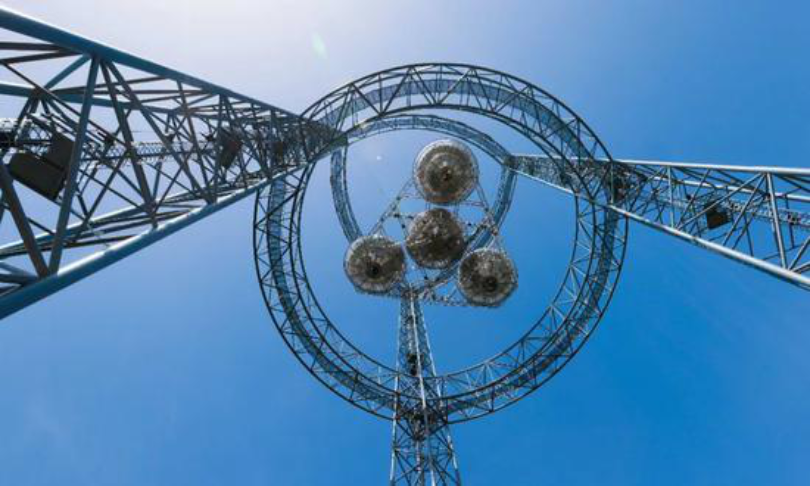
The Xidian engineering team has also constructed several important large-scale simulators it is using to establish final design concepts and evaluate different parameter choices in the design. The centerpiece for that simulator is a 75-meter (246 feet) high steel structure to be used for verification of the ground-based receiver design. It is being used in conjunction with working models of the massive microwave collecting antennas which will steer the energy very long distances away from outer space.
This 75-meter tall steel structure, viewed from the ground upwards, is actually a test structure to verify many of the performance parameters necessary for China's Space Solar Power System (SPSS) to function properly. Image:
People's Daily China, China State Media, via Twitter
Other subsystems the group has developed as development test beds are dedicated to improving the efficiency of the solar focusing systems from outer space. They are also being utilized to finalize the design parameters required to keep those systems aligned in a variety of different conditions.
China is now sufficiently far along in all these areas that all basic subsystem verifications were passed in June of last year.
China's Public Timetable
Based on plans recently published in the peer-reviewed technology journal
China Space Science and Technology, China is on track for to achieve an ambitious set of milestones for its SSPS deployment.
In
2028, a relatively short five years away, the Chinese government claims that it will conduct a critical space-based experiment to demonstrate its ability to transfer high-voltage electrical power via microwave wireless transmission.
The satellite used for the tests will be relatively low power, with 10 kilowatts of total transmission energy. It will incorporate a one-quarter-sized solar array, a scaled microwave transmission antenna, a low-power laser system, and a transmitting array just a few meters in size.
The purpose of the experiment is to verify the ability of the system to transmit power efficiently and accurately from low Earth space orbit to distances 400 kilometers or further away. However, China already knows that it can do this.
By
2030,
the original target date for full deployment of the SSPS, the Chinese team will test an upgraded version of the system. It will now incorporate solar panels capable of generating greater than 100 kilowatts. It will also be able to test medium power laser transmission at ranges as far away as 36,000 kilometers (over 22,000 miles). That distance is also precisely how high satellites must be to reside in geosynchronous orbits over the equator, with their rotational speed matching that of the rotation of the Earth.
Five years after that,
in 2035, China plans to boost the total energy gathering capacity of the solar arrays and the satellite by 100X, for a total of 10 MW. The microwave transmitting antenna will also be boosted to 100 meters in size, which will enable far more intense energy concentration when the radiation hits its intended land-based target.
In parallel with that, Chinese research scientists reportedly will be working on the technologies associated with building foldable large-scale receiving antennas for future deployment upgrades.
China has publicly targeted
2050 as the date by which it will have its first fully operational commercial Space Solar Power Station with a capability of generating and transmitting two gigawatts of electrical power to the ground, but it is highly likely that it will be operational much, much sooner. The official version of the SSPS will incorporate an antenna
one kilometer in diameter.
Based on progress already made to date, the Chinese scientists and engineers working on the SSPS and the overall “chasing the sun” Zhuri project which appears to extend far beyond it have already achieved multiple project milestones ahead of schedule. Among other things, that suggests that Beijing will likely not only beat its publicly announced schedule for the project but will also be able to roll out multiple additional satellites at the same time.
While some of those satellites will match the public promise for delivering low-cost, high-reliability, and virtually limitless electrical power from space for the masses, it is also equally certain others of those satellite families will be customized, ruggedized, and militarized for use as advanced space-based microwave weapons.
Further, all the while China will be hardening those systems against possible attack while it continues its aggressive airborne defensive and offensive military development programs.
Could the U.S. or some other power, perhaps Japan, which did continue its own SSPS-equivalent work up until around five years ago, catch up with Chinese innovation in these space-based “death rays” of destruction? It is not likely. China is simply too far ahead technologically, too well-funded, and too determined for the U.S. or its allies to overtake them. However, one should not easily dismiss the secret U.S. space program and its advanced weapons.
What is important to remember is that China has a secret military that is decades ahead of its visible program. If feigns weakness to prevent its foes (anyone not subservient to the CCP) from taking steps to defend themselves. So, it is possible that China's space based death ray is much farther along than it pretends.
Other parties have already deployed space based microwave weapons. Elon Musks Starlink 5G satellites can be quickly weaponized by merely using them in a sufficiently large array with each satellite focusing its beam on the same target. China recognizes this as a threat to their national security. In 2022 an article published in the Chinese journal
Modern Defense Technology entitled “The Development Status of Starlink and Its Countermeasures” discusses countering its military threat. However, the article focuses primarily on the communications threat, not on the energy weapon aspect.
An article published in the South China Morning Post on May 25, 2022 entitled “
China military must be able to destroy Elon Musk’s Starlink satellites if they threaten national security: scientists” also explored the potential threat of Starlink.
In addition to the destructive power of high amplitude microwaves is their utility for mind control. It is extremely easy to use a microwave beam as a carrier wave for mind control signals. One can implant sounds in a person's head as well as thoughts, tastes, smells and other sensations. This is all well documented in patents and in documents that survived destruction related to America's MK Ultra and similar programs. Using this technology, China could
effectively influence elections, neutralize opposition in an entire nation to its takeover or incite division and violence between people.