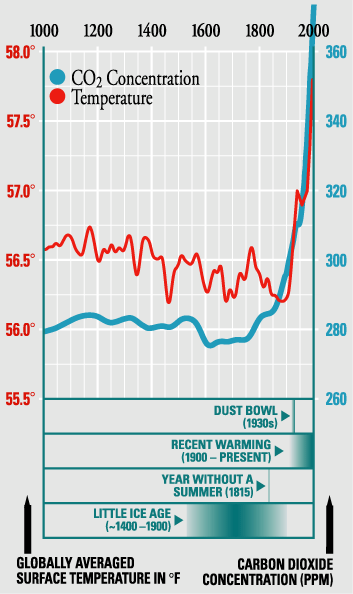
Jem did acknowledge, yesterday I think, that he saw the assertion that CO2 acts as a... "delayer" of heat loss back to space. He questions it, but I am glad he finally saw it. I've been holding that point in mind, too, but had lost the link to the paper. I would like to see a calculated chart of how our temperature changes would have looked if CO2 did not rise with the N. American summer but remained constant. I suspect the annual cooling would be significantly more pronounced.
There is a lot of confusion. Both CO2 and water vapor are indeed greenhouse gases. THAT is not by any means their only role however!
If one considers only their role as greenhouse gases, then one can not understand their affect on climate. Their greenhouse role requires the participation of an absorbing surface, the Earth's as it were. The result is that high quality solar quanta in the visible and ultraviolet regions are degraded into heat (infrared) by absorption and vibrational relaxation with coincident emission. The result is absorbed solar quanta being emitted from the Earth as lower quality infrared quanta. The greenhouse gases are transparent to visible light (they are colorless) and to the solar ultraviolet spectrum reaching the Earth. They partially absorb both infrared radiation from the sun and that emitted by the Earth however, and then they radiate it back it in all directions.
Think of the as Earth radiating heat, and the greenhouse gases acting as an insulating blanket to reduce the rate at which that radiated heat escapes from the atmosphere. Think of the Sun as the main source of thermal energy at the Earth's surface.
One of the important roles played by the greenhouse gasses is to moderate the atmosphere's temperature and keep it from swinging wildly day to night. If the concentration of CO2 and/or water vapor increases,
ceteris paribis, it is as though additional insulation is added between the Earth's surface and outer space. Then atmospheric heat will be dissipated to outer space more slowly; the mean temperature of the atmosphere should rise some, and there should be less difference between night and day temperatures.
However "ceteris paribis" never applies to changes in greenhouse gas concentrations. The assumption that even small changes in atmospheric concentrations can be treated as though they occur in isolation and independent of other biosphere phenomena is ridiculous. When CO2 rises, for example, photosynthesis in plants speeds up almost instantaneously and more CO2 is sequestered by plants and converted to carbohydrates. Later, when those plants die and decompose aerobically much of the captured CO2 is released; when they decompose anaerobically the carbohydrates may undergo reduction instead. When water vapor increases, clouds form, etc. It may rain or snow. When water evaporates the water absorbs heat and the surroundings are cooled.
In other words,
the atmosphere is extremely complex. Differential heating causes convection, i.e., wind, and chaotic mixing. The CO2 and water vapor content of the air varies from one place to another. The concentrations of these gases are constantly changing, and both CO2 and water vapor have important roles to play other than as greenhouse gases. In some of these roles they help cool the Earth and in others they help warm it. Current models for the atmosphere are nowhere near being useful for predicting temperature in the future. It's absurd to think they are, or even to suggest they might be.
I'm confident that the errors made by those who jumped prematurely to the conclusion that the Earth would experience disastrous run-away warming due to man caused CO2 emissions will in time become legendary. The first error was to underestimate the difficulty understanding climate to the point of being able to predict it, the second was to vastly oversimplify the role of greenhouse gases and their interactions, the third was to mistake correlation with cause, the fourth was to be suckered by the post hoc fallacy, and the fifth was to become emotionally involved and blinded by public approbation to the detriment of objectivity and the ability to admit mistakes.
Once we finally recognize that we've got much of the last 40 years of climate research wrong, I fear the next error committed will be to assume we can stop worrying about the affect of man's activities on our biosphere, or that we needn't be concerned about the amount and rate of fossil fuel burning, or worse, that we needn't be concerned about climate change.