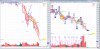
Thanks Jack. I am fairly new to your method. So that was the reason I was looking for other older threads where you provide explanation to all those lines. It looks like your method is very subjective. That is fine but I am trying to understand then nuances. 2 individuals could be looking at the same thing and still come out with 2 different opinions.
Would you be kind enough to provide at lease some basic explanation as to how you drew those lines etc. Thanks
The lines project into the future. This boundary context establishes when future forming bars end the existing trend.
A trend failure occurs when the definition of a trend is violated.
You may feel this is subjective. I do not.
Long trends are defined as higher highs and higher lows. (translation of bars.) Shorts are the opposite.
The contruction technique has a basis. Use the simplest consistent geometric container possible. This prevents any subjectivity. The geometric shape is a parallelogram.
From mathematical logic, it follows that when a trend ends another begins.
This fact allows for all construction rules.
As usual you do not do the work. you glance casually at a money maker and do not dig into the work of learning. So what I write will never aid you since all you do is not think and ask for help.
1. Begin at the end of a trend and assign geometric point 1 of a new parallelogram. All such end points are marked as ftt.
2, Use gold horizontal rays (gold color) to show when the trend definition passes and thus moves the trend forward to a susequent bar.
3. Assign point 3 to the same relative end as point 1 on the next bar after the point 1 bar.
4. Assign point 2 to get the greatest volatility of the parallelogram.
5. Project the formed RTL and LTL forward into the future.
6. If the volatility expands, accelerate the parallogram accordingly. This sentence is high in substntive content.
7. If an internal price case occurs on the RTL, then decelerate the parallelogram accordingly.
Making money geomertically is easy and not subjective.
In the example I provided you see the last market day.
To trade the instrument, you use 94% of capital. 6% is reserved to avoid maintenance margin calls due to bar volatility. Thus 2,000 dollars approximately is used per contract. An account of 60,000 dollars supports 30 contract trades (See my most recent three days of prints where I trade about 100 contracts.)
As I explained above in prior post the net for active capital was 211.25% per contract for the day.
By trading 60K on the example day, you will trade 180K on Monday.
This is called compounding in business.
Hedge funds make 20% a year. Friday was like 10 years of trading for a hedgefund .
I do MAT as some know.
Please think of me running 1 contract for you on a limited POA account where you can trade 1 contract on Friday and three on Monday. I do this as a courtesy for the owners of the accounts I trade.
As you see the actual turns I trade are on the five minute timeframe; they, as said, are boxed of Red for short reversal and black for long reversal.. hold throughs are pink or grey or no box. I am in the market from the open to bar 78 when margin doubles.
There is no chance that you can judge the precision represented. Your mind is slovenly and lazy. Do not kid yourself like others do that you understand anything about markets.
Post your work for the next 50 days so you can understand that you will never be a trader in any form whatsoever.
Why do you ask me questions?? Why?