
Come on.... would the fed actually admit there is a bubble, BUBBLE ben bernanke didn't even know there was a housing bubble while it was right in front of him.... greenspan didn't see the dot com bubble, so why would yellen of the federal reserve admit there is a bubble, there is a global bubble in ALL ASSET classes....the bubble is here because of the FED, THEY CREATED THE BUBBLE, the next crisis that is coming is all because of the fed, they should admit it now because they will have to admit it once on capitol hill again after global markets start to collapse...the fed created this false market place, meanwhile they believe they fixed the crisis, you can't fix a crisis with more debt, fools only believe that...we haven't learned, the only way the US can grow its economy is thorough asset bubbles and QE, there is ZERO ZERO ZERO ZERO organic growth left in the US, it all comes from stimulus and zero interest rates....we had the dot com collapse, the financial crisis and the next one will be called the fed crisis or fed collapse because they are the ones who created this new and upcoming crisis that will have no way out of...
Getty Images
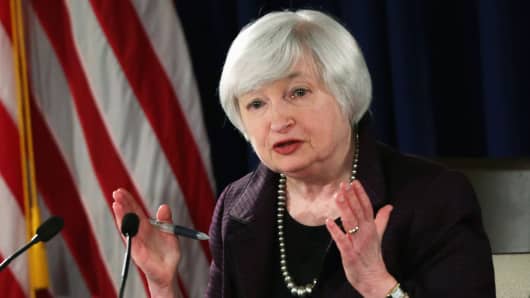
Janet Yellen
Federal Reserve Chair Janet Yellen on Wednesday warned that equity market valuations were "generally quite high," though she said the Fed was not seeing the hallmarks of a bubble.
She also noted that the Fed was watching the issue closely.
This is a developing story. Check back for updates.
Earlier Wednesday, Yellen said the Fed and other banking regulators have made significant progress in correcting flaws in the financial system that triggered the worst banking crisis in seven decades.
Banking regulators are remaining "watchful" for any areas where further reforms may be needed, she said in remarks at a financial conference.
Yellen cited the need to address the problem of "too big to fail"—the perception among investors that some institutions are so large that the government will step in and save them if they get into trouble.
She said the Fed and other regulators are taking steps to make sure that the collapse of even very large banking institutions can be handled in ways that don't jeopardize the stability of the entire system.
Yellen's comments came in a joint appearance with International Monetary Fund Managing Director Christine Lagarde at a conference sponsored by the Institute for New Economic Thinking.
Lagarde told the group that a recent IMF report found that risks to financial stability around the globe are rising with increasing risks at non-bank financial institutions and in emerging market countries.
"We need to build a financial system that is both more ethical and oriented more to the needs of the real economy -- a financial system that serves society and not the other way around," Lagarde said.
Yellen said a well-functioning financial sector promotes job creation, innovation and economic growth but that problems arise when the incentives become distorted, prompting bank executives to pursue risky strategies to increase profits.
"Unfortunately, in the years preceding the financial crisis, all too many firms took on risks they could neither measure nor manage," she said.
"The result was the most severe financial crisis and economic downturn since the Great Depression," the Fed chief said, noting that 9 million American lost their jobs and roughly twice that many lost their homes.


by Taboola
Getty Images
Janet Yellen
Federal Reserve Chair Janet Yellen on Wednesday warned that equity market valuations were "generally quite high," though she said the Fed was not seeing the hallmarks of a bubble.
She also noted that the Fed was watching the issue closely.
This is a developing story. Check back for updates.
Earlier Wednesday, Yellen said the Fed and other banking regulators have made significant progress in correcting flaws in the financial system that triggered the worst banking crisis in seven decades.
Banking regulators are remaining "watchful" for any areas where further reforms may be needed, she said in remarks at a financial conference.
Yellen cited the need to address the problem of "too big to fail"—the perception among investors that some institutions are so large that the government will step in and save them if they get into trouble.
She said the Fed and other regulators are taking steps to make sure that the collapse of even very large banking institutions can be handled in ways that don't jeopardize the stability of the entire system.
Yellen's comments came in a joint appearance with International Monetary Fund Managing Director Christine Lagarde at a conference sponsored by the Institute for New Economic Thinking.
Lagarde told the group that a recent IMF report found that risks to financial stability around the globe are rising with increasing risks at non-bank financial institutions and in emerging market countries.
"We need to build a financial system that is both more ethical and oriented more to the needs of the real economy -- a financial system that serves society and not the other way around," Lagarde said.
Yellen said a well-functioning financial sector promotes job creation, innovation and economic growth but that problems arise when the incentives become distorted, prompting bank executives to pursue risky strategies to increase profits.
"Unfortunately, in the years preceding the financial crisis, all too many firms took on risks they could neither measure nor manage," she said.
"The result was the most severe financial crisis and economic downturn since the Great Depression," the Fed chief said, noting that 9 million American lost their jobs and roughly twice that many lost their homes.
by Taboola

