 Israeli bombing of the Iranian embassy in Damascus
On 1 April 2024, an Israeli
airstrike destroyed the Iranian
consulate annex building adjacent to the Iranian embassy in
Damascus, Syria,
[2][6] killing 16 people, including a senior
Quds Force commander of the
Islamic Revolutionary Guard Corps (IRGC), Brigadier General
Mohammad Reza Zahedi, and seven other IRGC officers. Two civilians were killed in the attack.
[4][5] The airstrike took place during a period of
heightened tension between Israel and Iran, and amidst the
Israel–Hamas war and the
Israel–Hezbollah conflict.
Israeli bombing of the Iranian embassy in Damascus
Part of
2024 Iran–Israel conflict,
Israel–Hamas war,
Iran–Israel conflict during the Syrian civil war,
Israel–Hezbollah conflict and the
Iran–Israel proxy conflict

Iranian embassy compound after the attack: destroyed consular building on the right, adjacent to embassy building
[1]
Location
Damascus, Syria
33°30′14.0″N 36°15′37.6″E
Target Iranian consulate in Damascus
Date 1 April 2024 c. 17:00
[2] (
UTC+3)
Executed by Israel[3][a]
Outcome Iran retaliates with
missile strikes
Casualties 16 killed
[4][5]
7 Islamic Revolutionary Guard Corps soldiers
- 5 Iran-backed militiamen
- 1 Hezbollah fighter
- 1 Iranian advisor
- 2 civilians
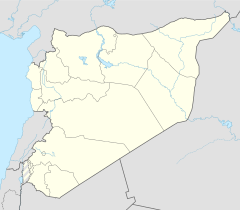
Location of Consulate in Syria

Many countries and international organizations
condemned the attack. On 13 April 2024,
Iran retaliated against the attack with
missile and drone strikes in Israel,
[7][8][9][10] with Iran claiming it was primarily targeting the bases from which the attack on the consulate was launched.
[11][12]
Contents Background
See also:
Iran–Israel conflict during the Syrian civil war
Since 2013 Iran has maintained a
presence of its troops in Syria in response to the Syrian civil war, as Syria is a crucial ally of Iran. Additionally, it has been involved in training and funding paramilitary forces from
Hezbollah, along with foreign militias from
Iraq and
Afghanistan, not only in Syria but also in neighboring
Lebanon.
[13] Since the outbreak of the
Syrian civil war in 2011, Israel has conducted hundreds of airstrikes targeting Hezbollah assets within the country.
[14]
With the onset of the
Israel–Hamas war in October 2023, Israel has increased the intensity of its attacks on Syria.
[15] From 12 to 22 October 2023, Israel launched at least three attacks on airports in Syria, particularly on
Damascus and
Aleppo.
[16][17] Notably, Israel carried out the assassination of
Razi Mousavi, a senior Iranian general, in the Syrian capital of Damascus on 25 December 2023, and Brigadier General
Sadegh Omidzadeh, an intelligence officer with the IRGC Quds Force, on 20 January 2024.
[18][19][20]
Attack
On 1 April 2024, the Iranian consulate annex building adjacent to the Iranian embassy in Damascus was destroyed by an Israeli airstrike. Iranian ambassador Hossein Akbari alleged that the consulate building "was targeted with six missiles from
Israeli F-35 warplanes".
[21] The Guardian stated that Israeli warplanes were responsible for the attack.
[22] The New York Times (
NYT) stated that four Israeli officials anonymously confirmed Israeli responsibility for the attack.
[23] Various other media outlets did not definitively attribute the attack to Israel, and the Israeli government refused to comment on the matter.
[24][25][26][27]
The suspected primary target of the attack was the Quds Force commander of the IRGC, Brigadier General
Mohammad Reza Zahedi, who was killed in the attack. According to
The Guardian, Zahedi was a critical figure in the relationship between Iran and Hezbollah.
[28][29] NYT reported that an anonymous source from the
Revolutionary Guards said that the strike targeted a meeting between Iranian intelligence officials and Palestinian militants, including leaders of
Palestinian Islamic Jihad, who were discussing the war in Gaza.
[30]
Footage and photos from the consulate area after the attack showed extensive damage, fire, and smoke.
[21] Iranian media reported that the building had been completely destroyed and that the ambassador and his family, who were housed in the embassy next door, were unharmed.
[31]
The unused Canadian embassy building on the other side of the consular building was also damaged in the attack, with at least some of its windows destroyed. It has been closed since 2012 because of the Syrian civil war, but it is still owned by the Canadian government.
[32]
Casualties
Sixteen were killed in total, including seven
Islamic Revolutionary Guard Corps (IRGC) soldiers, five Iran-backed militiamen, one Hezbollah fighter, one Iranian advisor, and two civilians.
[4][5]
In addition to Zahedi, casualties included Zahedi's deputy Brigadier General Mohammad Hadi Haji Rahimi and five Iranian officials: Hossein Aman Elahi, Sayid Mehdi Jalalati, Ali Agha Babaei, Sayid Ali Salehi Roozbahani, and Mohsen Sedaghat.
[28] Zahedi was the most senior IRGC officer to be killed since the
assassination of Qasem Soleimani by the U.S. in January 2020.
[33]
Analysis
The Guardian's journalists,
Peter Beaumont and Emma Graham-Harrison wrote that the Israeli strike was a miscalculation that had "bulldozed through every red line to attack a location that Tehran maintains was tantamount to attacking Iranian soil."
[34]
Sanam Vakil, the director of the Middle East and North Africa programme at the
Chatham House think tank stated that the Damascus attack and the “breach” of the Vienna convention was 'the straw that broke the camel’s back.’
[35]
Legality
Diplomatic premises, like homes and schools, are considered "civilian objects" under
international law. Diplomatic buildings are entitled to further protections from attack or other interference by the host country under international customary law, codified in the
1961 Vienna Convention on Diplomatic Relations and the
1963 Convention on Consular Relations.
[36]
A UN-commissioned panel of experts on international law consisting of
Ben Saul, Morris Tidball-Binz,
Javaid Rehman, Livingstone Sewanyana, and Cecilia M. Bailliet wrote that Israel had provided no legal justification for the attack, and had failed to report it to the
United Nations Security Council. Therefore, in their view, it violated Article 2(4) banning recourse to force against another state. They also issued a warning that the Israeli officials involved in the strike might have committed crimes.
[37] The subsequent Irani retaliation was also, in their view, prohibited under international law, since self-defense is only justified to deter continuing armed attacks, and the strike on the Iranian Embassy had ended 12 days earlier.
[38]
Others argue that these rules do not apply to Israel. According to Aurel Sari, a professor of international law at
Exeter University, "unless Israel was able to justify the airstrike as an act of self-defense" it would be in violation of
Article 2(4) of the United Nations Charter. Whether self-defense permits a strike on the territory of a third country is an ongoing legal debate.
[30] He argues that as a third state Israel "is not bound by the law of diplomatic relations with regard to Iran’s Embassy in Syria."
[30] In the view of Yuval Shany, an international law professor at
Hebrew University in Jerusalem in the Middle East, Iran has for many years blurred the lines between its diplomatic missions and its military operations and this would mean that the embassy was probably a legitimate target.
[30]
Reactions
International
Main article:
International reactions to the Israeli bombing of the Iranian embassy in Damascus
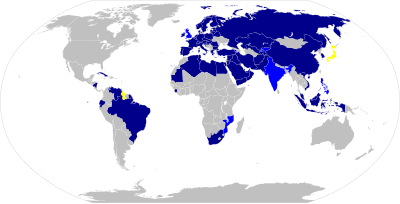
Countries that condemned the Israeli attack on the Iranian consulate.
Official entities from many countries condemned the attack and considered it a violation of the international laws, including the Prime Minister of
Iraq[39], the Prime Minister of
Spain,
[40] the President of
Nicaragua,
[41] and the foreign ministries of
Afghanistan,
[42] Algeria,
[43] Armenia,
[44]Brazil,
[45] Belarus,
[46] China,
[47] Cuba,
[48]Egypt,
[49] Indonesia,
[50] Jordan,[
citation needed]
Italy,
[51] Kazakhstan,
[52] Kuwait,
[53] Lebanon,
[54] Libya,
[55] Malaysia,
[50] Maldives,
[56] Mauritania,
[57]Norway,
[58][59] Oman,
[60] Pakistan,
[61] Qatar,
[62] Russia[63] (which called it a "political killing"
[64]),
Saudi Arabia,
[65] South Africa,
[66] Sierra Leone,
[67]Tajikistan,
[68] Tunisia,
[69][70] Turkey,
[71] United Arab Emirates,
[72] Uzbekistan,
[73] Venezuela,
[74] Vietnam,
[75] as well as the Spokesperson for
Yemen's Ansar Allah.[
citation needed] The Foreign Ministry of
Kyrgyzstan expressed concern.
[76]
The spokesperson for the
UN Secretary-General condemned the attack.
[77]
Russia requested the
UN Security Council to discuss the strike.
[78] A statement condemning the attack was drafted by
Russia to be issued by the Security Council, but the Western member states opposed the issuance of any statement.
[79][80][81][82] During the briefing in the
United Nations Security Council, the representatives of many countries (such as
Ecuador,
Guyana,
Slovenia,
South Korea, and
Switzerland) noted that any attack on diplomatic and consular premises violates the
Charter of the United Nations as well as the
1961 Vienna Convention on Diplomatic Relations and the
1963 Vienna Convention on Consular Relations. They also expressed concern that the incident could further escalate the regional conflict. The representative of
Japan only expressed concern, and the representative of the
United Kingdom noted the importance of "respect ... for diplomatic premises", but also criticized Iran.
[67] The spokesman of the
United States National Security Council only stated that the US was not involved and had no prior knowledge of the attack.
[83] The Representative of Russia criticized the statements made by the US and others including France, considering them to be
double standard.
[67]
The
Arab League,
[84] the
European Union,
[85][86][87] the
Gulf Cooperation Council (GCC),
[88] the
Organisation of Islamic Cooperation (OIC),
[89] as well as the
Shanghai Cooperation Organisation (SCO)
[90] also condemned the attack.
Israel
The Israeli military spokesman claimed that the building is neither a consulate nor an embassy, but a military building of Quds forces "disguised as a civilian structure in Damascus".
[91] Israel told the U.S. that if a retaliatory attack by Iran would prompt a robust response from Israel.
[92][93]
Seven Israeli embassies were evacuated in response to the potential threat of an Iranian retaliatory attack, after Iran publicly blamed Israel and vowed retaliation.
[94] The IDF deployed GPS jamming systems within Tel Aviv to safeguard against potential aerial attacks by Iran.
[95] Initial U.S. intelligence anticipated a significant attack on U.S. or Israeli assets as soon as the week of 8–12 April.
[96]
Iran
Ali Khamenei leading the funeral for the IRGC soldiers on 4 April
In several cities across Iran, including the capital,
Tehran, as well as
Tabriz and
Isfahan, large crowds of protesters gathered waving Palestinian and Iranian flags and demanding revenge.
[97][98] The Iranian Supreme Leader
Ali Khamenei vowed a harsh response to the attack. Khamenei's political advisor
Ali Shamkhani, said that the United States remains directly responsible.
[99] Iran also sent a letter to the
United Nations Security Council, saying it "reserves its legitimate and inherent right to respond decisively".
[100] Syria's Foreign Minister condemned the attack, calling it a
terrorist attack.
[101]
On 5 April 2024, Iran told the United States to "step aside" as it prepared for retaliation against Israel.
[102] On 13 April 2024, the
IRGC Navy boarded the Portuguese container ship MSC Aries in the Strait of Hormuz via helicopter. It was redirected to Iranian territory. The MSC Aries is partially owned by Israeli businessman
Eyal Ofer and operated by his company,
Zodiac Maritime.
[103]
Later on 13 April 2024, the
Iranian military launched an air attack, firing more than 300 standoff weapons at Israel, including at least 170
aerial drones, 30
cruise missiles, and 120
ballistic missiles. The attack, which constituted the largest single drone attack in history, claimed to be a failure by Israel but a success by Iran
[104], Israel claimed that it's air defenses, buttressed by those of allies, destroyed almost all the incoming weapons before they could reach their targets.
The sole casualty was Amina al-Hasoni, a 7-year-old
Arab Bedouin girl in the
Negev, who was critically injured by shrapnel from a downed missile. Israeli officials also said that the nearby Nevatim Airbase sustained light damage.
[105][106][107] Amina's father, Muhammad al-Hasoni, called Iran’s actions “inhumane.” Stating, “May God demolish them.”
[108]
Following Iran's attacks several countries evacuated embassies in Tehran and suspended their airlines' flights to the country.
[109]
See also
Notes
- Israel has not officially claimed responsibility for the attack.



