Wide or Tight Stop Losses for Breakout Trading

I trade instruments with wide range using tight stops
%%
Good;
I use tight stops with SPY+ related stuff...........................................................................
Some times even wide profit stops stops get hit, they reverse split FNGD @ $2.22 to $44/LOL:D:D
 
Here's the problem with your strategy:

There are millions of people identical to yourself trying to make money by point-and-click trading off exactly the same squiggly lines and chart points.
%%
I see your points; + can be profits more than problems. But my comments dont apply to crypto , or bitcon...... The profits can come 'cause a turtle or cheetah can never out size an elephant or less a herd of elephants.
NOT a prediction, not get rich quick..............................................................
 
%%
I see your points; + can be profits more than problems. But my comments dont apply to crypto , or bitcon...... The profits can come 'cause a turtle or cheetah can never out size an elephant or less a herd of elephants.
NOT a prediction, not get rich quick..............................................................

Do you mean we should observe the moves made by institutional traders and run with them?
 
Here's the problem with your strategy:

There are millions of people identical to yourself trying to make money by point-and-click trading off exactly the same squiggly lines and chart points.

Do you mean we should use crypto bots or trade algorithmically?
 
Seems like you may "want" to read up on Money management and volatility based position sizing.

If you are more technically inclined,you could sub technical levels for vol/atr..


For a while, I have attempted to trade breakouts (unsuccessfully).

For a certain crypto that is priced at around 0.10, and which has ranged from 0.08 to 0.20 in the past few months, my method is:

(a) Let's say that the price is in consolidation, and let's say, based on volume analysis, I have reason to believe that the price may break out of the range. Let's say that the price is currently hovering around 0.09850.

(b) I would set a stop entry at 0.09925 with a limit at 0.09950. My reasoning is that, if the price can break out of 0.09900, then it would likely go up to 0.10000. (My theory is that each .00100 mark is a kind of support or resistance.)

(c) After entry, I would set a stop loss at 0.09870. (I feel that if price hits 0.09870, then my thesis would have failed. Sometimes, I set my stop losses at the 0.00050 (e.g. 0.09850) or 0.00065 (e.g. 0.09865) mark instead, but I feel that the risk-reward ratio would be wrong.)

(d) If price goes up to 0.9980, then I would move my stop loss up to 0.09950. Due to fees and commissions, this is technically not break-even. However I feel that this reduces my potential loss significantly.

(e) Then, if price goes quite a bit beyond 0.10000, I would move my stop loss up to 0.9980 or 0.10000.

(f) Then, I wait.​

It seems to me that a tight stop loss is required for breakout trading, as breakouts often fail, and, without a tight stop loss, the losses will add up very quickly. This is why I have, to date, used a tight stop loss set at an arbitrary price, e.g. at the .00070 mark.

I have often been stopped out of big moves. In those cases, I would watch price movement to see if the downward movement has stopped and, if I feel it is appropriate to do so, enter again. In other cases, however, my system has saved me from considerable loss.

Most of my big losses have occasioned when I failed to follow my system. In those cases, I watch price fall while hoping without reason that price would go back up again.

I am surprised to read that in an online article, "Are you a breakout trader that looks for big moves to happen following a breakout of price and volatility for example? if that is the case than your stops should probably be very wide."

(https://www.financemagnates.com/tra...ight-stops-wide-stops-which-one-should-i-use/)

If stop losses are set based on price structures (e.g. support and resistance), or if wide stop losses are used, wouldn't losses accumulate to an intolerable extent in breakout trading?

I am not successful at breakout trading yet. Therefore, my question has two parts:

(a) What am I doing wrong with the method described above?

(b) How should one set stop losses for breakout trading?​
 
For a while, I have attempted to trade breakouts (unsuccessfully).
Have you ever watched someone trade breakouts?
There may be people on this forum who trade breakouts LIVE and have traders "Look Over Their Shoulder" as they do it.
Do they do that for free?
Would you? lol.
You know more about trading breakouts than you give yourself credit for.
Ask around, see if you can find a trader willing to let you follow along as they trade.
Will you trade the same way. Hell no. No two traders trade the same way. Never gonna happen.
Can you pick up some vital tips from a cat that's been doing breakout trades since moses was a pup? People will happily say hell no save your money dont do it etc. It's easy to say no. For a mere pittance something tells me there is the possibility to watch a cat trade breakouts Live during morning sessions.
Axe around if you are ready to pay to play.
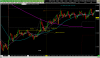
It ain't me by the way. I like working the pullbacks after a breakout. Do I miss numerous breakouts. Yep, those runaway mofos, but they usually pullback sooner or later, and that's where the ratchet sets its teeth and ...
Pullback after a Breakout ...

delete hgyt.png
 
Last edited:
Thank you to all for your helpful tips on scaling in, and wide and tight stops. I will also consider watching premium live trading as suggested.

Having considered this issue some more, in addition to these helpful tips, perhaps the ultimate solution is price action and volume analysis.

In other words, when we have reason to believe that we are in an uptrend, or that an uptrend is about to begin, then we should learn to trust our judgment and use a wider stop. In such cases, perhaps the purpose of the stop is simply to prevent a sudden and unexpected drop in price (as happens from time to time).

As long as our judgment is correct, there is really no wrong place to buy. It is possible that our judgment is wrong, but such is life.

Conversely, when we are in a trading range, when we are in a downtrend, or when we are simply not sure where price is going, then it is necessary to use a tight stop.
 
Thank you to all for your helpful tips on scaling in, and wide and tight stops. I will also consider watching premium live trading as suggested.

Having considered this issue some more, in addition to these helpful tips, perhaps the ultimate solution is price action and volume analysis.

In other words, when we have reason to believe that we are in an uptrend, or that an uptrend is about to begin, then we should learn to trust our judgment and use a wider stop. In such cases, perhaps the purpose of the stop is simply to prevent a sudden and unexpected drop in price (as happens from time to time).

As long as our judgment is correct, there is really no wrong place to buy. It is possible that our judgment is wrong, but such is life.

Conversely, when we are in a trading range, when we are in a downtrend, or when we are simply not sure where price is going, then it is necessary to use a narrow stop.
Do you have a written trading plan or more of an artist of trade?
 
Back
Top