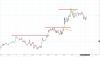
Why trading is sometimes difficult for me

but I guess I'm more annoyed at the noise of the market because in my head i have this assumption that, the market should respect a certain level, and when it does wick past it and then close below, it messes with my head.

This is the price you pay for trading the NQ. I sympathize 100% with you as I see this over and over again with the NQ. The ES is better behaved I would say in that it takes much more momentum to move it past areas that you think it shouldn't move past.

I think some of the reason why this is is simply liquidity. It sometimes only takes dozens, well less than 100 contracts, to blow through several levels. Whereas the NQ might spike 2-3 points, the ES will move 1 tick.

Also, often, in my opinion, NQ will breach or overshoot a level simply because ES still needs to reach its level. (ie. test of some level, test of a swing point, test of a high liquidity level). In this case, one market is dragged along with the other market to make this happen, and then both can drop or rise.
 
This is my opinion. Take it or leave it.

You are trying to trade a reversal BEFORE it gives any indication of a potential reversal. For reversals, in a case like this one, you need to see some strong enough selling pressure followed by a test of the bull extreme. That test may end up being a higher high or a lower high. In the brown circle we see price went south for a bit then a test was made of the prev extreme that ended up being higher high test but closed below the midpoint of the bar. The next bar was the first entry, however, I would not have taken it. Why not. Well look to the left ..strong bull trend...markets have inertia..tend to keep doing what they are doing..80% of reversal attempts in a bull trend FAIL. SO, while a trader could short at the first entry I would not. I would want to see more price action south..more SELLING PRESSURE. In the red circle we have a bigger push south from the extreme followed by a pullback test (green) of the extreme that ended up being a lower High test. Next bar was second entry. For me it was really the only viable entry so I would consider it the first entry but have labeled it the second entry since a reversal signal was given prior to that (which i label first entry). Basically, I would have ignored what I labeled first entry.

Your shorting entry had no basis. In fact probabilities favored a bull flag and a continuation of the previous bull trend. It didn’t make much PA sense to short where you did. Once you can see some genuine selling pressure then it makes more sense to look for a reversal.

Hope this helps.

Not sure if you got stopped on your short entry but if it was successful I’d say it was a bit of luck. It was against the odds short.

356C15C7-D1F0-41B7-ADAF-C00E72C0D31B.jpeg
 
Last edited:
To the OP,

Pick any opposite closing bar in a trend that is supported on the trend side of a 20 ema. Measure EVERY MAE / MFE (max fav excursion is 1 tick before the final one in the trend) for taking that as a trend entry (e.g., buy the close of a red bar in an uptrend). You will find that you have HIGH reward to risk ratios for just about all those entries except the last set which is closer to 1:1 RR (i.e., might be up to 3 consecutive red closes just before the end).

What does this tell you? DON'T WORRY ABOUT OPTIMAL ENTRY IN A TREND JUST BE ABLE TO IDENTIFY A TREND EARLY 50% OF THE TIME, AVG GREATER THAN 1.3:1 RR RATIOS AND YOU WILL BE SUCCESSFUL LONG TERM.

You need to accept that, in winning trading systems, very high winning pcts (70%+) yield low reward to risk ratios (1:1 or worse) and more moderate winng pcts (40-60%) yield higher reward to risk ratios (1.3:1 to 2.5:1). This is what the market can give you in the long term.

Nice quantitative method. Can you elaborate more, are you trading intraday(minutes) or dailies?
 
Why do I have an edge-- aka positive expectation?

Why should tweeking my current ideas allow me to overcome the bid/ask, trading costs, those ahead of me on the information flow, the algos and professionals?

What am I doing that is do special?

Is there really so much soft money out there?

How many savvy people sitting at home with a retail account are winning pros, but more importantly:

Who wins at this and what are they really doing?

Key questions to think about.

Can an edge be recognising trading patterns of a particular instrument after trading it for years?
 
This is my opinion. Take it or leave it.

You are trying to trade a reversal BEFORE it gives any indication of a potential reversal. For reversals, in a case like this one, you need to see some strong enough selling pressure followed by a test of the bull extreme. That test may end up being a higher high or a lower high. In the brown circle we see price went south for a bit then a test was made of the prev extreme that ended up being higher high test but closed below the midpoint of the bar. The next bar was the first entry, however, I would not have taken it. Why not. Well look to the left ..strong bull trend...markets have inertia..tend to keep doing what they are doing..80% of reversal attempts in a bull trend FAIL. SO, while a trader could short at the first entry I would not. I would want to see more price action south..more SELLING PRESSURE. In the red circle we have a bigger push south from the extreme followed by a pullback test (green) of the extreme that ended up being a lower High test. Next bar was second entry. For me it was really the only viable entry so I would consider it the first entry but have labeled it the second entry since a reversal signal was given prior to that (which i label first entry). Basically, I would have ignored what I labeled first entry.

Your shorting entry had no basis. In fact probabilities favored a bull flag and a continuation of the previous bull trend. It didn’t make much PA sense to short where you did. Once you can see some genuine selling pressure then it makes more sense to look for a reversal.

Hope this helps.

Not sure if you got stopped on your short entry but if it was successful I’d say it was a bit of luck. It was against the odds short.

View attachment 186996
Both of his entries have basis to me. And they do not require any confirmation. The op is a bit impatient but as for the entries they are great.
 
If the OP wants to trade the 1st entry, he needs to use more tools and going to finer details like this


or cherry pick his entries as volpri has mentioned
 
In fact probabilities favored a bull flag and a continuation of the previous bull trend. It didn’t make much PA sense to short where you did.
I think you provide an excellent analysis, but what must be stated is that you use stops that are much bigger, and you will average into a losing trade as it goes more against you. This of course works for you, but for many strategies, it might not.

Any time you are waiting for "confirmation", you are actually getting in fairly late and have to use a very wide stop, and hope the reversal continues, and hope that it doesn't test the high one more time. Had you shorted where you say was a good entry, you're well more than 10 points away from the high. So if trading the NQ, you now have to use a stop that is at least as big as this, and then also allow for that poke, because as you also say, it can even make a HH as a test of the previous high. So now you're looking at perhaps a 15 point stop.

When you speak about probabilities, you also have to take into account probabilities of risk and reward ratio. Perhaps your trade has a higher probability of working with your entry, but your stop of 10 points, which will sometimes hit, might in fact be the worse strategy than if you use a 3 point stop, take the trade right away, but win less often.

I don't doubt that you know this, but I just want to throw this out there because its an important consideration. Especially because, as you mention, 80% reversal attempts fail, it might be more important to get in right away if you are gonna try, then to get in much later. It may have more confirmation, but it also has a much likelier chance of turning around right after your entry simply because it has already gone down so far from the high.
 
I think you provide an excellent analysis, but what must be stated is that you use stops that are much bigger, and you will average into a losing trade as it goes more against you. This of course works for you, but for many strategies, it might not.

Any time you are waiting for "confirmation", you are actually getting in fairly late and have to use a very wide stop, and hope the reversal continues, and hope that it doesn't test the high one more time. Had you shorted where you say was a good entry, you're well more than 10 points away from the high. So if trading the NQ, you now have to use a stop that is at least as big as this, and then also allow for that poke, because as you also say, it can even make a HH as a test of the previous high. So now you're looking at perhaps a 15 point stop.

When you speak about probabilities, you also have to take into account probabilities of risk and reward ratio. Perhaps your trade has a higher probability of working with your entry, but your stop of 10 points, which will sometimes hit, might in fact be the worse strategy than if you use a 3 point stop, take the trade right away, but win less often.

I don't doubt that you know this, but I just want to throw this out there because its an important consideration. Especially because, as you mention, 80% reversal attempts fail, it might be more important to get in right away if you are gonna try, then to get in much later. It may have more confirmation, but it also has a much likelier chance of turning around right after your entry simply because it has already gone down so far from the high.
Not sure the points as I must have chopped off the price scale when i annotated his chart but my stop would not have been the extreme high as I think you are suggesting??

1) My stop would have been 1 or 2 ticks above the high of the PB (green line).

2) I don’t scale into just any losing trade. The practice is cherry picked and use under certain conditions. Like in a Small Pullback Bull Trend or Small Pullback Bear Trend. This context was not that so not a trade that i would scale into.

3) I differentiate between an initial SL and actual SL. In this second entry actual SL was “0”. From entry it never went against me. However, had it gone against me my initial SL would get me out at max 2 ticks above the high of the Pb (green PB line). In other words I have an initial Sl but calculate my PT off of actual SL AND how the bars are going after my entry.

Normally, if an actual SL is very small (as in this case “0”) I will not follow the trade very far (this is counter-intuitive I know). However, in this case my entry bar was a large Bear bar and it closed on its low. So, i would have done one of two things at that point. Locked in my profit (or scale out part of my position if my position were multiple contracts) waited for a PB and or continuation and entered again short an L1 (which took place on the third bar of this second PB) OR I would have held my original position through this second PB expecting a second leg down what I call an intraday swing trade (2 legs down).

Had the PA after my entry been small bars ..overlapping bars..i would not follow this action very far as my actual SL is “0” so I would not expect price to go far. In such a case it would be a high probabilty, low risk, but small reward trade 60% of the time. But since it WAS different.. huge bear bar ...it was worth following more and ended up being low risk, low probability (about 40%) but big reward. It ended up being a measured move down from the extreme high to pb then to the low. I am a discretionary trader so my decisions are made on the fly as price action unfolds as concerns my exits..and sometimes even my SL’s etc. In this case i would let the SL take me out if after my entry, on the pb, price traded back above the PB. Why? Even though i would consider my entry viable there exist alot of buying pressure to the left of the extreme high so the whole counter move could turn out being just a bull flag with an L1 and L2 short entry that fails and the bull trend (to the left of the extreme high) continues. Nevertheless, my L2 (counting from the top of the bull extreme..i.e. my entry labeled second entry) for me would be a trade I would take a chance on as there was enough selling pressure to consider it as viable. However, nothing is for certain in the markets so I would take the SL if subsequent PA proved my premise as being wrong.

Why hold? that huge bear entry bar (bigger than the prev 70 bars) shows alot of weakness and a probable second leg down which is what happened. That one big bear bar completely reversed the previous bull swing that made the extreme high. So, lots of selling pressure. Remember 80 % of reversals attempts in trends fail so I am not going to take a reversal without seeing some opposite trend pressure first showing.

I will show how I would trade his long position at the bottom of his chart in another post.

Not everyone would trade as I do but that is how I would have looked at trading this. This is what makes sense to me in this particular price action. Of course, it is all hindsite which is only good for expounding certain principles..tactics..etc. I realize that.
 
Both of his entries have basis to me. And they do not require any confirmation. The op is a bit impatient but as for the entries they are great.
That is another take on it but where is your explanation of why?
 
1GXVfVq.png


I sold NQ today at the red arrow... as you can see market closed there on the 5min bar, then on the next 5 min bar, it opens at same level but then makes a large wick above the open/close level very briefly before closing lower.

Then you can see on the next white line arrow, near the same level I sold, we make another wick higher before closing lower again.

Then later around 9am PT, we can see market making a HL and I buy at the bottom as well noted by the yellow arrow. However market chops/balances for almost a hour before deciding to rally higher.

So the science behind the trading I understand to see where big money usually comes in. My only problem is the stop hunting/poker playing/and starting to get wishywashy when the market takes it's time deciding what to do, whereas for the most part I feel like I already know where the market is gonna go next, I dont understand why it must take 1 hour+ to finally move. I dont understand the fact that it knows for example 7182 is the level, but yet makes large wicks past the level to hunt out stops.

My question is how do you other traders manage the "art" behind trading?

@traderGOD
@heavenskrow

heavenskrow,

I thought I show a chart of how i do so you know I wait for the money just like you. traderGOD, i know you like charts. lol

the red lines are support and resistance I woke up and drew on the chart.

orange arrow is stop loss
blue entry
green exit.

Once I set my stop loss, and buy limit order. That's it. I set my alarms at other support and resistance, and make decisions when the alarm goes off.

I either make money or lose money. Alllllllll that other stuff like whipsaw, the robots, the market this and that, and blah blah blah blah blah blah, I care less about. My job is done. Once my alarms comes back on I make decisions to take money or wait for more money.

As you can see, I waited for like 1 hour to make or lose money. During that time, i was working or doing something else.

In short, you gotta wait for the money, don't worry about all this hunting stops stuff, cause its too complex. Set an entry, exit, and wait for make money or lose money.
 

Attachments

  • Screenshot_1.png
    Screenshot_1.png
    91.8 KB · Views: 44
Back
Top