

Without getting into the shenanigans of whether or not the BLS is accurate by any definition of the word, lets just assume they are for the scope of this argument (hah) and have a read at Dr. Hussman's latest weekly missive. The link for the whole entry is below, but I'll just include the interesting info on the employment part - which should give us an impression of just how bad the Fed has made things for everyone (except Wall Street).
http://www.hussman.net/wmc/wmc120409.htm
What about recent employment gains?
But wait. How can we say that quantitative easing has such weak effects on the economy when we've clearly enjoyed a significant amount of job creation since mid-2009? Isn't that clear evidence that Fed policy is working?
Well, that depends on what one means by "working."
Last week, we observed "Real income declined month-over-month in the latest report, which is very much at odds with the job creation figures unless that job creation reflects extraordinarily low-paying jobs. Real disposable income growth has now dropped to just 0.3% year-over-year, which is lower than the rate that is typically observed even in recessions." It wasn't quite clear what was going on until I read a comment by David Rosenberg, who noted that much of the recent growth in payrolls has been in "55 years and over" cohort. Suddenly, 2 and 2 became 4.
If you dig into the payroll data, the picture that emerges is breathtaking. Since the recession "ended" in June 2009, total non-farm payrolls in the U.S. have grown by 1.84 million jobs. However, if we look at workers 55 years of age and over, we find that employment in that group has increased by 2.96 million jobs. In contrast, employment among workers under age 55 has actually contracted by 1.12 million jobs. Even over the past year, the vast majority of job creation has been in the 55-and-over group, while employment has been sluggish for all other workers, and has already turned down.
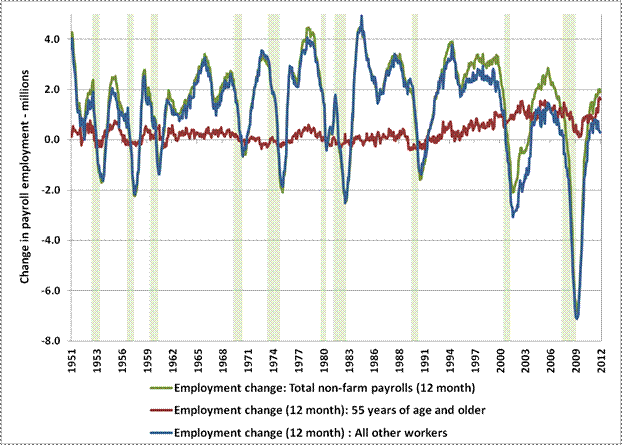
For most of history prior to the late-1990's, employment growth in the 55-and-over cohort was a fairly small and stable segment of total employment growth. Undoubtedly, part of the recent increase has simply been a change in the classification of existing workers as they've aged (1945 + 55 = 2000, so the we would have expected to see some gradual bulge in this bracket since 2000 due to aging baby boomers). But the shift is too large to be explained simply by reclassification. Something more troubling has been underway.
Beginning first with Alan Greenspan, and then with Ben Bernanke, the Fed has increasingly pursued policies of suppressing interest rates, even driving real interest rates to negative levels after inflation. Combine this with the bursting of two Fed-enabled (if not Fed-induced) bubbles - one in stocks and one in housing, and the over-55 cohort has suffered an assault on its financial security: a difficult trifecta that includes the loss of interest income, the loss of portfolio value, and the loss of home equity. All of these have combined to provoke a delay in retirement plans and a need for these individuals to re-enter the labor force.
In short, what we've observed in the employment figures is not recovery, but desperation. Having starved savers of interest income, and having repeatedly subjected investors to Fed-induced financial bubbles that create volatility without durable returns, the Fed has successfully provoked job growth of the obligatory, low-wage variety. Over the past year, the majority of this growth has been in the 55-and-over cohort, while growth has turned down among other workers. Meanwhile, overall labor force participation continues to fall as discouraged workers leave the labor force entirely, which is the primary reason the unemployment rate has declined. All of this reflects not health, but despair, and explains why real disposable income has grown by only 0.3% over the past year.
http://www.hussman.net/wmc/wmc120409.htm
