
Why some people say that once rates hit 0%, the central bank starts to "push on a string"

Although some is being saved, these charts from Wolfstreet beg to differ. Spending on durable goods has exploded, and even the services sector is already recovering.

https://wolfstreet.com/2020/11/25/the-state-of-the-american-consumer-free-pandemic-money-runs-low/

View attachment 245087
View attachment 245088

The real shocker is income. The government came in nicely to make sure money didn't run dry. As it is, most are probably doing better now than before the crisis, at least for now. Combine this with some people not paying rent, and you can see people are flush with cash.

View attachment 245089

But of course, income from wages hasn't fully recovered yet, but its shockingly close. In 2021, if there is no more stimulus, and when the evictions and back rent can commence, it will be interesting what will happen then. But its obvious that the whole problem has been nicely papered over.


View attachment 245090

Then where has inflation gone if everyone is spending? the US economy has been experiencing disinflation for the past 25 years
 
Although some is being saved, these charts from Wolfstreet beg to differ. Spending on durable goods has exploded, and even the services sector is already recovering.

https://wolfstreet.com/2020/11/25/the-state-of-the-american-consumer-free-pandemic-money-runs-low/

View attachment 245087
View attachment 245088

The real shocker is income. The government came in nicely to make sure money didn't run dry. As it is, most are probably doing better now than before the crisis, at least for now. Combine this with some people not paying rent, and you can see people are flush with cash.

View attachment 245089

But of course, income from wages hasn't fully recovered yet, but its shockingly close. In 2021, if there is no more stimulus, and when the evictions and back rent can commence, it will be interesting what will happen then. But its obvious that the whole problem has been nicely papered over.


View attachment 245090
Exactly!

This has been an interesting real time economic experiment. The Government begin to compensate with a living wage those in the service sector who had lost lower paying jobs in which they were being kept afloat with such devices as food stamps, hidden subsidies, bank credit, and the earned income credit. For example a worker who barely got by on $400/wk found themselves suddenly receiving $600/wk.

This is a preview of what we might initially expect if suddenly we begin to pay a living wage as the minimum wage. The economy would be expected to get a big shot in the arm. After the shock wave died down, we would see inflation in some areas, as we are seeing now. But in the long run almost everyone should do better. I think even most of those businesses that steadfastly believe they can not survive if they have to pay a living wage would survive just fine and actually prosper.

At one time, nearly every one thought it was common sense that way to handle a recession in the economy was to tighten our private sector belts and raise taxes or cut government spending to compensate for falling government revenue. We learned by experience that our intuitive common sense can be dangerously wrong!
 
Then where has inflation gone if everyone is spending? the US economy has been experiencing disinflation for the past 25 years

Most of the comments on this thread seem to see inflation as rates of consumption rather than the price for a basket of goods. The official stance is inflation is an increase the overall value of the price paid for a basket of goods from one period of time to another. If you see it from this perspective instead of the economic growth and stimulation perspective then inflation has at times been rampant and generally around the 2 percent target rate.

Although I appreciate your position and have some sympathy for economic growth and rates of consumer consumption being regarded as inflationary or deflationary, I feel I need to distinguish between the two. The official rate of inflation has fluctuated, but generally been around the target at least in aggregate. In terms of consumer consumption and economic growth, yes you are correct it has been dampened or deflationary of the last 10 years in particular.
 
When there is more money supply, velocity would go down. So they kinda cancel each other out.View attachment 245059
Its absurd to argue that the velocity is dropping BECAUSE of the increase in the monetary base (if anything, it helps velocity to move up not down), so I assume that's not what you are saying. So if velocity is dropping for other reasons, then the monetary base can offset that drop if done in SUFFICIENT amounts. How to tell if its sufficient? by looking at NGDP (Money supply * Velocity = NGDP, in particular EXPECTED NGDP). This is my point, the Fed has control of NGDP all along through increases on the monetary base (which boosts M2), they can offset all these velocity decreases that happen because of XYZ reasons. Which means the Fed NEVER runs "out of ammo" even if rates are at 0% because they can just keep increasing the monetary base

"Wouldn't that lead to hyperinflation?" No because as part of targeting NGDP (say 5% a year) they would also decrease the monetary base massively if velocity were to pick up (if people started to spend if they were concerned their cash would be worth less in a inflationary increase). Point is, for someone to belive that the Fed can 'run out of bullets' they must believe increases in the money supply cannot impact nominal incomes, and that nominal income increase will have no effect on consumer and asset prices. That seems a little nuts to me
 
Last edited:
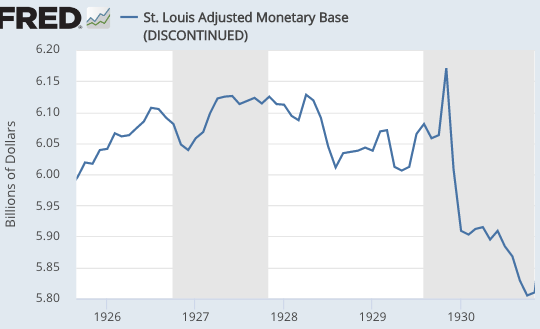
The Fed FAILED to do that in the 1930's

Screen-Shot-2020-11-26-at-6.37.34-PM.png
 
I'm not so sure that money supply means much to interest rate traders these days. And really hasn't since the 80's. Just my own observation, YMMV.
 
Its absurd to argue that the velocity is dropping BECAUSE of the increase in the monetary base (if anything, it helps velocity to move up not down), so I assume that's not what you are saying. So if velocity is dropping for other reasons, then the monetary base can offset that drop if done in SUFFICIENT amounts. How to tell if its sufficient? by looking at NGDP (Money supply * Velocity = NGDP, in particular EXPECTED NGDP). This is my point, the Fed has control of NGDP all along through increases on the monetary base (which boosts M2), they can offset all these velocity decreases that happen because of XYZ reasons. Which means the Fed NEVER runs "out of ammo" even if rates are at 0% because they can just keep increasing the monetary base

"Wouldn't that lead to hyperinflation?" No because as part of targeting NGDP (say 5% a year) they would also decrease the monetary base massively if velocity were to pick up (if people started to spend if they were concerned their cash would be worth less in a inflationary increase). Point is, for someone to belive that the Fed can 'run out of bullets' they must believe increases in the money supply cannot impact nominal incomes, and that nominal income increase will have no effect on consumer and asset prices. That seems a little nuts to me

The thing is the increase in money supply is not offsetting the decrease in money velocity because we are experiencing disinflation and decreasing GDP growth rate. Yes, there is both inflation and GDP growth, however, they are both decreasing for the past 25 years. So printing all this money is making people more and more reluctant to spend because they are in no hurry to spend as interest rates and inflation are both low.
ed224f7efef144dea8eaa26b5fe610ed.png
 
My very strong suspicion is that the COVID virus and the attendant uncertainty has regulated consumer spending much more than consumer prices or interest rates.

I think the Fed data (especially the Board commentary reflected in the meeting minutes) bears that out.

The thing is the increase in money supply is not offsetting the decrease in money velocity because we are experiencing disinflation and decreasing GDP growth rate. Yes, there is both inflation and GDP growth, however, they are both decreasing for the past 25 years. So printing all this money is making people more and more reluctant to spend because they are in no hurry to spend as interest rates and inflation are both low.View attachment 245245
 
Its absurd to argue that the velocity is dropping BECAUSE of the increase in the monetary base (if anything, it helps velocity to move up not down), so I assume that's not what you are saying. So if velocity is dropping for other reasons, then the monetary base can offset that drop if done in SUFFICIENT amounts. How to tell if its sufficient? by looking at NGDP (Money supply * Velocity = NGDP, in particular EXPECTED NGDP). This is my point, the Fed has control of NGDP all along through increases on the monetary base (which boosts M2), they can offset all these velocity decreases that happen because of XYZ reasons. Which means the Fed NEVER runs "out of ammo" even if rates are at 0% because they can just keep increasing the monetary base

"Wouldn't that lead to hyperinflation?" No because as part of targeting NGDP (say 5% a year) they would also decrease the monetary base massively if velocity were to pick up (if people started to spend if they were concerned their cash would be worth less in a inflationary increase). Point is, for someone to belive that the Fed can 'run out of bullets' they must believe increases in the money supply cannot impact nominal incomes, and that nominal income increase will have no effect on consumer and asset prices. That seems a little nuts to me
You're correct. The increased government spending ("outside money") is intended to compensate for a decline in velocity due to the service sector recession... And I agree with you re the way the fed will respond when it becomes necessary. And I am also in total agreement with respect to your comments re the "fed running out of bullets." It is interesting to note, however, that to some extent the fed is often "pushing on a string" when they introduce small incremental changes in the funds rate in an attempt to slow inflation by reducing credit demand. It's a weak, highly non linear tools. But fortunately they have other arrows in their quiver. It's just that their most powerful weapons require a cooperative Congress. In a typical economy, it is credit ("inside money") that is the most important determiner of the money supply. And the fed, without going to rate extremes, can affect credit demand only weakly by small changes in the funds rate over a fairly large range. But they do, indeed, have other tools.
 
Last edited:
Although some is being saved, these charts from Wolfstreet beg to differ. Spending on durable goods has exploded, and even the services sector is already recovering.

https://wolfstreet.com/2020/11/25/the-state-of-the-american-consumer-free-pandemic-money-runs-low/

View attachment 245087
View attachment 245088

The real shocker is income. The government came in nicely to make sure money didn't run dry. As it is, most are probably doing better now than before the crisis, at least for now. Combine this with some people not paying rent, and you can see people are flush with cash.

View attachment 245089

But of course, income from wages hasn't fully recovered yet, but its shockingly close. In 2021, if there is no more stimulus, and when the evictions and back rent can commence, it will be interesting what will happen then. But its obvious that the whole problem has been nicely papered over.

View attachment 245090
%%
2021,dont know about but US stock market uptrended >100+ years before federal reserve was formed.
Actually i traded some silver this year for federal reserve notes;
strange year/2020
The woman that printed my color tech ETF chart gave me a silver quarter in change/so i traded it/later........................................................................
 
Back
Top