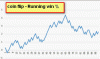
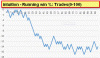
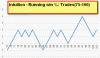
...You can make money trading by just tossing a coin to go long or short..providing..you have strict money management rules and "stick to it". If you do not believe me..then try it out..only way..forget about what anyone says..go and prove it to yourself!!!!
Now..once you prove it to yourself..or disprove it..come back and we will analyze your tosses and risk taken..all will be revealed in relation to how well you carried out the tasks.
In case you want to try it..as most will not..that I am certain of..here are the rules.
1. Divide your capital into at least 10 pieces..I would divide it into at least 50 for swing trades..into 100 for daytrades..but that is me..the choice is yours..but as the key is proper risk management then you must have a meaningful sample of trades to analyze.
2. Decide what you want to use for stop loss amount and profit target amount..or if you will use the charts to take your loss or profit based on your chart reading skills..remember..once you start you will be always in the market..either long or short..so..after your first entry..when your get stopped out..or win..you will toss the coin again and re-enter immediately..heads for long..tails for short.
3. Do it for as long as the money lasts..or until you have made an adequate number of trades for sampling..then the results can be looked at.
Note:as the key is both dividing your capital (the correct portions based on what style you pick..as in position..swing or daytrading)..and you stop loss and take profit criteria..spend some time on these..you do not have to worry one little bit about direction..as that is covered by the coin toss.
I will be very surprised if one person actually does it..but I am often wrong
I dunno why it took me so long, but I actually carried out this experiment? Over the course of a little over two months, live account, tiny money, real trades though, 100 trades.
Attached is a doc(some headings open collapsed) if anyone is curious, but here are the cliff notes if not interested in the word doc.
Direction was chosen by the coin flip. R:R was set at 1:1. Dollars risked was always a fixed amount through entire experiment, I.e., based on my reading of the instructions, I was not resizing as a % of account as account value increased/decreased. Target/Stop size was created by using 3 *(47 Period ATR on a 30 min chart). Always in.
Win % wound up being within the margin of error of a typical coin flip using 100 samples, 59% win.
I do not think the outcome is important, but I did make quite a few observations I intend to re-run, but w/o the coin.
 . It was interesting nonetheless.