Exactly what is volume scataphagos?

You are using an out of date browser. It may not display this or other websites correctly.
You should upgrade or use an alternative browser.
You should upgrade or use an alternative browser.
Why is 'market profile' only used for futures?
- Thread starter Jonathan Weissberg
- Start date

Exactly what is volume scataphagos?
It's some measure of the number of shares/contracts traded... with the implied "wisdom" that there is some value in knowing whether the number is high or low.
What do shares or contracts represent or indicate?It's some measure of the number of shares/contracts traded... with the implied "wisdom" that there is some value in knowing whether the number is high or low.

In an auction if everyone is trading at a certain price the market will gravitate back towards that price.Which goes to my point.
A trader's objective is to be "in tune with price"... that's how you get paid.
You don't get paid for being "in tune" with some volume consideration... including Market Profile or VWAP.
While "price and volume" is the conventional wisdom holy grail of markets and trading... Joe Granville significantly damaged his reputation with his obsession over his own measure of "On Balance Volume". At some point in his "early" usage of it, seem to correlate to market movement. When that calculation went all wonky, Granville stuck with it and continued to defend it... unfortunately to his discredit.
Bottom Line on volume.... FUGGETABOUTIT!!
The biggest issue with mp is figuring what type of day you're in. An inside day (normal day) is easy to trade. You trade from the extremes back to the price with the most volume.
The biggest difficulty is in recognising that day type that's why it doesn't work for most.
That plus you need ridiculous amounts of software and data subscriptions to use mp
Personally, I find no use whatsoever for Market Profile. It's based upon VOLUME*, for gawd sakes!
*Anyone who's read my rants on "volume" knows how I disdain it. Use of volume won't cause you to make bad trades, but it will cause you to miss some good ones.
KISS, baby.

Just for clarification, Market profile is not based on volume. It is based on the amount of time price spends at a specific level.
Just for clarification, Market profile is not based on volume. It is based on the amount of time price spends at a specific level.
And isn't that virtually the same as "number of contracts traded"? The more time price spends at one level, the more contracts get traded there.
That is not really what it is...Just for clarification, Market profile is not based on volume. It is based on the amount of time price spends at a specific level.
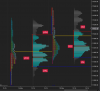
Market profile is number of contracts traded at a price (volume) 800 traded at 3660, 100 at 3670, 100 at 3650
The volume you see on your charts is contracts traded at a time - depending on your timeframe. 1000 traded at 10am when price was somewhere in between 3650 and 3670.
You can if you wish divide market profile by time segments if you want therefore combining the two.
Attachments
Last edited:

And isn't that virtually the same as "number of contracts traded"? The more time price spends at one level, the more contracts get traded there.
Not necessarily. At the open we see there is always a flurry of volume but price may not spend much time at that level, similarly at the close. That's why many Market Profile purists discount it or don't look at it at all. It is not required to view the two way auction or acceptance and rejection of price levels and the process of price discovery. Only price is.
Splitting hairs on Market Profile aside I agree with you for most retail traders going down the volume rabbit hole is a waste of time.
That is not really what it is...
Market profile is number of contracts traded at a price (volume) 800 traded at 3660, 100 at 3670, 100 at 3650
The volume you see on your charts is contracts traded at a time - depending on your timeframe. 1000 traded at 10am when price was somewhere in between 3650 and 3670.
You can if you wish divide market profile by time segments if you want therefore combining the two.
What you are referring to is Volume Profile and the segmentation of it through time. It is the offspring of the original market profiling technique developed by Peter Steidlmayer.
Market profiling developed by Pete Steidlmayer initially started with him simply marking the vertical range of price separated in 30 minute segments, creating the horizontal histogram formatting that is now synonymous with MP and VP visual. That's all, no volume. As he refined his method he added volume (but in the pit in the beginning it was not possible) and as we all know, his method of viewing market data was eventually packaged and marketed with volume data from the CBOT's LDB.
Over time he eventually left the 30 minute segmentation restrictiveness and desired to view the market more as the dynamic entity it is retaining the TPO (Time Price Opportunity) concept but dropping the time segmentation, leading to his latter work exhibited in the image below.
Till this day I have never found any software that can build profiles not based on a fixed time or volume segmentation.