Why do traders fail?

The big issue is a lack of skill - they don't know how to do anything the market is willing to pay money for.

Generally speaking the market pays for two things: correct prediction of future price, and arbitrage. if you don't have one of those two skills, you aren't getting paid.
 
Probably because they're not very good at trading. Like any zero sum game, it's tough to break into the big leagues.

Most people wouldn't expect to sit down at the biggest poker game in vegas and clean up without every having played before. Yet they'll trade ES and ZN right out of the gate.
 
Quote from emg:

Take a moment to look at the graphs


2i8i1ae.jpg


Small traders lacked higher education. They need to subscribed 3rd party educational/trading system vendors. when they do, their cycle begins


2ih5yd0.jpg


they will reload their accounts over and over again.


More than 90% of small traders lose! They just lose!


http://www.bloomberg.com/news/2012-...-seen-profiting-at-small-firm-expense-1-.html


2sanifm.jpg

I my opinion, the above info on a small trader is bogus. I am a small trader and did not walk the traditional path of working for any financial firm. I did not go to school for finance, economics, or business. My account size is in the 10's of thousands (started off with 6.5k).

I can only speak for myself, but in my opinion, the reason why a large number of RETAIL traders fail is that they try to mimic what large scale traders are doing (i.e., using trading products that represent extreme leverage vs. a retail traders available capital to trade with). As a small trader, I can't mimic what a prop firm, Goldman Sachs, or whatever else financial institution/hedge fund/prop firm/HTF/etc. does as far as trading.

Personally, I believe those charts posted represent nothing a RETAIL trader should focus on. Finally, I believe its relative in terms of capital growth. Someone starting out with a few thousand growing that amount to a few million is a great success (especially if that person lives well below their means). Being a small trader is independent of education level. If a small trader has discipline, focus, and determination, they will overcome most of the noise that is spewed forth as “trading”. If one has the ability to learn, then one can become a trader through time.
 
Quote from emg:

take a look at the article

http://articles.latimes.com/2011/apr/03/business/la-fi-amateur-currency-trading-20110403/3

e7kk95.jpg


According to FXCM. 75% of small traders lose on a quarterly basis. The annual basis result to almost 100% of small traders lose.


According to CFTC

http://www.cftc.gov/ConsumerProtect...on/ForeignCurrencyTrading/cftcnasaaforexalert

2ngbdon.jpg


because small traders are poor and lower educated, they are prone to become a victim of fraud. u can open a fx account as little as $300 and day trade high volatility and leverage.
 
In addition to the excellent comments above, I see far too many retail traders who don't treat trading seriously. They act like it should be fun, like a video game, instead of a business. They get bored and they post here to whine about it like children. "Yes I'm profitable (HA!) but why is trading so boooooring?"

I think some of these people have been brainwashed by the ads on CNBC and elsewhere that show traders having fun, Fun, FUN! But that doesn't explain all of them IMO.

Another element is gamblers who decide to try something different than the casinos and sports books they have become jaded with. Naturally and sadly, these addicts decide to give trading a whirl. And what a whirl it is. For a gambler, trading must look like the Wild West. There is no house (except the brokers of course), there are no rigid rules, you can pretty much do whatever you want. Unlike blackjack where the only way to press your advantage is to vary your bet size, in trading you can decide when to enter a market, when to exit a market, and of course how much to vary your trade size. You can even decide to ignore a trade signal, unlike blackjack where you must play every hand dealt or leave the table. We just got rid of a guy (probably blew up his <s>gambling</s> trading account) who loved starting threads about increasing size during a losing streak and all the other stupid stuff gambling addicts love to wallow in. It's like he was looking for validation for all his addictive behavior or maybe he was just trying to drag some of us down to his level. Annoying to say the least.
 
Quote from emg:

because small traders are poor and lower educated... [/B]

Stated again, one’s education level is independent of capital level. There are a lot of intelligent people on the planet that don't have large levels of capital. There are also people with capital that don't have high levels of education. These things are not one and the same. Last, it may be the case that too much "education" may hinder someone in actually trading well due to pre-conceived biases in a "high level education". Highly “educated” large capital traders fail too, with even larger levels of capital/leverage:eek:! I’ll go out on a limb and state that the traders that do fail are normally distributed across the education/capital spectrum. One thing is for sure: There are high education/high capital losers, high education/low capital losers, low education/high capital lowers, and low education/low capital losers and they outnumber the successful ones.

It would be great to see a true breakout of that data but I’m not sure where one could obtain it.

*I'm defining education as going to school/college and having a high general level of education finance/economics/business admin. To me (my opinion), this does not teach actionable trading.
 
Quote from Tradester123:

Guys, i am a student currently in the process of carrying out research fro why traders fail as i have to complete a 10,000 word project on why they do. I've been searching and i have come across a few reasons for why they do, but these few will not be enough, if anyone could help me and reply with reasons to why traders to fail, it would be much appreciated.

- Tradester123

Hi Tradester,

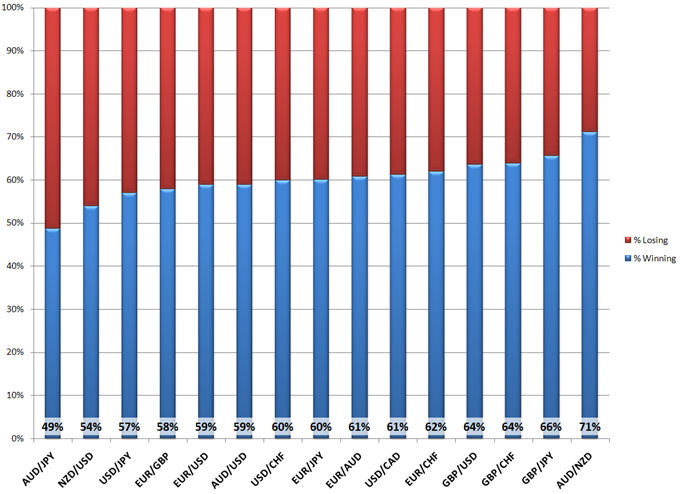
Poor risk management is a major factor that prevents traders from being profitable. For example, the chart below shows the results of a data set of over 12 million real trades conducted by FXCM clients worldwide in 2009 and 2010. It shows the 15 most popular currency pairs that clients trade.

What_is_the_Number_One_Mistake_Forex_Traders_Make_body_percent_trade_profitable.png


The blue bar shows the percentage of trades that ended with a profit for the client. Red shows the percentage of trades that ended in loss. For example, in EUR/USD, the most popular currency pair, FXCM clients in the sample were profitable on 59% of their trades, and lost on 41% of their trades.

So if traders tend to be right more than half the time, what are they doing wrong?

What_is_the_Number_One_Mistake_Forex_Traders_Make_body_trade_pips.png


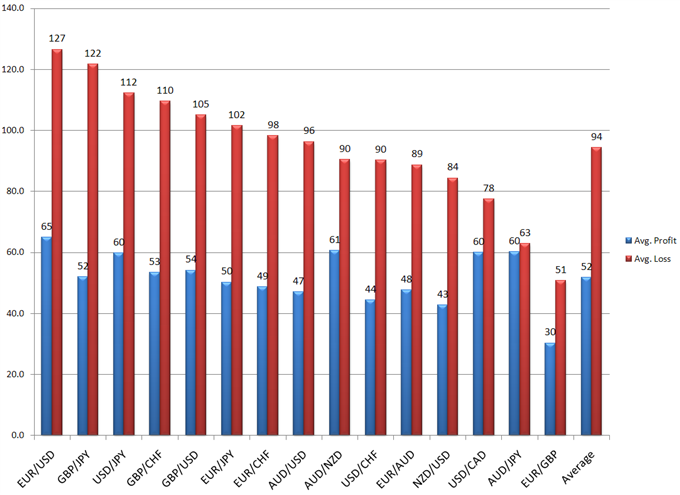
The above chart explains it. In blue, it shows the average number of pips traders earned on profitable trades. In red, it shows the average number of pips lost in losing trades. We can now clearly see why traders lose money despite being right more than half the time. They lose more money on their losing trades than they make on their winning trades.

Let’s use EUR/USD as an example. We know that EUR/USD trades were profitable 59% of the time, but trader losses on EUR/USD were an average of 127 pips while profits were only an average of 65 pips. While traders were correct more than half the time, they lost nearly twice as much on their losing trades as they won on winning trades losing money overall.

The track record for the volatile GBP/JPY pair was even worse. Traders were right an impressive 66% of the time in GBP/JPY – that’s twice as many successful trades as unsuccessful ones. However, traders overall lost money in GBP/JPY because they made an average of only 52 pips on winning trades, while losing more than twice that – an average 122 pips – on losing trades.

That data above are from a series of studies into trader profitability conducted by the analysts at DailyFX. I hope you'll find the information useful for your project.

Good hunting!

Jason

 
Quote from Jason Rogers:

Hi Tradester,

Poor risk management is a major factor that prevents traders from being profitable. For example, the chart below shows the results of a data set of over 12 million real trades conducted by FXCM clients worldwide in 2009 and 2010. It shows the 15 most popular currency pairs that clients trade....

What's amazing about this data is how BAD the averages are - these traders are losing 7-15 pips on average per trade depending on pair. That means you could reverse their signals, eat the spread and slippage, and STILL make solid money.

This is actually one of the clearest contradictions of the EMH I've ever seen in print because of the incredible sample size.
 
Back
Top