
With number 3 being the most important. It is in fact, the only true edge in trading.Basically, it goes like this:
1. Study. (This can take from 1 to 10 years.)
2. Entry.
3. Money management.
4. Exit.
5. Repeat 2-4.

You are using an out of date browser. It may not display this or other websites correctly.
You should upgrade or use an alternative browser.
You should upgrade or use an alternative browser.
Why Do Most Retail Traders Favour Technical Analysis ?
- Thread starter Fundlord
- Start date
Because retail traders are not investors and generally don't have the capital to trade fundamentals and hold through huge drawdowns before their thesis is finally proved correct. (Read "The Big Short" for an example of fundamental analysis being spot on, but a year or two too early.) For short term trading and day trading, NOTHING beats technical analysis for providing a framework of low risk, high reward setups.
99% of retail traders don't lose because they use technical analysis and/or indicators; they lose because they have no idea how to conduct statistical analyses (or no work ethic to do so) and/or no idea how to think in terms of probabilities once a statistically sound plan is developed.
Correlation does not equal causation.
How do you conduct statistical analysis? Something like based on 100 trades i seem to recall you saying. peace. surf
More traders are in TA because FA has a big lag and could be used for long-term trading. You cannot use FA in intraday trading where many traders turn trading into a gambling by trying to catch several points. On the other hand TA helps those traders to see parent dominant trend and build trading strategy accordingly, calculate expected profit and stop loss levels, define points where intraday trend is sensitive to changes and etc. People use TA to develop system and trade them.
At the same time, you cannot use TA in long-term analysis. You may use some indicators to see when market is predisposed to reverse its long-term trend. Yet, it will be just a current sentiment that could become completely opposite in a week and or a month. TA will not tell you where the market will be in 1 or 2 years. Whoever does it is just trying to sell something.
I guess the conflict between those who believe in TA and those who believe in FA is simply imaginary. Each analysis has its cons and pros. Simply put, most of FA traders are long-term investors and they just do not want to understand the TA traders who mostly trade in short-term. At the same TA traders do not want to understand FA traders.
Every tool has it purpose and there is no straight answer on what is better, TA or FA. Both, TA and FA use past data to predict possible future trend development which in both cases is not guaranteed.
At the same time, you cannot use TA in long-term analysis. You may use some indicators to see when market is predisposed to reverse its long-term trend. Yet, it will be just a current sentiment that could become completely opposite in a week and or a month. TA will not tell you where the market will be in 1 or 2 years. Whoever does it is just trying to sell something.
I guess the conflict between those who believe in TA and those who believe in FA is simply imaginary. Each analysis has its cons and pros. Simply put, most of FA traders are long-term investors and they just do not want to understand the TA traders who mostly trade in short-term. At the same TA traders do not want to understand FA traders.
Every tool has it purpose and there is no straight answer on what is better, TA or FA. Both, TA and FA use past data to predict possible future trend development which in both cases is not guaranteed.
More traders are in TA because FA has a big lag and could be used for long-term trading. You cannot use FA in intraday trading where many traders turn trading into a gambling by trying to catch several points. On the other hand TA helps those traders to see parent dominant trend and build trading strategy accordingly, calculate expected profit and stop loss levels, define points where intraday trend is sensitive to changes and etc. People use TA to develop system and trade them.
At the same time, you cannot use TA in long-term analysis. You may use some indicators to see when market is predisposed to reverse its long-term trend. Yet, it will be just a current sentiment that could become completely opposite in a week and or a month. TA will not tell you where the market will be in 1 or 2 years. Whoever does it is just trying to sell something.
I guess the conflict between those who believe in TA and those who believe in FA is simply imaginary. Each analysis has its cons and pros. Simply put, most of FA traders are long-term investors and they just do not want to understand the TA traders who mostly trade in short-term. At the same TA traders do not want to understand FA traders.
Every tool has it purpose and there is no straight answer on what is better, TA or FA. Both, TA and FA use past data to predict possible future trend development which in both cases is not guaranteed.
The point you assume is that there is trend development. TA assumes that and is a study in how to get on the bandwagon. However, there are the random walkers and other models such as those that price options that don't assume there is a trend.
One should always assume that trend will occur. Markets are always trending on some time frame. There is no such thing as range trading. Kramer frutes will typically have difficulty with this concept.The point you assume is that there is trend development. TA assumes that and is a study in how to get on the bandwagon. However, there are the random walkers and other models such as those that price options that don't assume there is a trend.

1) Let's look into intraday trend formed by a report. Let's assume on Wed, a report came out that oil supplies increased. As anyone who took a basic Economic course in college knows that when supply increases price decreases. So price now trends down. That is how a trend forms and will either continue until another report comes out or a certain price level is reached. This is why random walk theory and price drivers are bullshit. We have cause and effect that can be quantified.
2) Now while markets are in fact always trending (caused by a previous report), trend can take a break and form a range. If the range is wide enough it can in fact be traded intraday. For a longer term trend trader, you would not see this range and think that there is no such thing as range trading since your stops and targets lie outside of the range. For example, if you are short, you would just be sitting on your position till the market breaks out of the range and either continues to go down or goes back up and hits your stop. Either way, you don't see the range since you are already in a trade.
3) This is not to say that sometimes the market is during the day either moving randomly or in a barb wire sideways formation. In both cases, you should not be initiating a trade or if in a trade, you should get out of it. Again this does not apply to a longer term trader that is holding over multiple days.
2) Now while markets are in fact always trending (caused by a previous report), trend can take a break and form a range. If the range is wide enough it can in fact be traded intraday. For a longer term trend trader, you would not see this range and think that there is no such thing as range trading since your stops and targets lie outside of the range. For example, if you are short, you would just be sitting on your position till the market breaks out of the range and either continues to go down or goes back up and hits your stop. Either way, you don't see the range since you are already in a trade.
3) This is not to say that sometimes the market is during the day either moving randomly or in a barb wire sideways formation. In both cases, you should not be initiating a trade or if in a trade, you should get out of it. Again this does not apply to a longer term trader that is holding over multiple days.
One should always assume that trend will occur. Markets are always trending on some time frame. There is no such thing as range trading. Kramer frutes will typically have difficulty with this concept.
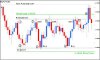

Markets only trend. They do not range.
When price in between its all time hi / all time low - for that instrument
That's a range

RN