Why are Central Banks using Economic Growth Control Mechanisms to Control Inflation?

  • Thread starter Thread starter morganist
  • Start date Start date
TAYLOR RULE:
As an equation...

According to Taylor's original version of the rule, the nominal interest rate should respond to divergences of actual inflation rates from target inflation rates and of actual Gross Domestic Product (GDP) from potential GDP:

f5b0deedb18aaa3151bae6ad4acdd2020bcd35af


In this equation,
66beb59459029e09f988ee95c8cfe5f9bd8758ff
is the target short-term nominal interest rate (e.g. the federal funds rate in the US, the Bank of England base rate in the UK),
ca8dac7c61a6bb1439e89dff079a7d0511c4e0a6
is the rate of inflation as measured by the GDP deflator,
05fd4f30920cec20c1e29da234bdcc6274ab8242
is the desired rate of inflation,
bc58c437226952cff9d048d1f72d23a6003433e6
is the assumed equilibrium real interest rate,
fea9882b96b5fd262e3c428b4b3ff1c3b50821c9
is the logarithm of real GDP, and
8d2599eb2fb4060469d403d142d440e5b8cefe62
is the logarithm of potential output, as determined by a linear trend.

In this equation, both
868e5d00fa801401bcb55ed3b060b025f4c0de0d
and
4332752b07ec00b533637753ef567a2730cf335f
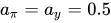
should be positive (as a rough rule of thumb, Taylor's 1993 paper proposed setting
84c513e7db727141b5c1f9d0db9a8e2063a5e94e
).[6] That is, the rule "recommends" a relatively high interest rate (a "tight" monetary policy) when inflation is above its target or when output is above its full-employment level, in order to reduce inflationary pressure. It recommends a relatively low interest rate ("easy" monetary policy) in the opposite situation, to stimulate output. Sometimes monetary policy goals may conflict, as in the case of stagflation, when inflation is above its target while output is below full employment. In such a situation, a Taylor rule specifies the relative weights given to reducing inflation versus increasing output.

Entirely stolen from Wikipedia:
https://en.wikipedia.org/wiki/Taylor_rule

 
Inflation is theft and a redistobution scheme

conventional wisdom, used by gold/silver/bitcoin salesmen to push the so called 'safe' assets.

a 2% inflation target is necessary safety margin to avoid the deflation black hole.

inflation is theft only if you put cash under the mattress.
 
there is a difference between 2% and 200%
more
actually it is 1600% but why quibble. if you believe that US government inflation figures reflect reality I will sell you the San francisco bridge real cheap.
 
more
actually it is 1600% but why quibble. if you believe that US government inflation figures reflect reality I will sell you the San francisco bridge real cheap.

sure, people can debate price indexing to the end of time... and I am not really a fan of the CPI indexing.

but, if you didn't put money under the mattress, and invest, especially in the SF area, the return will more than negating the inflation index.
 
TAYLOR RULE:
As an equation...

According to Taylor's original version of the rule, the nominal interest rate should respond to divergences of actual inflation rates from target inflation rates and of actual Gross Domestic Product (GDP) from potential GDP:

f5b0deedb18aaa3151bae6ad4acdd2020bcd35af


In this equation,
66beb59459029e09f988ee95c8cfe5f9bd8758ff
is the target short-term nominal interest rate (e.g. the federal funds rate in the US, the Bank of England base rate in the UK),
ca8dac7c61a6bb1439e89dff079a7d0511c4e0a6
is the rate of inflation as measured by the GDP deflator,
05fd4f30920cec20c1e29da234bdcc6274ab8242
is the desired rate of inflation,
bc58c437226952cff9d048d1f72d23a6003433e6
is the assumed equilibrium real interest rate,
fea9882b96b5fd262e3c428b4b3ff1c3b50821c9
is the logarithm of real GDP, and
8d2599eb2fb4060469d403d142d440e5b8cefe62
is the logarithm of potential output, as determined by a linear trend.

In this equation, both
868e5d00fa801401bcb55ed3b060b025f4c0de0d
and
4332752b07ec00b533637753ef567a2730cf335f
should be positive (as a rough rule of thumb, Taylor's 1993 paper proposed setting
84c513e7db727141b5c1f9d0db9a8e2063a5e94e
).[6] That is, the rule "recommends" a relatively high interest rate (a "tight" monetary policy) when inflation is above its target or when output is above its full-employment level, in order to reduce inflationary pressure. It recommends a relatively low interest rate ("easy" monetary policy) in the opposite situation, to stimulate output. Sometimes monetary policy goals may conflict, as in the case of stagflation, when inflation is above its target while output is below full employment. In such a situation, a Taylor rule specifies the relative weights given to reducing inflation versus increasing output.

Entirely stolen from Wikipedia:
https://en.wikipedia.org/wiki/Taylor_rule


Niceee... simple working stuff for Fed. that's why they are now calm with inflation above 2 percents. Can we expect further stock rally because of that?
 
Inflation is theft and a redistobution scheme

Regardless of the question of whether you should control inflation or not. The question raised is why do they use aggregate demand controls (another thing) to control inflation.

Read the linked article. This may be a bigger issue than the question of controlling inflation in the first place. There are other mechanisms which can control inflation.
 
Back
Top