White Privilege

Majority Of 'Fox News Sunday' Guests Discussing Ferguson Are White
By Jackson Connor

n-FOX-NEWS-SUNDAY-large570.jpg


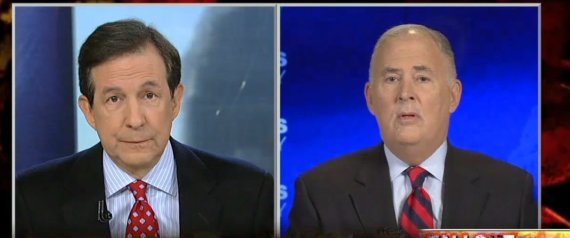
"Fox News Sunday" had a disproportionate number of white guests on air to discuss the protests in Ferguson, Missouri, and the resignation of officer Darren Wilson, according to a report by Media Matters published Monday.

On Nov. 30, "Fox News Sunday" invited six white guests and two guests of color to discuss the events unfolding in Ferguson. The debate centered on the killing of an unarmed black teenager, Michael Brown, and the greatly affected black community in America.

"On Fox Broadcasting Co.'s Fox News Sunday, an all-white panel discussed the developments in Ferguson and how the United States can best combat racial discrimination," the report reads. "The show also hosted a separate discussion with two lawyers in the case, one of whom is white, and held solo interviews on the topic."

Sunday talk shows on other networks offered more diversity in their handling of the discussion, however.

"On November 30, 67 percent of guests on NBC's Meet the Press during segments on Ferguson were people of color, or six out of a total of nine," the report reads. "ABC's This Week hosted three white guests and three black guests, or 50 percent, while CBS' Face the Nation hosted slightly more white guests, four out of a total of seven."

original.jpg


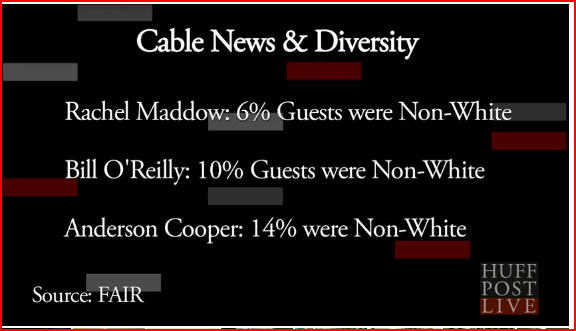
Studies have shown that people of color are often under-represented on television news, regardless of the topic of conversation. In July, progressive watchdog Fairness and Accuracy in Reporting (FAIR) found that 84 percent of guests on top cable news shows were white.

--------------------------

No bias here. Move along please.
http://www.huffingtonpost.com/2014/...rsity-fair-study-cnn-msnbc-fox_n_5591591.html
huffprodiv_zps48b37361.png
 
In one of the most famous passages of the New Testament, the apostle Paul writes to the Christians of Corinth, employing a complicated series of metaphors on the theme of transformation: from childhood to adulthood, from ignorance to knowledge, from sinfulness to a state of grace. “When I was a child, I spake as a child, I understood as a child, I thought as a child,” the epistle runs, in the memorable rhythms of the King James Version. “But when I became a man, I put away childish things. For now we see through a glass, darkly; but then face to face: now I know in part; but then shall I know even as also I am known.”

I’m not a believer, in the ordinary sense of that word, and I’m aware that Paul is a problematic figure in theological history, to put it mildly. But those words have resonated with me over the last two weeks. Painful recent events on the ground in Ferguson, Missouri — and the strongly divided national response to those events — offer us a chance to become aware of the ways we see race in America “through a glass, darkly,” and perhaps also the beginnings of a chance to see each other face to face, to know as we are known. Let me be clear that when I say “we” I am primarily addressing America’s white majority, to which I belong. We are the ones whose vision is occluded by the darkened glass of white privilege, and it’s up to us to do something about it. Black people can see white privilege pretty clearly, but from a different perspective, and it’s beyond their power to change it.

White privilege is a term that sometimes gets thrown around too cavalierly, especially when people are having a fight on the Internet and want to shut each other up. (I find myself echoing here many of the things I wrote about masculinity and male privilege in the wake of the Elliot Rodger case in May. It’s been a tough summer in America.) Recognizing white privilege does not mean that white people don’t get to express our views on controversial racial topics, or that we have to defer to whatever a person of color may say. It does mean, however, that we have a responsibility to be alert to advantages we may possess, whether as ordinary citizens on the street, economic agents or wielders of rhetoric that appears neutral rather than “racial.” By definition, it means that some of those advantages are things we don’t notice, or take entirely for granted.

My former Salon colleague Matt Zoller Seitz (now the editor of Roger Ebert’s website) wrote a memorable personal essay on this topic last week. It generated some heated discussion among my colleagues, because it’s arguably only half on-topic. It was partly a confession about a period of extreme disorder in Matt’s own life, when he did some foolish and destructive things, and partly a reckoning with the fact that the consequences of those actions could have been a whole lot worse if he hadn’t had white skin. I have no anecdotes anywhere near that dramatic in my past, but like many other white people who read Matt’s story, I was compelled to think about encounters with cops where I was treated courteously and given the benefit of the doubt, and where it never even occurred to me that the outcome might have been different for someone who didn’t look like me. (A traffic stop in suburban California at age 18: underage, probably over the limit and carrying both alcohol and marijuana. “Drive yourself straight home, son, and don’t let me see you out here again.”)

But the most insidious power of white privilege, the albatross effect that makes it so oppressive to white people themselves, is the way it renders itself invisible and clouds the collective mind. It’s like a virus that adapts in order to ensure its own survival and perpetuation, in this case by convincing its host it isn’t there. So we see polls suggesting that large percentages of white Americans believe that racism is not a significant factor in Ferguson or law enforcement in general, that cops are just doing their jobs, and that whatever bad things may have happened once upon a time in our beloved country, they’ve been locked away in the dusty cabinet of history and don’t matter anymore. We passed the Voting Rights Act and exiled the Ku Klux Klan to the margins of society (or at least to websites with really bad graphics). Ergo, white privilege obviously doesn’t exist anymore.

Among the “childish things” we need to put aside, white people, is the idea that America’s tormented racial legacy belongs to the past. You know exactly the attitude I mean: We have twice elected a biracial president and LeBron James and Jay Z are zillionaires, so no more talk of racism, please. In the more paranoid formulation prevalent in the Fox News demographic (but not limited to it), this becomes the idea that the federal government has spent the last 50 years giving away money, housing, education and other “free stuff” to black people who don’t work or pay taxes, while vigorously grinding down the white man. So either the vision of healing and reconciliation conjured up so eloquently by Martin Luther King, Jr. more than 50 years ago has now been fulfilled (and black people need to stop complaining), or America is being not so slowly turned into a gay-Muslim-socialist totalitarian state where every day is Kwanzaa. Both scenarios come up against the nettlesome fact that African-Americans stubbornly persist in being poor, living in disadvantaged circumstances, getting shot by the police for no particular reason and going to prison in large numbers.

This kind of white privilege is a willful blindness, along with a passionate embrace of exactly the kind of aggrievement and victimhood that white people often claim to resent in others. It’s found in Sarah Palin and Sean Hannity, of course, but also among people like hipster über-troll Gavin McInnes, the co-founder of Vice, who wrote a piece not long ago explaining that racism, sexism and homophobia do not actually exist. But I’m not principally talking about Republican ideologues and their hardcore supporters, who have built their power and influence on thinly veiled racism over the past 40 years and barely even bother denying it. There is a much larger population of white Americans, I believe, who feel troubled by what they saw in Ferguson but are unable or unwilling to face the fact that it reflects a recurring historical pattern that has obviously not been exorcised, a pattern of power, privilege and domination in which they are complicit.

Any white person who is being honest can understand this reluctance, and probably any other kind of person too. It’s a lot more comfortable to believe that equal opportunity has been pretty much afforded to all, allowing for some bumps in the road – or to believe that you yourself belong to the unfairly downtrodden and stigmatized group – than to consider the alternatives. It is not comfortable at all for any white American to read the case assembled by Ta-Nehisi Coates in his magisterial reported essay “The Case for Reparations” that American society has not done nearly enough to erase the cultural and historical debt left behind by 250 years of slavery followed by another century-plus of economic discrimination, political suppression, institutionalized theft and straight-up terrorism. “It is as though we have run up a credit-card bill and, having pledged to charge no more, remain befuddled that the balance does not disappear,” Coates writes. “The effects of that balance, interest accruing daily, are all around us.”

William Faulkner’s famous remark that the past is not dead, and isn’t even past, could not be more vividly illustrated than by the images from Ferguson: A black man shot dead in the street; angry African-American protesters facing impassive and heavily armed white police officers; tear gas, broken glass and the National Guard. But how to deal with these events that seem like nightmarish echoes of too many previous events? One way, the path of survival pursued by the virus of white privilege, is to detach each of these cases from history. Each of these inexplicably dead black men becomes an isolated phenomenon, with no reference to any discernible pattern. History is bunk, as Henry Ford and then the Gang of Four told us; there are no lessons in the past.

(cont'd)

Dipshit,

Can you please post links to the original articles when posting articles?

TIA

WeToddDid
 
Dipshit,

Can you please post links to the original articles when posting articles?

TIA

WeToddDid

I can't imagine why anyone would not leap at the opportunity to answer a question that is put so politely.

Why not google it? Or fuck yourself? Or both?
 
Fatalism Is Not An Option In Battle Against Racism
Ed Mazza


While many of the recent protests around the country have focused on racism and the police, the officers themselves may only be part of the problem.

During MSNBC's "All In with Chris Hayes" on Wednesday night, Ta-Nehisi Coates, national correspondent at The Atlantic, said police are just doing what society wants them to do.

"We have this long history of racism in this country, and as it happens the criminal justice system has been perhaps the most prominent instrument for administering racism," Coates said. "But the racism doesn't actually come from the criminal justice system. It doesn't come from the police. The police are pretty much doing what the society that they originate from want them to do."

However, Coates also told Hayes that it was important to avoid fatalism.

"I'm the descendent of enslaved black people in this country. You could've been born in 1820, if you were black and looked back to your ancestors and saw nothing but slaves all the way back to 1619. Look forward another 50 or 60 years and saw nothing but slaves.

There was reason at that point in time to believe that emancipation was 40 or 50 years off. And yet folks resisted and folks fought on. So fatalism isn't really an option. Even if you think you're not going to necessarily win the fight today in your lifetime, in your child's lifetime, you still have to fight. It's kind of selfish to say that you're only going to fight for a victory that you will live to see.

As an African-American, we stand on the shoulders of people who fought despite not seeing victories in their lifetime or even in their children's lifetime or even in their grandchildren's lifetime. So fatalism isn't really an option."​
 
Fox News’ racial confusion: What Charles Barkley and Ben Carson could teach Megyn Kelly
Fox's Megyn Kelly says something can't be racist if a person of color believes it. Here's the lesson she's missing
ELIAS ISQUITH


Charles Barkley, Megyn Kelly, Ben Carson (Credit: AP/Elise Amendola/Alex Kroke/Reuters/Mike Theiler/Photo montage by Salon)​

During a characteristically unilluminating and stupefying interview with Texas Rep. Al Green on Tuesday, Fox News’ Megyn Kelly seemed to think she had a mic drop-worthy response to the Democrat’s criticisms of the outcome in Ferguson, Missouri. “Every witness that testified [Michael Brown] was charging [at Darren Wilson] was African-American!” she said. “How is this a race thing?” Green, who is a member of the Congressional Black Caucus, essentially responded by simply ignoring and talking over Kelly, which was probably for the best.

For the kind of people who can spend an hour listening to Bill O’Reilly’s insights on black people’s meager intelligence, only to then decide that they’d like to hear the greatest hits of white resentment politics, but this time from a more telegenic singer, Kelly’s line was probably a real winner. (Indeed, not since the first suburban white 13-year-old blasted the double-standard that keeps him from saying the N-word, while letting Jay Z do it unchallenged, has a white person leveled a more crushing blow to the “racial grievance industry.”) Anyone who understands that being a member of a minority group does not negate the capacity for independent thought, however, likely found Kelly’s comeback less definitive.

Megyn Kelly is popular, influential and fond of disseminating racist nonsense throughout American politics. But that’s not the reason I’m bringing her Tuesday interview up. Instead, the phenomenon that I think it illustrates quite cleanly — and that still goes unappreciated by many Americans, and not just the ones watching Fox — is how bigoted logic, if it’s mainstream enough, can grab hold of anyone, regardless of their political or social identity. Put differently, there’s no reason that the long-standing American meme of the irrational, hostile and animalistic young black man cannot be adopted by people who are themselves black [bold mine]. And there’s no reason they can’t bring that inherited worldview with them when they’re sitting on a grand jury.

While it’s certainly possible for someone to harbor prejudice toward a group they belong to — the archetype of the self-hating Jew, for example, wasn’t just a creation of hard-line right-wing Zionists — what usually happens when we harbor these thoughts about ourselves is that we find some reason, no matter how flimsy, to conclude “we” are not like “them” [bold mine]. For women, this can take the form of blaming female rape victims for their own misfortune, which usually rests on the idea that the assaulted did something her female critic would never do. The process may also be evident with members of the LGBTQ community who argue that hatred directed their way could be lessened if only folks on their side were more mild-mannered.

To see this at play among black people in America, let’s look at two African-American celebrities who are known to enjoy slamming people who look like them for failing to act like them, too: Ben Carson and Charles Barkley. Carson, of course, is in the news right now because of his vainglorious and all-but-official campaign to be elected president in 2016. But while Carson was an enormously successful and celebrated neurosurgeon in an earlier life, he’s become a national conservative icon over the past few years chiefly because of his willingness to say things about President Obama — and black people, in general — that white conservatives want to but know they can’t. Former NBA great and beloved TV personality Charles Barkley, meanwhile, is now earning attention from a whole new audience by using the controversy in Ferguson to do much the same by defending the unconstitutional practice of racial profiling, as well as the grand jury’s decision in favor of Darren Wilson.

In both cases, these wealthy and powerful men set themselves up as positive, contrary examples of black masculinity. They wear their pants high. They work hard. They respect their country and its various sacred myths. And in both cases, it’s very likely that they truly believe in their own superiority; they’re both supremely gifted and have both expressed sentiments along these lines for decades. But the fact that they believe themselves to be living proof that most of their fellow black Americans more or less are what racists claim — lazy, entitled, irrational and, above all else, more invested in their victimhood than in the quality of their and their children’s lives — is not a sign that these sentiments aren’t racist. It’s merely a sign of the enormous, lingering influence of white supremacy in our culture, as well as the boundless human capacity to respond to that which scares us (like the idea that we, too, might be treated unjustly for reasons outside our control) by concocting some reason why we need not feel unsafe.

Whether they’re good or bad, cruel or kind, ideologies like racism, homophobia and sexism have a life of their own. They’re adaptable. They’re flexible. They can contort themselves to best fit their time and place. So if we believe in equality — as I’m sure Barkley, Carson and Kelly believe they do — there’s no reason to be surprised that a black person might’ve voted in Wilson’s favor or echoed Bill O’Reilly’s latest rant. But none of it proves Kelly’s point.
 
Ferguson had nothing to do with race, Salon is a fag rag, you listen to judy garland.


Fox News’ racial confusion: What Charles Barkley and Ben Carson could teach Megyn Kelly
Fox's Megyn Kelly says something can't be racist if a person of color believes it. Here's the lesson she's missing
ELIAS ISQUITH


Charles Barkley, Megyn Kelly, Ben Carson (Credit: AP/Elise Amendola/Alex Kroke/Reuters/Mike Theiler/Photo montage by Salon)​

During a characteristically unilluminating and stupefying interview with Texas Rep. Al Green on Tuesday, Fox News’ Megyn Kelly seemed to think she had a mic drop-worthy response to the Democrat’s criticisms of the outcome in Ferguson, Missouri. “Every witness that testified [Michael Brown] was charging [at Darren Wilson] was African-American!” she said. “How is this a race thing?” Green, who is a member of the Congressional Black Caucus, essentially responded by simply ignoring and talking over Kelly, which was probably for the best.

For the kind of people who can spend an hour listening to Bill O’Reilly’s insights on black people’s meager intelligence, only to then decide that they’d like to hear the greatest hits of white resentment politics, but this time from a more telegenic singer, Kelly’s line was probably a real winner. (Indeed, not since the first suburban white 13-year-old blasted the double-standard that keeps him from saying the N-word, while letting Jay Z do it unchallenged, has a white person leveled a more crushing blow to the “racial grievance industry.”) Anyone who understands that being a member of a minority group does not negate the capacity for independent thought, however, likely found Kelly’s comeback less definitive.

Megyn Kelly is popular, influential and fond of disseminating racist nonsense throughout American politics. But that’s not the reason I’m bringing her Tuesday interview up. Instead, the phenomenon that I think it illustrates quite cleanly — and that still goes unappreciated by many Americans, and not just the ones watching Fox — is how bigoted logic, if it’s mainstream enough, can grab hold of anyone, regardless of their political or social identity. Put differently, there’s no reason that the long-standing American meme of the irrational, hostile and animalistic young black man cannot be adopted by people who are themselves black [bold mine]. And there’s no reason they can’t bring that inherited worldview with them when they’re sitting on a grand jury.

While it’s certainly possible for someone to harbor prejudice toward a group they belong to — the archetype of the self-hating Jew, for example, wasn’t just a creation of hard-line right-wing Zionists — what usually happens when we harbor these thoughts about ourselves is that we find some reason, no matter how flimsy, to conclude “we” are not like “them” [bold mine]. For women, this can take the form of blaming female rape victims for their own misfortune, which usually rests on the idea that the assaulted did something her female critic would never do. The process may also be evident with members of the LGBTQ community who argue that hatred directed their way could be lessened if only folks on their side were more mild-mannered.

To see this at play among black people in America, let’s look at two African-American celebrities who are known to enjoy slamming people who look like them for failing to act like them, too: Ben Carson and Charles Barkley. Carson, of course, is in the news right now because of his vainglorious and all-but-official campaign to be elected president in 2016. But while Carson was an enormously successful and celebrated neurosurgeon in an earlier life, he’s become a national conservative icon over the past few years chiefly because of his willingness to say things about President Obama — and black people, in general — that white conservatives want to but know they can’t. Former NBA great and beloved TV personality Charles Barkley, meanwhile, is now earning attention from a whole new audience by using the controversy in Ferguson to do much the same by defending the unconstitutional practice of racial profiling, as well as the grand jury’s decision in favor of Darren Wilson.

In both cases, these wealthy and powerful men set themselves up as positive, contrary examples of black masculinity. They wear their pants high. They work hard. They respect their country and its various sacred myths. And in both cases, it’s very likely that they truly believe in their own superiority; they’re both supremely gifted and have both expressed sentiments along these lines for decades. But the fact that they believe themselves to be living proof that most of their fellow black Americans more or less are what racists claim — lazy, entitled, irrational and, above all else, more invested in their victimhood than in the quality of their and their children’s lives — is not a sign that these sentiments aren’t racist. It’s merely a sign of the enormous, lingering influence of white supremacy in our culture, as well as the boundless human capacity to respond to that which scares us (like the idea that we, too, might be treated unjustly for reasons outside our control) by concocting some reason why we need not feel unsafe.

Whether they’re good or bad, cruel or kind, ideologies like racism, homophobia and sexism have a life of their own. They’re adaptable. They’re flexible. They can contort themselves to best fit their time and place. So if we believe in equality — as I’m sure Barkley, Carson and Kelly believe they do — there’s no reason to be surprised that a black person might’ve voted in Wilson’s favor or echoed Bill O’Reilly’s latest rant. But none of it proves Kelly’s point.
 
And Elias Isquith looks like just another guy who can't get a real journalism job.

The real proplem you Americans have is you still have not fully worked out your "race issues".
All the world seems to know that about your people, and you seem the last one to want to at least acknowledge your country problem. Even when you try to hide it, minimize it, it will not go away
till you, Americans, recognise it and start sorting it out.
 
Back
Top