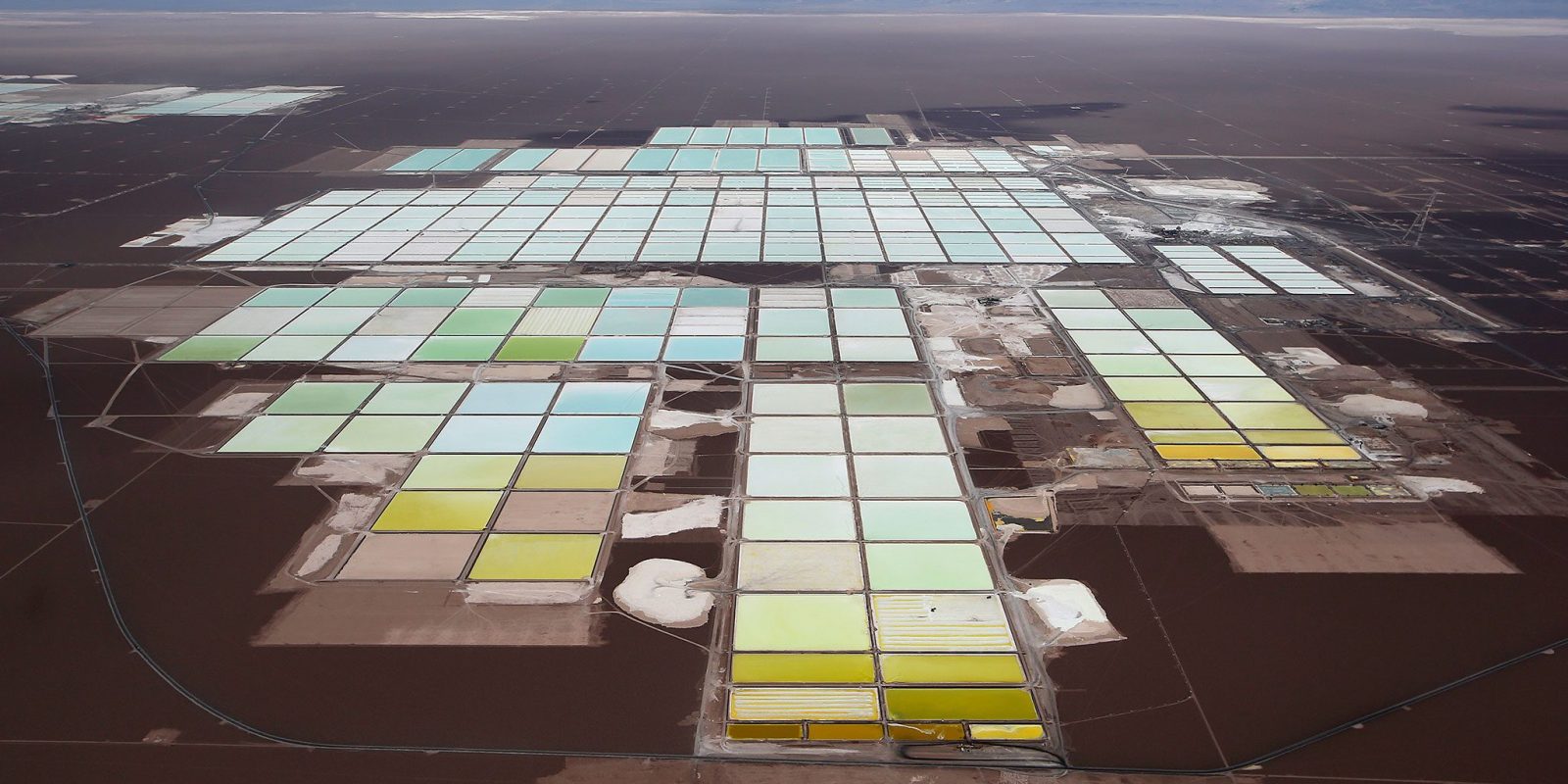
China Starts a War on Commodity Prices Goldman Says It Can’t Win
Bloomberg News June 4, 2021,
https://www.bloomberg.com/news/arti...on-commodity-prices-goldman-says-it-can-t-win
- Beijing is trying to rein in surging raw-materials costs
- The crackdown could ripple through markets around the world
It sounds like a Mao-era relic of China’s planned economy: the Department of Price.
But this rarely discussed corner of the Chinese bureaucracy is now playing an increasingly important role in the inflation
debate that’s whipsawing financial markets around the world.
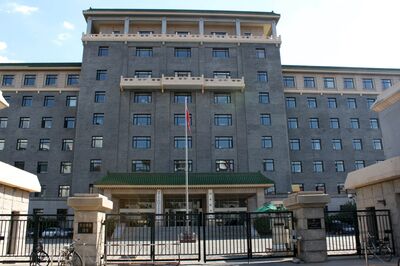
It’s here, in a drab office building on the west side of Beijing, where Communist Party apparatchiks have for months been formulating one of the country’s most expansive campaigns to influence market prices since an ill-fated
attempt to tame the Chinese stock market in 2015. The target this time around: a commodities boom that has lifted prices of everything from coal to glass and steel rebar to record highs.
The National Development and Reform Commission headquarters in Beijing.
Source: Imaginechina/AP Photo
Over the past three weeks, policy makers from Premier Li Keqiang on down have unleashed a near-constant barrage of rhetoric and administrative measures to rein in the commodities surge that’s
squeezing China’s export-manufacturing machine and threatening to derail the nation’s economic recovery. Officials have raised transaction fees, changed tax rules, censored industry research, urged producers to sell inventories, cajoled trading firms to cut bullish wagers, vowed to clamp down on “malicious” speculators and
more.
While strategists at Goldman Sachs Group Inc. and Citigroup Inc. have
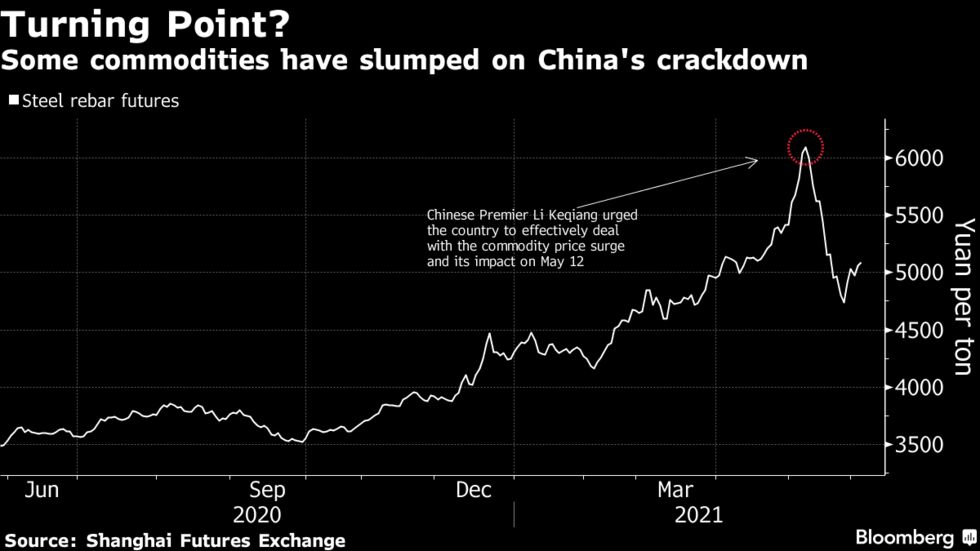
said any attempt to stop the rally will likely fail in the face of supply constraints and buoyant global demand, Chinese authorities show few signs of letting up after achieving some early successes. Prices for rebar and coal have fallen as much as 22% from their highs in May, though they’re still sitting on substantial 12-month gains.
That’s turning China’s campaign into a must-watch for traders of not just commodities, but also Treasuries, tech stocks and nearly every other major asset class where inflation concerns have bubbled to the fore in recent months.
It also marks a potentially pivotal moment for China’s
start-stop transition toward freer markets. Even as policy makers focus much of their attention on commodities, they’re also ramping up a clampdown on
cryptocurrencies and taking increasingly assertive
steps to manage moves in the yuan and housing prices.
The scope of the government’s meddling as it juggles these challenges -- along with risks from a record pile of corporate debt and a
tense relationship with the U.S. –- may shed light on how Beijing plans to strike a balance between giving a “
decisive role” to markets and maintaining economic and social stability. While the government has dialed back use of direct intervention in recent years, authorities haven’t hesitated to act in myriad other ways to guide prices and curb volatility.
“The starting point of this crackdown is to maintain economic stability,” said Dong Hao, director of Chaos Ternary Research Institute, a subsidiary of one of China’s largest commodities asset managers. “There is of course a choice to let the market freely adjust the allocation of resources through conventional market mechanisms. But this time, it seems that the social cost may be very large.”
This account of the crackdown is based on interviews with nearly 20 Chinese officials, commodity company executives and consultants, along with public remarks from senior policy makers and reporting by state media. Many of those interviewed agreed to speak on condition of anonymity given the sensitivity of the subject.
Anxiety over the commodities boom has been building since the start of the year inside the halls of the Department of Price, which is part of China’s economic planning agency, the National Development and Reform Commission.
Even though few outside China have ever heard of department, it plays a key role in the country’s commodity sector. Its main responsibilities include monitoring and forecasting price changes and promoting price reforms for key commodities and services, according to the NDRC’s website.
As bureaucrats at the Department of Price, and colleagues at other NDRC units such as the Bureau of Economic Operations, studied the commodities rally and brainstormed countermeasures earlier this year, they summoned a steady stream of industry officials, executives and researchers to the NDRC building in Beijing.
The discussions were heated at times, with some government officials urging participants to focus on solutions instead of offering fundamental explanations for why prices should be rising, according to people familiar with the matter. Some of the most concerning reports came from manufacturers, builders and even some power plant operators, who complained they were struggling to cope with soaring input costs.
Rising prices have long been a source of angst for Chinese policy makers. An inflation spike in the late 1980s -- fueled in part by policies devised by a precursor to the Department of Price -- is widely viewed as one contributor to the protest movement that culminated in China’s deadly crackdown in Tiananmen Square on June 4, 1989.
The first public signal that authorities had become serious about clamping down on this year’s commodities boom came on May 12. In a
statement issued by the State Council after a meeting chaired by Premier Li, authorities called for “adjustments to deal with the excessively rapid rise in commodity prices.” Li delivered an even more pointed warning a week later,
saying that targeted measures would be taken to “screen abnormal transactions and malicious speculations.”
Commodities firms have responded by paring their bullish futures bets, some after direct requests from policy makers and others because they want to avoid unwanted government scrutiny. Meanwhile, producers have abandoned plans to stockpile inventories in hopes that prices would rise further.
Some market watchers have argued the crackdown’s longer-term impact on prices will be limited.
Goldman strategists led by Jeffrey Currie said in a May 27 report that China has lost its power to dictate prices for key commodities including oil and copper, advising clients to “Buy the China led dip.” After a brief slump in mid-May, the Bloomberg Commodity Spot Index of contracts traded mostly in the U.S. and London rebounded to a fresh decade-high on June 2. It’s one sign of how difficult it will be for China to insulate itself from volatility in global commodity prices, even as the country pursues a “dual circulation”
strategy to reduce its reliance on overseas markets.
The NDRC didn’t respond to multiple requests for comment.
How far China pushes the crackdown may depend in large part on whether rising input costs begin to filter through to Chinese consumers. Overall consumer inflation has remained
tame so far, thanks to falling pork prices and intense competition among manufacturers that has made them reticent to pass on higher costs.
Inflation pressures are likely to tick higher, at least in the short-term. Figures due next week are expected to show producer prices jumped 8.4% in May, the most since 2008, according to the median estimate in a Bloomberg survey of economists.
“The recovery in China turned out much better than expected, but this has also resulted in a very different set of problems from what the government had to deal with for the last few years,” said Chen Long, an economist at Beijing-based consulting firm Plenum. “Now we are seeing a lot of upside surprises.”
While the chances of widespread street protests from an inflation surge are remote, anxiety levels at the Department of Price may stay elevated for some time yet.
— With assistance by Alfred Cang, Lucille Liu, Dan Murtaugh, Jason Rogers, and Tom Hancock