
no, i was basically saying that from your reply, bitcoin is so sketchy that you are afraid to recommend a wallet app because of its likelihood to be connection to crime.I do not understand. Are you trying to use bitcoin as payment for illegal activities? Maybe the problem is you and not bitcoin
Microsoft accepts bitcoin as payment. AT&T accepts bitcoin as payment. NewEgg accepts bitcoin as payment
Bitcoin is legal tender in El Salvador
https://99bitcoins.com/bitcoin/who-accepts/

You are using an out of date browser. It may not display this or other websites correctly.
You should upgrade or use an alternative browser.
You should upgrade or use an alternative browser.
which crypto wallet and why?
- Thread starter zghorner
- Start date

no, i was basically saying that from your reply, bitcoin is so sketchy that you are afraid to recommend a wallet app because of its likelihood to be connection to crime.
Bitcoin's first adoption was in the darknet markets, used for buying drugs and other contrabands or procuring illegal services such as hackers or a hitman. In case you did not know this about bitcoin
Perhaps you did not hear in the news that the hackers demand bitcoin as payment, you can google Colonial Pipeline
If you said you wanted to use bitcoin to purchase goods from Microsoft or tickets and other merchandise from the Mavericks, or you want to hire a software contractor overseas and pay them in bitcoin then I can recommend a wallet for you
Do you want to say on record what you want to use the bitcoin for?
Is there any reason you do not want to accept the others' wallet recommendations?
on the record, i will not be using this wallet to purchase illegal goods or services.Bitcoin's first adoption was in the darknet markets, used for buying drugs and other contrabands or procuring illegal services such as hackers or a hitman. In case you did not know this about bitcoin
Perhaps you did not hear in the news that the hackers demand bitcoin as payment, you can google Colonial Pipeline
If you said you wanted to use bitcoin to purchase goods from Microsoft or tickets and other merchandise from the Mavericks, or you want to hire a software contractor overseas and pay them in bitcoin then I can recommend a wallet for you
Do you want to say on record what you want to use the bitcoin for?
Is there any reason you do not want to accept the others' wallet recommendations?
And its not that i dont want to accept the other posters wallet recommendations...I would like as much input as possible.
its more directed towards you posting nothing within the scope of this thread. I am surprised because you are one of the most active members of the crypto forum, that you have posted nothing of substance relating to the OP.
on the record, i will not be using this wallet to purchase illegal goods or services.
And its not that i dont want to accept the other posters wallet recommendations...I would like as much input as possible.
its more directed towards you posting nothing within the scope of this thread. I am surprised because you are one of the most active members of the crypto forum, that you have posted nothing of substance relating to the OP.
That's the first time you mentioned you were not going to use it for illicit purposes
I use Electrum wallet app and recommend it
If the balance is higher than 1 btc, I would not recommend it, and Coinbase with 2fa is probably better for security
I’ll check it out thank you for the reply.That's the first time you mentioned you were not going to use it for illicit purposes
I use Electrum wallet app and recommend it
If the balance is higher than 1 btc, I would not recommend it, and Coinbase with 2fa is probably better for security

let me throw in my 2 cents.
A Crypto wallet can hold all types of cryptos in it, among them, bitcoin.
A wallet is used for many purposes, among them, purchase stuff. But I would say it is the least useful function of the wallet, now, among others.
So, most people choose a wallet based on criteria not related to its purchase functions, at least not the purchase of physical goods.
A good comparison I can think of now, is to compare a brokerage account to a wallet. If you use IBKR as your brokerage account, you want it to be able to trade stocks (cryptos), the last function you think of IBKR is the debit card it provides that can tap onto your account balance to purchase a sandwich.
For this reason, you can think of crypto wallets are now in the stage of online brokerage accounts year 1990-1999----not many to choose from, and some will die, maybe, confusing to choose, but for your protection, better to scatter around and use several you can find out and learn about online.
And yes, that does call for a lot of work, but I assume that anything requires a lot of initial investment in time and learning will be duely rewarded in the future.
I use MetaMask, coinbase, mainly. The first for its multi-chain support and Defi popularity, and second, its the easiest for US dollars on ramp to the crypto world. If this last sentence sounds a lot of jargon to you, this is where you start your reading and learning online.
A Crypto wallet can hold all types of cryptos in it, among them, bitcoin.
A wallet is used for many purposes, among them, purchase stuff. But I would say it is the least useful function of the wallet, now, among others.
So, most people choose a wallet based on criteria not related to its purchase functions, at least not the purchase of physical goods.
A good comparison I can think of now, is to compare a brokerage account to a wallet. If you use IBKR as your brokerage account, you want it to be able to trade stocks (cryptos), the last function you think of IBKR is the debit card it provides that can tap onto your account balance to purchase a sandwich.
For this reason, you can think of crypto wallets are now in the stage of online brokerage accounts year 1990-1999----not many to choose from, and some will die, maybe, confusing to choose, but for your protection, better to scatter around and use several you can find out and learn about online.
And yes, that does call for a lot of work, but I assume that anything requires a lot of initial investment in time and learning will be duely rewarded in the future.
I use MetaMask, coinbase, mainly. The first for its multi-chain support and Defi popularity, and second, its the easiest for US dollars on ramp to the crypto world. If this last sentence sounds a lot of jargon to you, this is where you start your reading and learning online.
I use MetaMask, coinbase, mainly. The first for its multi-chain support and Defi popularity, and second, its the easiest for US dollars on ramp to the crypto world. If this last sentence sounds a lot of jargon to you, this is where you start your reading and learning online.
I think the Coinbase wallet app is a custodial wallet, but I've never used it so I cannot be sure. I only use the Coinbase website when I use Coinbase
I think the OP is interested in true decentralized crypto wallets and I get the impression that the OP wants P2P transactions and although he did not mention it, I think he wants non-KYC coins, which can be a challenge if he does not know how to navigate interblockchain and dexes and bridges, and or utilize privacy coins
A multi-coin wallet I've used is Trust wallet, which has some relation to the Binance ecosystem and may not be as decentralized
With any SPV wallets, there are compromises, but running a full node and a full copy of the blockchain is difficult for most. I cannot even run a full Ethereum node due to the the resources it requires, so I'm satisfied with Metamask and having it connect to the publicly available servers
Same thing with Electrum which is a bitcoin SPV wallet and connects to publicly available servers
I tried running a full node of Doge and it got stuck after a few hours. I tried running a full node of the Binance Smart Chain but got nowhere, maybe it's a permissioned chain
If you want true decentralized,p2p crypto, then the process is (imho) below:
native coin wallet (private keys) --> your own copy of a full node you control (blockchain) --> coin network (other nodes)
Each coin has a dedicated data path per above. If you cannot see the first 2 parts under your control, you're relying on someone else's (usually the 2nd one). Part 1 and 2 can be on the same machine (i.e. bitcoin)

"Electrum Atom" is probably one to avoid.
https://krebsonsecurity.com/2021/08/man-robbed-of-16-bitcoin-sues-young-thieves-parents
https://krebsonsecurity.com/2021/08/man-robbed-of-16-bitcoin-sues-young-thieves-parents
Man Robbed of 16 Bitcoin Sues Young Thieves’ Parents
August 25, 2021
87 Comments
In 2018, Andrew Schober was digitally mugged for approximately $1 million worth of bitcoin. After several years of working with investigators, Schober says he’s confident he has located two young men in the United Kingdom responsible for using a clever piece of digital clipboard-stealing malware to siphon his crypto holdings. Schober is now suing each of their parents in a civil case that seeks to extract what their children would not return voluntarily.
In a lawsuit filed in Colorado, Schober said the sudden disappearance of his funds in January 2018 prompted him to spend more than $10,000 hiring experts in the field of tracing cryptocurrency transactions. After months of sleuthing, his investigators identified the likely culprits: Two young men in Britain who were both minors at the time of the crime (both are currently studying computer science at U.K. universities).
A forensic investigation of Schober’s computer found he’d inadvertently downloaded malicious software after clicking a link posted on Reddit for a purported cryptocurrency wallet application called “Electrum Atom.” Investigators determined that the malware was bundled with the benign program, and was designed to lie in wait for users to copy a cryptocurrency address to their computer’s temporary clipboard.
When Schober went to move approximately 16.4 bitcoins from one account to another — by pasting the lengthy payment address he’d just copied — the malware replaced his bitcoin payment address with a different address controlled by the young men.
Schober’s lawsuit lays out how his investigators traced the stolen funds through cryptocurrency exchanges and on to the two youths in the United Kingdom. In addition, they found one of the defendants — just hours after Schober’s bitcoin was stolen — had posted a message to GitHub asking for help accessing the private key corresponding to the public key of the bitcoin address used by the clipboard-stealing malware.
Investigators found the other defendant had the malware code that was bundled with the Electrum Atom application in his Github code library.
Initially, Schober hoped that the parents of the thieving teens would listen to reason, and simply return the money. So he wrote a letter to the parents of both boys:
“It seems your son has been using malware to steal money from people online,” reads the opening paragraph of the letter Schober emailed to the families. “Losing that money has been financially and emotionally devastating. He might have thought he was playing a harmless joke, but it has had serious consequences for my life.”
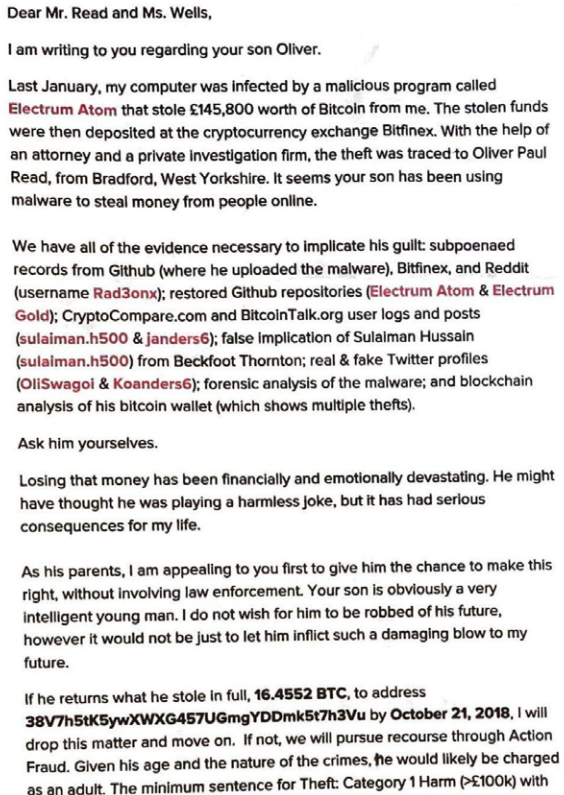
A portion of the letter than Schober sent to two of the defendants in 2018, after investigators determined their sons were responsible for stealing nearly $1 million in cryptocurrency from Schober.
Met with continued silence from the parents for many months, Schober filed suit against the kids and their parents in a Colorado court. A copy of the May 2021 complaint is here (PDF).
Now they are responding. One of the defendants —Hazel D. Wells — just filed a motion with the court to represent herself and her son in lieu of hiring an attorney. In a filing on Aug. 9, Wells helpfully included the letter in the screenshot above, and volunteered that her son had been questioned by U.K. authorities in connection with the bitcoin theft.
Neither of the defendants’ families are disputing the basic claim that their kids stole from Mr. Schober. Rather, they’re asserting that time has run out on Schober’s legal ability to claim a cause of action against them.
“Plaintiff alleges two common law causes of action (conversion and trespass to chattel), for which a three-year statute of limitations applies,” an attorney for the defendants argued in a filing on Aug. 6 (PDF). “Plaintiff further alleges a federal statutory cause of action, for which a two-year statute of limitations applies. Because plaintiff did not file his lawsuit until May 21, 2021, three years and five months after his injury, his claims should be dismissed.”
Schober’s attorneys argue (PDF) that “the statute of limitations begins to run when the Plaintiff knows or has reason to know of the existence and cause of the injury which is the base of his action,” and that inherent in this concept is the discovery rule, namely: That the statute of limitations does not begin to run until the plaintiff knows or has reason to know of both the existence and cause of his injury.
The plaintiffs point out that Schober’s investigators didn’t pinpoint one of the young men’s involvement until more than a year after they’d identified his co-conspirator, saying Schober notified the second boy’s parents in December 2019.
None of the parties to this lawsuit responded to requests for comment.
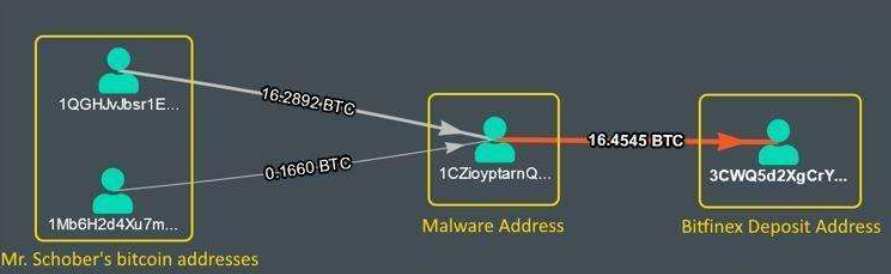
Image: Complaint, Schober v. Thompson, et. al.
Mark Rasch, a former prosecutor with the U.S. Justice Department, said the plaintiff is claiming the parents are liable because he gave them notice of a crime committed by their kids and they failed to respond.
“A lot of these crimes are being committed by juveniles, and we don’t have a good juvenile justice system that’s well designed to both civilly and criminally go after kids,” Rasch said.
Rasch said he’s currently an attorney in a number of lawsuits involving young men who’ve been accused of stealing and laundering millions of dollars of cryptocurrency — specifically crimes involving SIM swapping — where the fraudsters trick or bribe an employee at a mobile phone store into transferring control of a target’s phone number to a device they control.
In those cases, the plaintiffs have sought to extract compensation for their losses from the mobile phone companies — but so far those lawsuits have largely failed to yield results and are often pushed into arbitration.
Rasch said it makes sense that some victims of cryptocurrency theft are spending some serious coin to track down their assailants and sue them civilly. But he said the legwork needed to make that case is tremendous and costly, and there’s no guarantee those investments will pay off down the road.
“These crimes can be monumentally difficult and expensive to track down,” he said. “It’s designed to be difficult to do, but it’s also not designed to be impossible to do.”
As evidenced by this week’s CNBC story on a marked rise in reports of people having their Coinbase accounts emptied by fraudsters, many people investing in cryptocurrencies find out the hard way that unlike traditional banking transactions — cryptocurrency funds lost to theft are likely to stay lost because the transactions are irreversible.
Traditionally, the major crypto exchanges have said they’re not responsible for lost or stolen funds. But perhaps in response to the CNBC story, Coinbase said it was introducing a new pilot “guarantee” for U.K. customers only, wherein they will be eligible for a reimbursement of up £150,000 if someone gains unauthorized access to their account and steals funds.
However, it seems unlikely Coinbase’s new guarantee would cover cases like Schober’s — even if he’d been a U.K. customer and the theft occurred today. One of the caveats that is not covered in the guarantee is sending funds to the wrong address by accident.
Exodus app is good. Simple, clean, easy to use."Electrum Atom" is probably one to avoid.
https://krebsonsecurity.com/2021/08/man-robbed-of-16-bitcoin-sues-young-thieves-parents
Exodus app is good. Simple, clean, easy to use.
Changed my bitcoin node to an Umbrel node a few weeks ago to be able to support the lightning network
Been playing around with lightning payments wherever it's supported
Instant payment confirmations and cheap fees, although the latter doesn't matter much since bitcoin on-chain fees have been very cheap lately at 2-3 satoshis/byte for high-priority
Anyway, I really like Umbrel, and everything runs on the tor network for privacy
It does have a built-in wallet for bitcoin and lightning network but the LN requires technical knowledge and setup of channels
https://getumbrel.com/