When P-C parity does not hold

No, I do not. Your definition is different than mine and I'm not interested in this debate anymore. If you can't easily make money from it, the prices are correct.

Of course the prices are correct, just that put-call parity doesn't necessarily hold for American Style options.

What other definition of put-call parity is there ?
 
Since you're both blind and dumb, let me just quote Robert:
"yes, but Put/Call party includes dividends and cost of carry"
"There is still put-call parity"

This means that put-call parity always holds.
Is this clear now? Oh, you're blind so it may still not be clear. Too bad.


Guru ... the name itself is one of life's delicious ironies ... still believe that put-call parity always holds ... or like Bob ... just not interested in this debate anymore ?
 
The existence of a dividend isn’t the defining feature that explains why put-call parity might not hold. P-C parity holds for European style options where the underlying pays a dividend.

As others have explained / alluded it would not (theoretically) be in the interest of a holder of an American option (calls) whose underlying is going ex dividend to exercise the option if the time value on the same strike / expiration (OTM) put exceeded the dividend. In this sense whether you’re holding a European or American option is mute; the outcome (ie not exercising) is identical.

In practice, the market can be so wide for the exercisable DITM calls to make it practically impossible to make money.
 
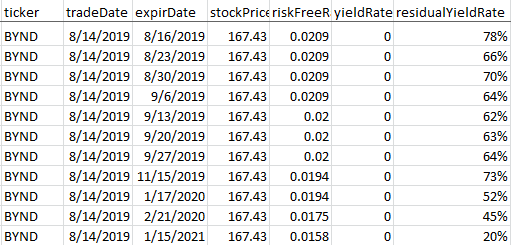
Here's how we handle this situation. We create a residual yield rate to line up the calls and puts. For BYND the residual rate is the market's implied borrow rate.
e4f6e91a2b20150c78cc5ecea4314527.png


For Robert's example, the Sep implied borrow is 63%. This lines up the call and put IVs to about a 55%.

1159c96f88a47f7d21e7a7e822c911c6.png


When you have a systematic way to calculate borrow, you can compare (as Robert says) the implied borrow to your borrow rate.

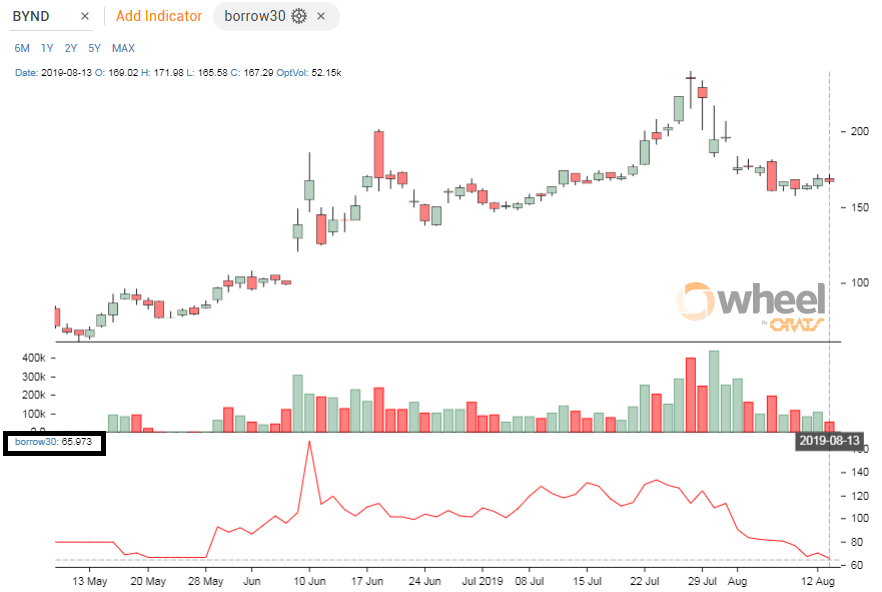
You can also graph the borrow.
00fba4c2f87041d4724f5d0a597e0e2b.png


We graph the constant maturity borrow at 30 days and 2 years to expiration interpolated. Above is the borrow at 30 days.
Notice how borrow spikes when the stock runs up.

This is nice analysis!
 
Guru ... the name itself is one of life's delicious ironies ... still believe that put-call parity always holds ... or like Bob ... just not interested in this debate anymore ?

It depends on how you look at it. Bob is explaining in a VERY professional way. Most likely hard to understand for a non pro though. Guru is also right, albeit less patient.

P/C parity always holds.
 
It depends on how you look at it. Bob is explaining in a VERY professional way. Most likely hard to understand for a non pro though. Guru is also right, albeit less patient.

P/C parity always holds.

Here we go again
... when Bob lost the argument about p-c parity ... he claimed he just wasn't interested in the debate any more

If you think p-c parity always holds, then try to do what Bob/Guru refused to do
... and explain why it always holds when the following example clearly shows that it doesn't

For American Style options
... Spot $100
... with 30 days to expiry
... IV 20%
... interest rates 0%
... Dividend $10
... $80 strike shows a put-call difference / inequality of 9.9643

pcp_Parity_European_v_American.png


Of course, you may be confusing p-c parity with non-arbitrage
... but that is a different subject
 
"in my particular market (China)"

@Baozi,

I'm avoiding this thread, as getting into a convo about calculating early exercise premium for an American option is an extremely complicated issue. But I have to ask, as no one has so far, what is the cross margin allowances in China? Has the market recently moved considerably in the product you are discussing? The worst I have ever seen p/c parity blow out was as a result of no cross margin.
 
Here we go again
... when Bob lost the argument about p-c parity ... he claimed he just wasn't interested in the debate any more

If you think p-c parity always holds, then try to do what Bob/Guru refused to do
... and explain why it always holds when the following example clearly shows that it doesn't

For American Style options
... Spot $100
... with 30 days to expiry
... IV 20%
... interest rates 0%
... Dividend $10
... $80 strike shows a put-call difference / inequality of 9.9643

View attachment 207785

Of course, you may be confusing p-c parity with non-arbitrage
... but that is a different subject


TRY TRADING IT. :D
 
Back
Top
