When is recession and correction coming?

Quote from Aaron:

Returns for the stock market are driven by dividends plus growth in earnings plus inflation plus changes in the average P/E ratio.

The dividend yield is a little under 2%.

Real growth in earnings can't exceed growth in real GDP over long periods, and real GDP growth has averaged about 3% over the past century.

Inflation is running a little under 3% currently.

P/E ratios are pretty high, so let's optimisically assume they stay at the current level.

Add these all together and we can expect 2%+3%+3%+0% = 8% annually.

Your fully invested analyst,
Aaron Schindler
Schindler Trading


Excellent summation.

Decelerating earnings is the real risk to the U.S. economy and equity markets right now, which can rapidly alter skew P/E ratios up or down, IMO.

GDP is a derivative.
 
Quote from ByLoSellHi:

Excellent summation.

Decelerating earnings is the real risk to the U.S. economy and equity markets right now, which can rapidly alter skew P/E ratios up or down, IMO.

GDP is a derivative.

And GDP figures, which I do not trust, are getting revised down.

And new claims are going up - - 327K the last time. And New Claims don't include people who can't claim because they're independent contractors - - such as nearly idle realtors, mortgage brokers, appraisers, solo and casual construction people and others. Probably a half a million to a million right there.

Here's something from Floyd Norris NYT blog -

Here’s another way to look at the housing start numbers: Take a three-month moving average of single-family starts, at a seasonally adjusted rate. That smoothes out some of the weather-induced volatility.
By that measure, starts have now fallen for 11 consecutive months, and are off more than 30 percent over that period.
Here’s a list of the only four other times (going back to 1959) that the figure fell for 11 consecutive months.
1. November 1973 was the 11th month. A recession began that very month.
2. April 1980 was the 11th month. A recession began in January of that year.
3. November 1981 was the 11th month. A recession began in July of that year.
4. February 1991 was the 11th month. A recession began the previous July.

To my way of thinking the recession battle line has been drawn. On the one side we have the coming fallout in housing and collapsing loan demand versus The Super Spenders consisting of the very wealthy, the swollen ranks of state/federal/non-profit and financial/health care workers, all of whom should enjoy income stability in slower times. Can they keep us afloat is my big question?

 
"Market keeps going up and not taking a break....what's up with dat?"

Simple answer. Historical data supports a rising market in the mid year election cycle. Chuck the headlines and pick up a copy of the Stock Traders Almanac.
 
"Stocks have reached what looks like a permanently high plateau." Irving Fisher, Professor of Economics, Yale University, 1929.

Maybe its my manic depressive nature that cannot tolerate seeing positive things in the marketplace........:mad:
 
Quote from yxy:
So I can conclude a lot of Japanese money is tied into/with the US market. Like the Japanese owns lots of U.S. government bonds and have lots of money invested in the US markets, right?
Not necessarily Japanese owned money, but yes, the strength/weakness of the JPY is intertwined with weakness/strength of the US equity markets.

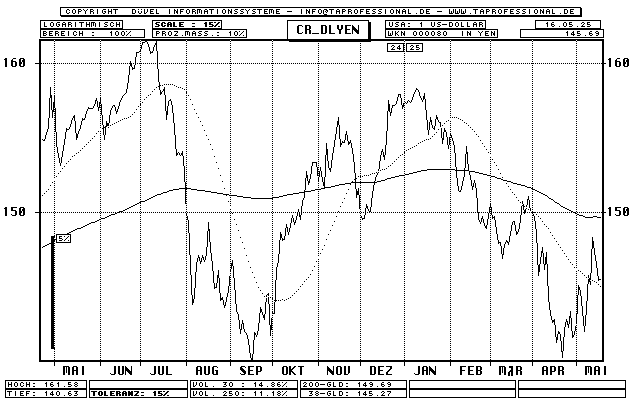
You can borrow USD and short JPY against it, make money on the swap (interestrate difference between 5.25 USD vs. 0.5% JPY), make money on the declining JPY and go long US equity index futures with the money. What sounds like a joke is an investment "strategy" is abused by billions of dollars worth of funds since years, with great returns. Works great as long as the BOJ has these ridiculous interest rates with zero support for the strength of its currency.

Whenever there is a snapback in the Yen you can feel the shockwaves throughout the financial system. See 1998 and also May 2006, where we saw a 5% correction in the USDJPY within five days or so:

Dollar-Yen-Chart-short-term.gif
 
Quote from Covertibility:

What goes up ...

<IMG SRC=http://www.marketwatch.com/News/Story/Image.aspx?Guid=efe83a7807e34360886b94315a8b46f4&Track=201>

A little correction doesn't hurt as long as the market keeps running with the long term trend.

The question is, if you knew now that the market is set to fall 10% or more, would you be a buyer, and more importantly, would you be a seller, NOW.
 
Quote from ByLoSellHi:

The question is, if you knew now that the market is set to fall 10% or more, would you be a buyer, and more importantly, would you be a seller, NOW.

If anyone knew if the market was gonna fall, you'd probably know where the bottom was too, who shot Kennedy, why was Generallissimo Bush so concerned about that Pet Goat, etc... I don't play the "what if you knew" game.

In terms of selling, one would have to take into consideration the tax ramifications, opportunity cost, etc..

A simple question but very many things to consider.
 
Back
Top