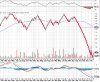
MACD does follow price, I look for patterns that indicate weakness or strength. This one pre-drop is a very strong pattern indeed. Have a nice Easter!
I do to - whether I am looking at price data bundled into a particular bar interval or if I am looking at an indicator to try to figure out how I can get my platform to trade how I want without me having to be there to tell it. But, imo, patterns are the starting points out of which hypotheses grow, and not full-blown trading systems in and of themselves. What I find useful, and you might aw well, is to go one or two steps farther, and having identified a pattern, try to get behind or beneath the pattern to figure out
why it is indicating strength or weakness, and why some patterns, such as the one you show here, can be developed into a high probability set up where as others patterns, e.g. simple divergence, may have little or no edge at all absent additional information.
Since you're using MACD I'll assume you have more than a passing interest in finding out more about it. Gerald Appel, the technician/analyst credited with MACD's creation, has a book called
Technical Analysis: Power Tools for Active Investors. Chapter 8, "Advanced Moving Average Convergence-Divergence (MACD): The Ultimate Market Timing Indicator" should be of especial interest to you. However, you would get the most out of that chapter by reading the chapters that come before.
For example, though Appel is writing about indicators, he does not advise using them in absence of price action concepts such as Support & Resistance:
In fact, some here might be surpised that much of Appel's understanding of technical analysis sounds remarkable similar to Richard Wyckoff's description of price action:
Appel also makes a point of noting that the "out of the box" defaults is just that - a "default." The MACD is a tool, and this tool can be adjusted to various conditions, markets, bar intervals, and time frames. He himself demonstrates that in this chapter where he explains how to use the indicator he himself created:
Finally, he cautions that while MACD may seem perfect to some, that it is not so simple as that. For example, you might be interested in studying, and perhaps applying to your own trading some of the suggestions that he provides beneath this section header:
Why would there be additions to the basic ruels. Well, for one thing, Appel tells us this:

You seem to respond frequently from a stance of defense. I do not see you being attacked - and if so, certainly not in the same vein in which your internet friend B1S2 attacks nearly everyone whose opinion differs from his own. Trust me - I am not looking for enemies. They choose me, and not the other way around. There is a world of knowledge out there for you and me and anyone who wishes to improve as a result of that knowledge. But it requires an open mind to let it in, and then thoughtful reflection to have any benefit. Let's put our "dukes" down, rather than up, and see if there is not only more common ground available between us to let us learn and grow, but also plenty of room to disagree without having to resort to personal attacks and juvenile belittlement of others. Afterall, just look above to the Appel materials and see that not only is he an advocate of indicator trading systems, but he is also a proponent using what some refer to as the straight line approach (SLA) or, more lovingly, "Scribbles" as context in which to deploy those indicator systems.
Happy Easter to you as well.