
You are using an out of date browser. It may not display this or other websites correctly.
You should upgrade or use an alternative browser.
You should upgrade or use an alternative browser.
When Indicators Don't Lag
- Thread starter BOC
- Start date

I only use MACD, I have tried others, perhaps I didn't dedicate enough research time to others, therefore not going to claim their usefulness or uselessness. IMO MACD is probably the most universal forecasting tool available, again from what I have seen. Also, its simplicity is its strongest point. No need to overthink or re-invent the settings as B1 said earlier, just lots of screen time and providing you have an open mind and can see patterns and draw parallels you ought to make sense of it. It's really a marvelous FREE tool available to all, it shows potential strength, weakness, it's also a great timing tool and it can also forecast range based targets. Regarding divergences I would say that you gotta treat them making a comparison to a coiled spring, the more it's suppressed and its coils are pressed together tighter and tighter the more the reverse effect. Ok they don't work all of the time (nothing does in trading), but when they do oh boy do they work, look at monthly USDJPY as a quick example, price kept on going down and down, yet MACD was showing weakening selling thrusts and Ok it wouldn't have worked on probably a few entries, but then there came the last thrust down and BANG, it's still going up! Isn't that remarkable? Isn't that simple enough? There are lots of egos on this site and weirdos, B1 is a great person, I learnt a lot from him and am very grateful for sharing his knowledge for FREE.
Last edited:
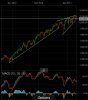
Excuse the images as I am on the phone at the moment. Weekly current divergence is not one of my favourites, yet when you look at the other image of Monthly MACD and consider how far market valuation has climbed in recent years I would still trade that divergence. If one wants to be conservative then wait on weekly support break and have stop outside ATH or go with smaller stops based on shorter time frame charts. Again, MACD on Monthly doesn't look optimistic to keep on investing into stocks and then there's price level adage - buy low, sell hi. Well, this is certainly not low.
Attachments
I used to use MACD myself. Twenty years ago. But I eventually abandoned it along with every other indicator because trading without it/them improved my results so much. There's simply no reason to replot any of these things.
The "divergences", again, are an illusion created by the way in which the MACD is calculated in the first place (the number of traders who use the MACD and have actually read Appel could probably fit in my living room). In your chart above, for example, there was a "divergence" 18 months ago, yet price kept right on climbing. And if the trend line had been drawn properly, there would be no break of it and the trader would be forewarned of a reversal as price approached 2140. As the current "divergences" began a year ago, they have served no purpose except in hindsight. A PA trader, on the other hand, would know well in advance what to look for and where and, to some extent, when.
All of which goes back to the OP. This thread isn't about whether to use indicators or not. It is about whether or not indicators lag. And indicators do lag. They can't help but lag. If one can make use of them in spite of these inherent lags, that's fine. But the trader should never delude himself with regard to what he's looking at.
The "divergences", again, are an illusion created by the way in which the MACD is calculated in the first place (the number of traders who use the MACD and have actually read Appel could probably fit in my living room). In your chart above, for example, there was a "divergence" 18 months ago, yet price kept right on climbing. And if the trend line had been drawn properly, there would be no break of it and the trader would be forewarned of a reversal as price approached 2140. As the current "divergences" began a year ago, they have served no purpose except in hindsight. A PA trader, on the other hand, would know well in advance what to look for and where and, to some extent, when.
All of which goes back to the OP. This thread isn't about whether to use indicators or not. It is about whether or not indicators lag. And indicators do lag. They can't help but lag. If one can make use of them in spite of these inherent lags, that's fine. But the trader should never delude himself with regard to what he's looking at.
Well, I beg to disagree with you, as I have previously have come up with multiple instances time stamped on ET of divergences that forecasted great reversal/correction signals. Platinum, Silver, DAX, AAPL, S&P and some others I can't remember now from the top of my head. Of course some didn't work out, but that's life. I am no judge of your system based solely on price action, but I am more than certain that you do have losses, at least sometimes. Price can yo-yo taking out trader's stops for a while until it finally pushes through.
Indeed, indicators do lag price action, but that doesn't stop their ability to forecast weakness and strength together with price performance, markets are still at least partially driven by greed and fear of loss.
Edit: I have now unignored you, as I found your recent writings of interest and openness.
Indeed, indicators do lag price action, but that doesn't stop their ability to forecast weakness and strength together with price performance, markets are still at least partially driven by greed and fear of loss.
Edit: I have now unignored you, as I found your recent writings of interest and openness.
Wins and losses are not the issue, rather whether or not indicators lag, and, again, they do. This does not mean that some divergences can't work out. But the divergences are in the mind, not in the market. Manipulating data so that one can find "divergences" where none exist is the antithesis of trading price. As for their ability to "forecast", that is in the mind as well.
As for whether or not you ignore me, that's your choice. Personally, I find ignoring silly. If one doesn't want to read what a particular individual has to say, just skip it.
A swing high or low represents a point at which traders are no longer able to find trades, i.e., either buyers are no longer willing to pay the ask or sellers are no longer willing to lower it. Whether that point represents important support or resistance will be seen the next time traders push price in that direction. But everyone knows this point, even if they aren't following a chart. It exists independently of the trader and his lines and charts and indicators and displays. It is the point beyond which price could not go. Hence its importance, both to those who want to see price move higher and those who don't.
Therefore, before coming to any conclusions about what “works” or “doesn’t work”, and thus does or does not provide an edge, one ought to keep in mind that a given event -- such as price seemingly finding support or resistance at a trendline (or moving average, candlestick, Pivot Point, Fib level or whatever) -- may be only incidental to what is truly providing that support or resistance.
A fundamental misunderstanding of how "indicators" are calculated and what they're supposed to do can lead to all sorts of off-task behavior. We think we see the indicators indicating something, or not, and believe we have made an important discovery. We then devote our efforts to improving the hit rate and the probability of whatever it is we think the indicator is indicating when our efforts ought to be focused on determining whether or not the indicator is actually indicating what we think it's indicating. In most if not all cases, it isn't.
Consider the virgin being tossed into the volcano: sometimes it results in a great crop, sometimes it doesn't. Maybe tossing her in earlier or later will change the probability of a healthy crop. Maybe two virgins are better than one. Maybe six. Maybe tall virgins are more effective than short ones. And surely age is important. But does the robustness of the crop really have anything to do with tossing the virgin into the volcano in the first place?
The money under the pillow is not evidence of the existence of the tooth fairy, and spring will arrive regardless of whether the virgin is tossed into the volcano or not.
As for whether or not you ignore me, that's your choice. Personally, I find ignoring silly. If one doesn't want to read what a particular individual has to say, just skip it.
A swing high or low represents a point at which traders are no longer able to find trades, i.e., either buyers are no longer willing to pay the ask or sellers are no longer willing to lower it. Whether that point represents important support or resistance will be seen the next time traders push price in that direction. But everyone knows this point, even if they aren't following a chart. It exists independently of the trader and his lines and charts and indicators and displays. It is the point beyond which price could not go. Hence its importance, both to those who want to see price move higher and those who don't.
Therefore, before coming to any conclusions about what “works” or “doesn’t work”, and thus does or does not provide an edge, one ought to keep in mind that a given event -- such as price seemingly finding support or resistance at a trendline (or moving average, candlestick, Pivot Point, Fib level or whatever) -- may be only incidental to what is truly providing that support or resistance.
A fundamental misunderstanding of how "indicators" are calculated and what they're supposed to do can lead to all sorts of off-task behavior. We think we see the indicators indicating something, or not, and believe we have made an important discovery. We then devote our efforts to improving the hit rate and the probability of whatever it is we think the indicator is indicating when our efforts ought to be focused on determining whether or not the indicator is actually indicating what we think it's indicating. In most if not all cases, it isn't.
Consider the virgin being tossed into the volcano: sometimes it results in a great crop, sometimes it doesn't. Maybe tossing her in earlier or later will change the probability of a healthy crop. Maybe two virgins are better than one. Maybe six. Maybe tall virgins are more effective than short ones. And surely age is important. But does the robustness of the crop really have anything to do with tossing the virgin into the volcano in the first place?
The money under the pillow is not evidence of the existence of the tooth fairy, and spring will arrive regardless of whether the virgin is tossed into the volcano or not.
Well I will be more than happy to display of MACD on daytrade application in real time, works for me. I have a journal going at the moment based on MACD on 30min chart, up around 60+ ES points since start 2 weeks ago I believe. So call it Voodoo or whatever else, it may be a slow moving diesel old motor, but it works for me.
No need. I'm not saying that the MACD or any other indicator is not useful. I'm pointing out that whatever the indicator is indicating is in the trader's head, not in the market. This eventually creates problems which are avoided by not using indicators at all. Those 60+ ES points have more likely been earned in spite of the indicator than because of it.
Buy1Sell2 are you going to reply to what the standard timeframe is?So what is standard timeframe to use on a RSI(14)?
Huh?

Because you stated there is one.
When the discussion was about TIMEFRAME not indicator settings.
So what is it?
You have 8739 posts already. Let's see the 8740th one.
There are all sorts of algos that fade indicators. MACD was hit a long ago because it was popular and stochastics too.Now there are not many retail traders and the focus is on things like golden cross and head and shoulders to target longer -term position holders and technical fund trading. Interesting blog about the golden cross in TAN, the solar ETF, last week and how it was faded right away.