What's your End of Month (Cost/Returns) Ratio ?

I've done the maths and it's ugly.
Let's define the equation:
(Nt*Cc + Ce) / R
Nt: Number of Trade
Cc: Comission Cost (Roundturn)
Ce: Else Cost (Plateform, Bundles...)
R: Return

Let's consider (100*4.34 + 15) / 2000
Which gives (449) / 2000 = 22.5
Hell, about a fifth that's gone.
It is such a heat engine !

Didn't expect such a cost.
What about yours ?
 
Last edited:
I've done the maths and it's ugly.
Let's define the equation:
(Nt*Cc + Ce) / R
Nt: Number of Trade
Cc: Comission Cost (Roundturn)
Ce: Else Cost (Plateform, Bundles...)
R: Return

Let's consider (100*4.34 + 15) / 2000
Which gives (449) / 2000 = 22.5
Hell, about a fifth that's gone.
It is such a heat engine !

Didn't expect such a cost.
What about yours ?

This is a really good question. Too few people pay attention to costs.

I target paying 6% of my returns in costs. To be precise I conservatively target around 1.5% of account value a year, which may be a larger or smaller figure depending on how returns come out. That's made up of 0.3% in commissions (data costs etc are tiny) plus 1.2% in slippage.

Actually last time I checked I only paid 0.65% of my account value in costs. And my average return is running well above backtested expectations, at around 50% annualised (this won't last, but still this is the figure you wanted), so I'm only paying 1.3% of my returns in costs, so much less than 1% just in commissions.

I notice you didn't include slippage. It's worth including that since it will normally form a bigger part of your costs than you realise.

20% of returns going just in commissions seems extremely high to me.... but I would imagine you're trading a lot quicker than I am.

GAT
 
Wondering if bid/offer spread should also be included?

Anyway, my costs are around the 10% mark, which is explained by my use of SB firms to make the returns tax free. However i'm thinking i might be better off paying the tax and having lower costs.
 
This is a really good question. Too few people pay attention to costs.

I target paying 6% of my returns in costs. To be precise I conservatively target around 1.5% of account value a year, which may be a larger or smaller figure depending on how returns come out. That's made up of 0.3% in commissions (data costs etc are tiny) plus 1.2% in slippage.

Actually last time I checked I only paid 0.65% of my account value in costs. And my average return is running well above backtested expectations, at around 50% annualised (this won't last, but still this is the figure you wanted), so I'm only paying 1.3% of my returns in costs, so much less than 1% just in commissions.

I notice you didn't include slippage. It's worth including that since it will normally form a bigger part of your costs than you realise.

20% of returns going just in commissions seems extremely high to me.... but I would imagine you're trading a lot quicker than I am.

GAT

I knew you care about cost.
I've seen your awesome journal.
Can't be more professional than you.

Unfortunately I can't hold overnight,
I can't meet the needed requirements ..
Thus I'd trade more and shorter than you.
But I'm not that proud seeing your ratio =P

However I've got no slippage cost. Really.
I trade mainly with limit orders but anyway.
The ES would have no problem absorbing 1 lot.
I have been really surprised about your slippage.
That's because I am still playing in a kindergarten.

Well done GAT, that's an efficient machine you have.
More cost are taken into your equations,
But you still manage to beat me.

Hands down,
& Thanks for sharing your experience.

 
Wondering if bid/offer spread should also be included?

Anyway, my costs are around the 10% mark, which is explained by my use of SB firms to make the returns tax free. However i'm thinking i might be better off paying the tax and having lower costs.

Beautiful ratio too.

IMO, the spread is not a cost.
Otherwise we could deduce lots of things ...
Like the difference between our short and the top ?

However I didn't mention taxes.
When they have to be taken into consideration.
Unfortunately I can't be of any help on that matter.
Wish you could get both =P Lower costs and tax free !
 
I knew you care about cost.
I've seen your awesome journal.
Can't be more professional than you.

Unfortunately I can't hold overnight,
I can't meet the needed requirements ..
Thus I'd trade more and shorter than you.
But I'm not that proud seeing your ratio =P

However I've got no slippage cost. Really.
I trade mainly with limit orders but anyway.
The ES would have no problem absorbing 1 lot.
I have been really surprised about your slippage.
That's because I am still playing in a kindergarten.

Well done GAT, that's an efficient machine you have.
More cost are taken into your equations,
But you still manage to beat me.

Hands down,
& Thanks for sharing your experience.

Don't beat yourself up.

Understanding what costs you are paying is more than 99.999% of other traders are doing. For someone who is day trading your cost ratio is about what I'd expect; and actually better than most (most day traders in the long run probably end up paying more than 100% of their returns as costs).

Using only limit orders means you're actually getting negative slippage (gaining half the spread), so your true cost is lower than you think.

My advice would be to keep an eagle eye on that cost statistic and only worry if it starts to climb.

GAT
 
Don't beat yourself up.

Understanding what costs you are paying is more than 99.999% of other traders are doing. For someone who is day trading your cost ratio is about what I'd expect; and actually better than most (most day traders in the long run probably end up paying more than 100% of their returns as costs).

Using only limit orders means you're actually getting negative slippage (gaining half the spread), so your true cost is lower than you think.

My advice would be to keep an eagle eye on that cost statistic and only worry if it starts to climb.

GAT

I don't really beat myself up,
But I recognize my weaknesses.

Indeed, traders should focus on the downsides.
Whereas it's usually not the case. At least ...
According to the "Similar Threads" links.

I do my best to let the winners breath.
Chasing (Scalping) points isn't cost efficient.
Hazardous Reward:Risk and especially costly.

According to you, to cross the spread is a cost ?
Does is has something to do with slippage ?

Ok, I'll keep that metric up to date.
I do enjoy playing with numbers.
Especially if it's for business.

Best of luck.
 
actually better than most (most day traders in the long run probably end up paying more than 100% of their returns as costs).


yes, this is very true. i've seen traders here playing for ticks on the es...i don't think they have done the maths.
 
yes, this is very true. i've seen traders here playing for ticks on the es...i don't think they have done the maths.
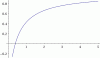
Especially when commission adjusted :
1 tick loss is twice as big as 1 tick profit...

Attached file:
Reward Underperfom Risk
For Symmetrical Coordinates.
Tend toward 1 as width dilute coms.

(12.5x-4)/(12.5x+4)
Reward: ES tick value * Ticks - Comission
Risk: ES tick value * Ticks + Comission
from 0 to 5 points.

R:R for :
1 tick = 0.5
2 ticks = 0.7
3 ticks = 0.8
4 ticks = 0.85
5 ticks = 0.88
 

Attachments

  • image.gif
    image.gif
    8.4 KB · Views: 55
Last edited:
You converted your formula from decimal to percent
February for me was 9.6% (give or take, I assumed 2 entries and 1 exit per trade)

Such an exercise can really be curative for those willing to consider they are making their brokers rich by overtrading
 
Back
Top