What is your strategy?

Status
Not open for further replies.
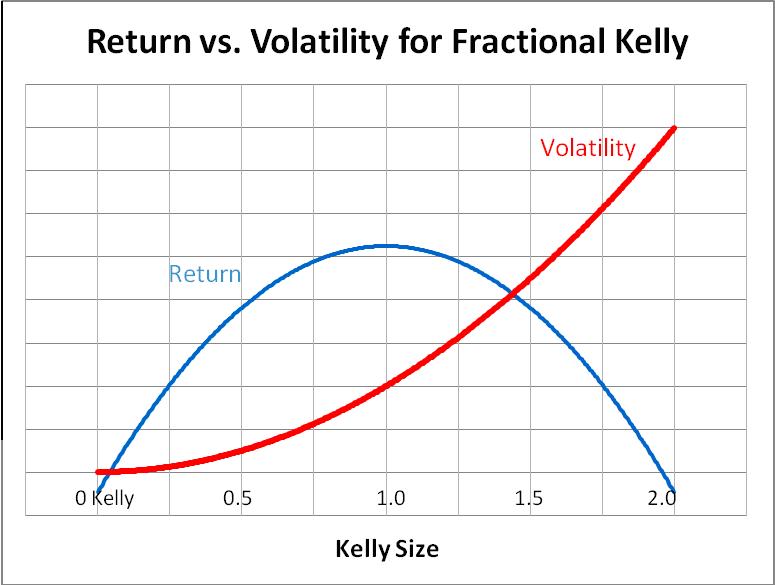
The general relationship between an increase in bet size and variance is if you double your bet size, the variance increases by a factor of root 2 and vice versa. Hope that helps in what you are looking for.

What's the formula from which this relationship is derived? And how does the growth rate scales when Kelly is reduced?

As Kelly is reduced, the growth rate decreases slower than the variance, which implies that the risk-adjusted growth (growth divided by variance) goes up. I'd like to know at which fraction of Kelly this risk-adjusted growth reaches its peak. I am guessing it would occur at somewhere around 1/4 of full Kelly.
 
Nonlinear has already given an explanation which you need to read and understand. The brief answer is that you have fallen into some layman's fallacy.

True story to illustrate: a couple of years ago, i was dating this young, very sexy girl who, unlike me, did not have any money and was not trained in the dark art of mathematics (which you refer to as dogma lol). I had that day received from an online casino a particularly juicy offer of a 50% cashback on any losses up to £1000. Between rounds (wink, wink), i explained the offer to her and asked her what she thought about it. She said she wouldn't be interested in participating since a) she couldn't afford to lose (even though i explained that she could bet a small amount that she was comfortable with rather than a bet of £2000) and more importantly b) because it was a ONE OFF deal, the casino would not give her another chance if she lost on the offer. Clearly she thought there was only value if there was a string of similar offers, she just couldn't grasp that there was value in just doing one offer.

You didn't prove anything, you did not even try. I can't blame you, proving the Kelly fraction is the best bet for a single spin is impossible task.

But I am going to show you that even on 10-spins, it is not the optimum bet, at least from a statistical point of view.

I run a 10-spins MC simulation, comparing your 8%-bankroll bet strategy (Red16) vs a flat $50 bet strategy (same Red16).

In 70% of the 10-spins runs, $50-fix bet comes ahead of your Kelly bet.

In the scenario presented, 10-spins run, Kelly is NOT optimal.
 
Now, if you change the "Kelly" bet strategy, and use 8% of the max Bankroll instead of 8% of the current Bankroll, and compare with a fixed $80 bet, the stats change as follow:

$80 fixed-bet: better in 35.4% of the 10-spin runs
8% of max Bankroll: better in 28.7% of the 10-spin runs
Tie: 35.9%

Fixed-bet still comes ahead.
 
It's impossible to know what the interviewers were looking for.

I think the interviewers wanted to see which candidates did think with their brain, and which candidates were just using cookbooks without analysis of the problem at hand.
 
In 70% of the 10-spins runs, $50-fix bet comes ahead of your Kelly bet.

But in the 30% of the outcomes, the payout on the Kelly bet is many times larger than the payout on the fixed $50 bet, isn't it? Why are you ignoring these 30% of the outcomes?
 
But in the 30% of the outcomes, the Kelly payout is many times larger than the fixed $50 payout, isn't it? Why are you ignoring these 30% of the outcomes?

I am not ignoring that the 30% has a much larger outcome, I am just highlighting that as an individual who has only 1 go at the 10-spin run, I want to maximize my probability of having the best outcome, not the potential total gain in the unlikely event of 10 times 16.
 
This 10-spin game is much different from a infinite process, it seems this is difficult to grasp for some.

My utility function is to maximize my chances of winning some.

It seems most people on this thread are focused on maximizing the potential gain, at the cost of having a low probability such high gain.

This isn't optimal asset allocation IMO - it is gambling.
 
I am just highlighting that as an individual who has only 1 go at the 10-spin run, I want to maximize my probability of having the best outcome, not the potential total gain in the unlikely event of 10 times 16.

Ok, so you are uncomfortable with the high variance of the results when using full Kelly. Me too. But it doesn't disprove the hard mathematical fact that Kelly maximizes the compound rate of return, either over 1 trial, or over 1 million trials.

My utility function is to maximize my chances of winning some.

Mine is to maximize the return-to-risk ratio.

This isn't optimal asset allocation IMO - it is gambling.

The full Kelly is, indeed, the fine edge between the "aggressive" and the "insane" capital allocation.

Aggressive%20vs%20insane%20risk%20taking-oct01,07.jpg
 
All those Kelly graph apply to infinite processes.

It is ridiculous to say they apply to a unique 1-spin game.

As for the 10-spin game, you prefer a higher probability (than fixed-bet) of winning less or losing, in return for higher gains in lower probability scenarios. That is your choice, but can't be called optimal asset allocation, optimal gamble for sure.
 
Status
Not open for further replies.
Back
Top