What is the historical evidence that Jesus Christ lived and died?

Furthermore, the logic of calling "Jesus' believers" as "Christians", as recorded 3 times in Paul's letters, should be fairly weak, theologically.

There should be just One Christ, who saved the world for his work done to All others. Once his work is done, it's one-off salvation work for All others.

There should be no need for another Christ in order to do/repeat the same work or any additional work. Otherwise, that would indicate/ prove that Jesus didn't do enough work for saving the world, and he needed someone else to back him up, doing more follow-up work for him. Of course not. Jesus definitely did enough!

Any learners of Jesus wants to become another Christ is just a funny concept. Too proud of one's own ability, and divinity - To be another Christ! Her/his own work might not be able even to save herself/himself.

Perhaps Paul really wanted to become another Christ, besides calling/appointing himself an Apostle - which seemed not good enough!

Perhaps, Jesus' followers should simply learn from God, the Nature. Just like many secular people do!

"God is (y)our teacher. Nobody else" - Jesus!

Jesus himself purposely did not write any holy books!

LOL
 
Last edited:
Consider that the Islamic faith considers Jesus to have been a real person. They do not recognize him as God of course, just a prophet of God.
They were smart. Better to give each one a part of the religions market. Kind of an oligopoly. Another smart move was to sayb that people should believe without proof. Something like a fundmanager without trackrecord.

But a few years ago Allah started an offensive to take a bigger market share. A rather aggressive campaign, but with members that are ready to die for their boss.

If religions would never have existed, the world would already have been over populated centuries ago. As the killed ones combined with their reproductions would make a huge difference.
 
imo, Jesus was very successful in 3 points. Both are marketing related. (Traditionally a student to learn a philosophy system like Stoicism would have to go to the teacher's place (except going to very wealthy families), requiring to paying tuition fee. )

1st, he popularised the theory of Stoicism by translating it into popular concepts that the general public in the marketplace where he personally preached can easily understand and accept.

2nd, he also send travelling evangelists everywhere spreading his message.


To make his messages even more popular, he also converted Stoicism, a practical philosophy, into a new religion. Incorporating some miracles including 'resurrection of the death', , parables including even heaven/ eternity/ etc.

3rd, ,,,

It's possible that all of the above marketing acts was designed for one purpose.

Jesus had a vision, to provide good education to everyone for free!

He believed good education comes from good messages.

He also believed good messages can easily reach the whole world effectively when outreaching is organised and implemented well.

(Printing was uncommon then and very expensive.)

Through outreaching with a network of travelling preachers - "Multiplication - Exponential compounding"!

He was confident his messages, good or bad, can one day reach the whole world!

Perhaps the world's first!

Without using Multiplication approach, many pretty good religions (like Zoroastrianismor) or philosophies (like Stoicism) could not even survive well!

LOL
 
Last edited:
It's possible that all of the above marketing acts was designed for one purpose.

Jesus had a vision, to provide good education to everyone for free!

He believed good education comes from good messages.

He also believed good messages can easily reach the whole world effectively when outreaching is organised and implemented well.

(Printing was uncommon then and very expensive.)

Through outreaching with a network of travelling preachers - "Multiplication - Exponential compounding"!

He was confident his messages, good or bad, can one day reach the whole world!

Perhaps the world's first!

Without using Multiplication approach, many pretty good religions (like Zoroastrianism) or philosophies (like Stoicism) could not even survive well!

LOL

https://en.wikipedia.org/wiki/Justin_Martyr
In the opening of the Dialogue,[9] Justin describes his early education, stating that his initial studies left him unsatisfied due to their failure to provide a belief system that would provide theological and metaphysical inspiration to their young pupil. He says he tried first the school of a Stoic philosopher, who was unable to explain God's being to him. He then attended a Peripatetic philosopher but was put off because the philosopher was too eager for his fee. Then he went to hear a Pythagorean philosopher who demanded that he first learn music, astronomy, and geometry, which he did not wish to do. Subsequently, he adopted Platonism after encountering a Platonist thinker who had recently settled in his city.

Obviously, not everyone had the required intellect and was able to become a philosopher due to its hard work. Justin finally settled down with Jesus' theory, which could be a simplified version of integrating Zoroastrianism and Stoicism.

When Jesus presented them in a Zen approach with many easy-to-understand parables, basically almost everyone in marketplace now can understand his messages.

Without an effective marketing scheme including outreaching, messages and parables, they would never have the chance to learn so much about Stoicism and Zoroastrianism.


Believe it or not, Jesus mentioned to his believers that after taking now water baptism they would need about fire baptism in the future. Without much further elaboration/ exploration.

The fire baptism I guess could well be leading to Zoroastrianism in his mind, awaiting his followers to find it out by themselves https://en.wikipedia.org/wiki/Zoroastrianism . There are 20 times mentioning Fire in the page.


ZoroastrianismSymbolWhite.PNG
Atar (fire), a primary symbol of Zoroastrianism


https://en.wikipedia.org/wiki/Zoroastrianism
Principal beliefs

Humata, Hukhta, Huvarshta (Good Thoughts, Good Words, Good Deeds) are the basic tenets of the religion.

In Zoroastrianism, Ahura Mazda is the beginning and the end, the creator of everything that can and cannot be seen, the Eternal, the Pure and the only Truth. In the Gathas, the most sacred texts of Zoroastrianism thought to have been composed by Zoroaster himself, the prophet acknowledged devotion to no other divinity besides Ahura Mazda.

Daena (din in modern Persian) is the eternal Law, whose order was revealed to humanity through the Mathra-Spenta ("Holy Words"). Daena has been used to mean religion, faith, law, and even as a translation for the Hindu and Buddhist term Dharma. The latter is often interpreted as "duty" but can also mean social order, right conduct, or virtue. The metaphor of the "path" of Daena is represented in Zoroastrianism by the muslin undershirt Sudra, the "Good/Holy Path", and the 72-thread Kushti girdle, the "Pathfinder".

Daena should not be confused with the fundamental principle asha (Vedic rta), the equitable law of the universe, which governed the life of the ancient Indo-Iranians. For these, asha was the course of everything observable—the motion of the planets and astral bodies; the progression of the seasons; and the pattern of daily nomadic herdsman life, governed by regular metronomic events such as sunrise and sunset.


The fire baptism I guess could also imply Stoic Physics as well https://en.wikipedia.org/wiki/Stoic_physics . There are about 8 times mentioning Fire in this page.


330px-EarthOverAfrica.jpg
In Stoic physics, the universe is shaped by a divine artisan-fire.


Stoic physics

Stoic physics is the natural philosophy adopted by the Stoic philosophers of ancient Greece and Rome used to explain the natural processes at work in the universe. To the Stoics the universe is a single pantheistic God, but one which is also a material substance. The primitive substance of the universe is a divine essence (pneuma) which is the basis of everything which exists. The separation of force from matter produces a divine fire (aether) which, as the basis of all matter, is differentiated into elements and shaped by the tension caused by the pneuma working according to the divine reason (logos) of the universe. These processes are responsible for the formation, the development, and ultimately, the destruction of the universe in a never-ending cycle (palingenesis). The human soul is an emanation from the fiery aether which permeates the universe, and sensation is transmission of pneuma-currents from objects, which interact with the substance of the mind, which is the soul's ruling part. The Stoics also recognised the existence of other gods and divine agents as manifestations of the one primitive God-substance.


LOL
 
Last edited:
I like to think Christianity has a lot of positives. Love not hate. Construction not destruction etc.
Unlike some others.
 
" I just guess my religion is a better one, if not the best. I like to think it has a lot of positives. Love, not hate. Construction, not destruction/ etc. Unlike some others. " --- A positive believer with a loving heart and constructive mind
 
I saw an interesting documentary on TV about finding the tomb of the High Priest of the Temple at the time of the crucifixion. Inside the elaborately carved sarcophacos were 2 iron nails. Tests conducted on these nails proved that they had been used in a crucifixion. Why they were put in the tomb nobody knows.


sk-2017_04_article_main_mobile;jpeg_quality=20.jpg
Film director Simcha Jacobovici holds two Roman-era nails during a press conference.

https://www.seeker.com/nails-tied-to-jesus-crucifixion-found-1765201328.html

Gabi Barkai, a professor of archaeology at Tel Aviv's Bar Ilan University who has 40 years of experience excavating tombs in Jerusalem, confirmed the nails dated back to the first century, but said it was impossible get a more accurate date.

"Nails are a rare things in tombs from Second Temple period Jerusalem," he told reporters, noting that there was no bone residue attached to them.

There were several theories as to why they might have been put inside a grave, one of which was that crucifixion nails were believed to be powerful amulets for the afterlife.

But there was "no proof whatsoever that these nails came from the cave of Caiaphas," he said.

Asked if he believed they were used in the crucifixion, Barkai was cautious.

"It's a possibility," he said.


What blood type? How could they verify/investigate the nails were once used for Jesus, but not others? DNA test? Based on any other blood samples from Jesus' close relatives? Who are they, and how to get their samples?


https://en.wikipedia.org/wiki/Justin_Martyr
The church of St. John the Baptist in Sacrofano, a few miles north of Rome, claims to have his relics.[16]

The Church of the Jesuits in Valletta, Malta, founded by Papal decree in 1592 also boasts relics of this second century Saint.[17]

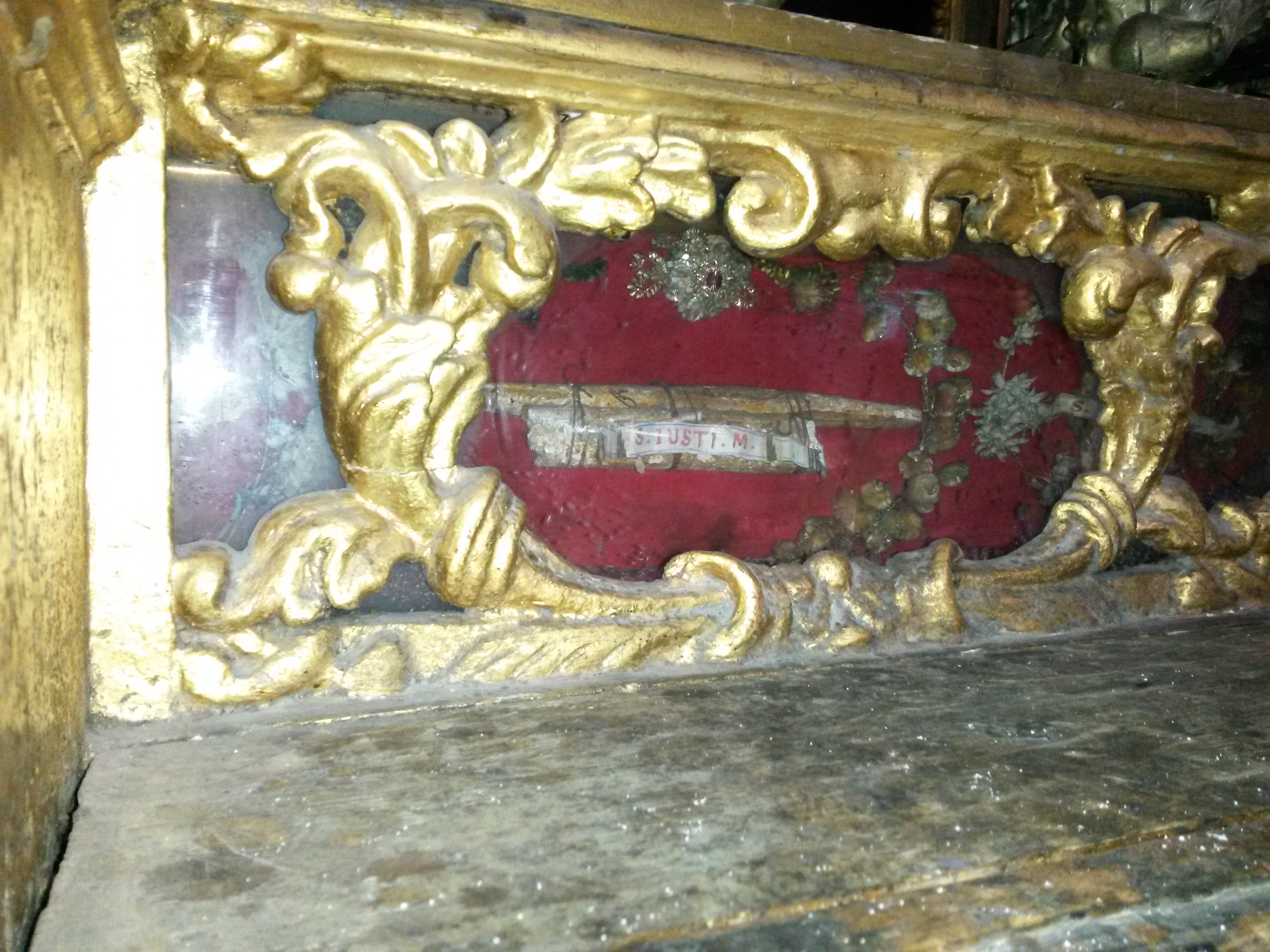
S._Iusti_M..jpg
Relics of St. Justin and other early Church martyrs can be found in the lateral altar dedicated to St. Anne and St. Joachim at the Jesuit's Church in Valletta, Malta.[18]

Why was it so hard for so long time that people just could not find any hard evidence such as any relics related directly to Jesus? Such as the iron nails, trees of the cross, Crown Of Thorns (probably with blood sample), etc.

If there were any valid relics, there should have been a proper place for people to keep them already, where is the place similar to the one for Justin's above, who died in year 165?

Jesus is definitely a much more significant figure in Christianity history.

Any recently new findings would be questionable, imo.
 
Last edited:
I like to think Christianity has a lot of positives. Love not hate. Construction not destruction etc.
Unlike some others.

Indeed. But those were secular values prior to their use to form the general format which became Christianity.

In my view if those positives can't be applied purely for their own sake without the condition of a religion demanding them under instruction or with threat and fear of retribution as reason to employ them, that can only diminish their worth.
 
Talking about Religions in general can be equally or much more complicate than this current thread. imo

In simple words, I would think there were many of the historical traditions, family-rules, society-rules, religious-rules, myths, mysteries and phenomenons, generated either by human or by the nature, that could not be rationally explained by the common knowledge and theories of the era.

The concept of Sin was commonly used to punish individuals due to serious lack of scientific and medical knowledge.

e.g. A baby if born blind or disabled was considered due to the sins of its parents. The whole family could be expelled by the community, moving far far away from the community.

With zero support from the community members (or even relatives), that would make the family's living even much harder.

In a sense, the community simply expect the whole needy family would completely vanish/die.

A figure like Jesus understood what to do through providing rational education/knowledge to everyone for free, in order to correct the misconceptions and mistakes people made according to this kind of bad traditions.

Jesus himself did not invent a religion of his theory, at all. He simply told every person, whether he healed or not, just "Go home!". He did not say, "Come to my church! My name is Jesus."

LOL
 
Since scientists were marching yesterday, let's throw in a little knowledge (gnosis) into this thread:

For anyone who comes with Josephus or anybody near contemporary of Jesus, I would like to discuss the other writings from the same time:

https://en.wikipedia.org/wiki/Biblical_apocrypha

https://en.wikipedia.org/wiki/Canon_of_Trent

Now we can bet serious money that any nearly contemporary, but contradictory (to dogma) writings didn't make it through the censoring process of 20 centuries and today we simply don't even have any idea what was left out. Except when we find old writings in caves or in dry sand. My fav is this:

https://en.wikipedia.org/wiki/Gospel_of_Peter

"The Gospel of Peter is one of the non-canonical gospels rejected as apocryphal by the Church Fathers and the Catholic Church's synods of Carthage and Rome, which established the New Testament canon.[1] It was the first of the non-canonical gospels to be rediscovered, preserved in the dry sands of Egypt.
....this gospel denies the crucifixion of Jesus which contradicts the belief of mainstream Christianity but has similarities with Docetism."
 
Back
Top