What is the historical evidence that Jesus Christ lived and died?

The term "Christian" or "Christians" was first used to describe Paul's converts at Antioch, the Greek word Christos was a translation for the Hebrew word for Messiah.

Literally a follower of the Messiah or Christ. The term denotes Divinity.

Christianity or the Church is the product and sole property of Jesus. He paid for it.

Whoever Paul might have actually been he was not an eye witness. He was developing his missives well after the supposed life time of Jesus.
So once again it is stuff which is not contemporaneous, first hand or verifiable nor to be frank, the product of a mentally well balanced person unless it was written as fiction. Anyone who reads Paul while maintaining a grain of common sense would immediately see why.

If you say Paul invented Christians and or Christianity, then you do indeed confirm how Jesus is the product of Paul's Christianity not the source.

And of course it goes without saying that because the person calling himself Paul says something in the Bible, it doesn't mean that what Paul says in the Bible is true or real, any more than what C.S.Lewis says in The Chronicles of Narnia is true or real.

The Jesus character was the Messiah, first crafted by the writings of messianic Jewish sects separating themselves from Judaism before Paul came along. So it could be said they were Christians before Christ was later re-invented by Christians.
if anyone holds the copyright on Jesus, it must be the early dissenting Jews.

The term Christian was not first used by Paul but was used in mockery, not to denote divinity.

The rest, as they say, is show business and the Bible, being much the same things.
 
Last edited:
https://www.gotquestions.org/Justin-Martyr.html

Justin Martyr’s First Apologies (or simply Apologies) is addressed to the Roman Emperor Antonius Pius. It presents Christian truth within the context of current Greek thought. Justin emphasizes that Jesus is the logos incarnate (see John 1:1), since logos was a commonly understood Greek philosophical concept. Justin believed that any person who lived in accordance with the logos was a Christian whether that person knew it or not. Socrates was thus a “Christian” before Christ, in much the same way that Abraham was. Apologies was provoked by persecution of Christians and attempted to clear away popular misconceptions about Christianity.

From Justin Martyr’s writings we get early descriptions of Christian worship services and the Eucharist. We see that the Jewish trappings of Christianity were falling away. We also see that Justin opposed the early heresies of Gnosticism, Doceticism, and Marcionism.

In 165, Justin and some of his followers were arrested for their faith. In answer to threats of death, Justin is reported to have said, “If we are punished for the sake of our Lord Jesus Christ, we hope to be saved.” He was beheaded under the reign of Emperor Marcus Aurelius, son of Antonius Pius, and he later became known as Justin Martyr.
 
Whoever Paul might have actually been he was not an eye witness. He was developing his missives well after the supposed life time of Jesus.
So once again it is stuff which is not contemporaneous, first hand or verifiable nor to be frank, the product of a mentally well balanced person unless it was written as fiction. Anyone who reads Paul while maintaining a grain of common sense would immediately see why.

If you say Paul invented Christians and or Christianity, then you do indeed confirm how Jesus is the product of Paul's Christianity not the source.

And of course it goes without saying that because the person calling himself Paul says something in the Bible, it doesn't mean that what Paul says in the Bible is true or real, any more than what C.S.Lewis says in The Chronicles of Narnia is true or real.

The Jesus character was the Messiah, first crafted by the writings of messianic Jewish sects separating themselves from Judaism before Paul came along. So it could be said they were Christians before Christ was later re-invented by Christians.
if anyone holds the copyright on Jesus, it must be the early dissenting Jews.

The term Christian was not first used by Paul but was used in mockery, not to denote divinity.

The rest, as they say, is show business and the Bible, being much the same things.

What do you consider "well after" a few months, less than 3 years? Paul aka Saul of Tarsus was very much alive during the life of Jesus and active in the Sanhedrin, the ruling theological council of the Hebrews. He was used to persecute the Church, Christians after Jesus' death, and was the instigator in the stoning of Stephen. He was feared by the Apostles and early Church prior to his conversion.

You in retrospect some 2000 years later want to decide the veracity of early Christian writings, when they have already been verified by the early Church. If the early Church would have deemed Paul a fraud his writings wouldn't be in the Bible today.
 
Gospel_of_Mary.jpg
Gospel of Mary, P. Oxyrhynchus L 3525.

https://en.wikipedia.org/wiki/Gospel_of_Mary

History

Papyrus Berolinensis 8502, also known as the Akhmim Codex, also contains the Apocryphon of John, the Sophia of Jesus Christ, and a summary of the Act of Peter. All four works contained in the manuscript are written in the Sahidic dialect of Coptic.[2] Two other fragments of the Gospel of Mary have been discovered since, both written in Greek (Papyrus Oxyrhynchus L 3525 and Papyrus Rylands 463). P.Oxy. L 3525 "... was in fact found by Grenfell and Hunt some time between 1897 and 1906, but only published in 1983,"[3] by P. J. Parsons.[4]

The two fragments were published in 1938 and 1983 respectively, and the Coptic translation was published in 1955 by Walter Till.[5]

Most scholars agree that the original gospel was written in Greek sometime during the 2nd century.[6] However, Hollis Professor of Divinity Karen King at Harvard Divinity School suggests that it was written during the time of Christ.[7][8]


http://gnosis.org/library/marygosp.htm


The Gospel According to Mary Magdalene
(The Gospel of Mary)


Chapter 4

(Pages 1 to 6 of the manuscript, containing chapters 1 - 3, are lost. The extant text starts on page 7...)

. . . Will matter then be destroyed or not?

22) The Savior said, All nature, all formations, all creatures exist in and with one another, and they will be resolved again into their own roots.

23) For the nature of matter is resolved into the roots of its own nature alone.


24) He who has ears to hear, let him hear.

25) Peter said to him, Since you have explained everything to us, tell us this also: What is the sin of the world?

26) The Savior said There is no sin, but it is you who make sin when you do the things that are like the nature of adultery, which is called sin.

27) That is why the Good came into your midst, to the essence of every nature in order to restore it to its root.


28) Then He continued and said, That is why you become sick and die, for you are deprived of the one who can heal you.

29) He who has a mind to understand, let him understand.

30) Matter gave birth to a passion that has no equal, which proceeded from something contrary to nature. Then there arises a disturbance in its whole body.

31) That is why I said to you, Be of good courage, and if you are discouraged be encouraged in the presence of the different forms of nature.


32) He who has ears to hear, let him hear.

33) When the Blessed One had said this, He greeted them all,saying, Peace be with you. Receive my peace unto yourselves.

34) Beware that no one lead you astray saying Lo here or lo there! For the Son of Man is within you.

35) Follow after Him!

36) Those who seek Him will find Him.

37) Go then and preach the gospel of the Kingdom.

38) Do not lay down any rules beyond what I appointed you, and do not give a law like the lawgiver lest you be constrained by it.

39) When He said this He departed.
 
Last edited:

https://en.wikipedia.org/wiki/Early_Christianity

Early Christianity is the period of Christianity preceding the First Council of Nicaea in 325. It is typically divided into the Apostolic Age and the Ante-Nicene Period (from the Apostolic Age until Nicea).

The first Christians, as described in the first chapters of the Acts of the Apostles, were all Jews either by birth or conversion, for which the biblical term "proselyte" is used,[1] and referred to by historians as Jewish Christians. The early Gospel message was spread orally, probably in Aramaic,[2] but almost immediately also in Greek.[3] The New Testament's Acts of the Apostles and Epistle to the Galatians record that the first Christian community was centered in Jerusalem and its leaders included Saint Peter, James, the brother of Jesus, and John the Apostle.[4]

After the conversion of Paul the Apostle, he claimed the title of "Apostle to the Gentiles". Paul's influence on Christian thinking is said to be more significant than that of any other New Testament author.[5] By the end of the 1st century, Christianity began to be recognized internally and externally as a separate religion from Judaism which itself was refined and developed further in the centuries after the destruction of the Second Temple.

Numerous quotations in the New Testament and other Christian writings of the first centuries,
indicate that early Christians generally used and revered the Hebrew Bible (the Tanakh) as religious text, mostly in the Greek (Septuagint) or Aramaic (Targum) translations.[6]

As the New Testament canon developed, the Pauline epistles, the canonical gospels and various other works were also recognized as scripture to be read in church. Paul's letters, especially Romans, established a theology based on Christ rather than on the Mosaic Law, but most Christian denominations today still consider the "moral prescriptions" of the Mosaic Law, such as the Ten Commandments, Great Commandment, and Golden Rule, to be relevant. Early Christians demonstrated a wide range of beliefs and practices, many of which were later denounced as heretical.
 
Problems are an artifact could be fake. Any real record could be destroyed purposely.

Jesus perhaps was not worth to mentioned in mainstream history until very late stage.

Besides there were probably (most likely) too many competing preachers/teachers from various religious cults/sects during the era.

After all, logically Paul should be a key figure, especially he himself once killed believers of Jesus, who were not violent ones with any intention of hurting others. Only because they had a firm conviction of a new belief.

Of course, that the whole picture/process about Jesus could be a fake news. Which was especially uneasy, when encountering serious objection from the mainstream Judaism believers like Paul.

However, obviously his teachings/theory surely was a believable/attractive theory to the believers, making them worth to die for the theory.

imo, the probability of the historical Jesus should not be overly underestimated.

After all, there would be almost always having an originator named/known for every single religion.


http://www.nbcnews.com/id/26972493/...earliest-reference-describes-christ-magician/
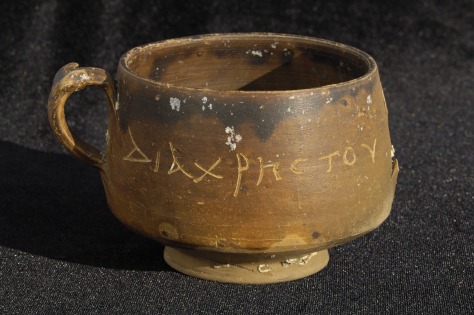
jesus-bowl.grid-6x2.JPG
A bowl, dating to between the late 2nd century B.C. and the early 1st century A.D., is engraved with what may be the world's first known reference to Christ. The engraving reads, "DIA CHRSTOU O GOISTAIS," which has been interpreted to mean either, "by Christ the magician" or, "the magician by Christ."

I think the whole issue would be this argument cannot be easily defined as commonly expected.

I would suggest one of the effective approaches as follows:

Since the early believers were willing martyrs and were executed by the Romans authority, why didn't the authority just simply investigated and provided evidences in order to clarify this figure of historical Jesus had never existed.

The evidences could be collected and supplied by both some doubtful believers (with little conviction) and non-believers, from various angles/aspects.

Obviously, this approach would be the most direct and effective to disqualify whatever stories, any kind, about the existence of Jesus. If the authority can do that!

If not, the authority could even possibly make up some probable evidences. AT least, writings, books, or court cases against believers, whether succeeded or failed cases.

Just similar to what the authority did to Jesus, opened many court cases for so many very early Christian martyrs. These cases would have been recorded naturally in the historical books, stating None of them could provide evidence for the existence of a living Jesus.

It would be almost absolutely impossible that the authority didn't know how to do that, or didn't want to do that at all.

Unless, that knew very likely when doing so they could make the situation even much worse. Therefore, no any record was written down in any books, purposely. That could well be a planned outcome by the authority.

That No record is the best record! Or whatever useful records such as for prosecuting early Christian martyrs had been completely eliminated intentionally.

Purpose - Maximum uncertainty! LOL
 
Last edited:


https://www.gotquestions.org/Justin-Martyr.html
In 165, Justin and some of his followers were arrested for their faith. In answer to threats of death, Justin is reported to have said, “If we are punished for the sake of our Lord Jesus Christ, we hope to be saved.” He was beheaded under the reign of Emperor Marcus Aurelius, son of Antonius Pius, and he later became known as Justin Martyr.

https://en.wikipedia.org/wiki/Justin_Martyr

In the opening of the Dialogue,[9] Justin describes his early education, stating that his initial studies left him unsatisfied due to their failure to provide a belief system that would provide theological and metaphysical inspiration to their young pupil. He says he tried first the school of a Stoic philosopher, who was unable to explain God's being to him. He then attended a Peripatetic philosopher but was put off because the philosopher was too eager for his fee. Then he went to hear a Pythagorean philosopher who demanded that he first learn music, astronomy, and geometry, which he did not wish to do. Subsequently, he adopted Platonism after encountering a Platonist thinker who had recently settled in his city.

Justin was once a Stoic-in-training, then trying others, and finally a convert to Christian after observing certain Stoic behaviour/virtues actually witnessed in believers. (Page 190 http://bakerpublishinggroup.com/books/stoicism-in-early-christianity/335281)

Christians were viewed as true Stoics in the Roman purview. (Page 188)


https://en.wikipedia.org/wiki/Marcus_Aurelius
Marcus Aurelius (/ɔːˈriːliəs/; Latin: Marcus Aurelius Antoninus Augustus;[9][notes 1][12] 26 April 121 – 17 March 180 AD) was Emperor of Rome from 161 to 180. He ruled with Lucius Verus as co-emperor from 161 until Verus' death in 169.

https://en.wikipedia.org/wiki/Galen
Aelius Galenus or Claudius Galenus (/ɡəˈliːnəs/;[1] Greek: Κλαύδιος Γαληνός; September 129 AD – c. 200/c. 216), often Anglicized as Galen and better known as Galen of Pergamon (/ˈɡeɪlən/),[2] was a prominent Greek physician, surgeon and philosopher in the Roman Empire.[3][4][5] Arguably the most accomplished of all medical researchers of antiquity, Galen influenced the development of various scientific disciplines, including anatomy,[6] physiology, pathology,[7] pharmacology,[8] and neurology, as well as philosophy[9] and logic.

Both Marcus and Galen (Marcus' personal physician) were very well-known Stoics.

Galen considered Christianity like a third-rate philosophy, and Christians displaying some features like philosophers. http://www.tertullian.org/rpearse/galen_on_jews_and_christians.htm
http://www.earlychristianwritings.com/galen.html

It seemed they both didn't even challenge the fact whether Jesus was in reality a living figure. That's weird!
 
Last edited:
What do you consider "well after" a few months, less than 3 years?
50 years well after.
Of which period just 6 of the 13 letters of Paul can be substantiated enough to make them only potentially authentic.

So Paul or Saul or whatever the pen name or true name was, is writing in an era when the history of a religion starts to get cobbled together. The product of which is the mythical Jesus.
But this is at least 50 years after the totally unverified life and death of the same Jesus who was supposed to have already invented it!

Paul aka Saul of Tarsus was very much alive during the life of Jesus and active in the Sanhedrin, the ruling theological council of the Hebrews. He was used to persecute the Church, Christians after Jesus' death, and was the instigator in the stoning of Stephen. He was feared by the Apostles and early Church prior to his conversion.

So he was alive during the suppositious time of Jesus when such tales, such exceptional events, such world changing times abounded that a God actually lived on Earth, yet nothing whatsoever is written, not a mention not a word, by Paul or anyone else in all the voluminous records and chronicles until at least 50 years later when those fantastical tales begin to be written down. Like JK Rowling would have Harry Potter developing in her head for a good many years no doubt.

You in retrospect some 2000 years later want to decide the veracity of early Christian writings, when they have already been verified by the early Church.

Christian writings have veracity because the church says Christian writings have veracity. A pointless and meaningless circular argument. Stuff does not get veracity that way.

It is known how most letters attributed to Paul were forged in the name of Paul. The complete string of fake letters between Paul and Seneca for example.
That these epistles attributed to Paul were written in the 50's CE and one or many people definitely lived to author them is obviously true.
That does not mean the first person narrative of Paul or Saul or whoever portrayed in those letters actually existed.
I think you could justifiably argue he has slightly more attestation than Jesus who has non at all, but that evidence is far from fulfilling the characteristics which veracity requires for establishing a person's historical authenticity.

There are no credible accounts of a Bible Jesus and church stories including those associated to Paul are rendered, by both their lack of providence and outrageous claims, as simply that - stories.

Things that do all the things ducks do are ducks.
Stories that do all the things fiction does, are fiction.
 
https://en.wikipedia.org/wiki/Jesus

Disciples and followers

Near the beginning of his ministry, Jesus appoints twelve apostles. In Matthew and Mark, despite Jesus only briefly requesting that they join him, Jesus' first four apostles, who were fishermen, are described as immediately consenting, and abandoning their nets and boats to do so (Matthew 4:18–22, Mark 1:16–20). In John, Jesus' first two apostles were disciples of John the Baptist. The Baptist sees Jesus and calls him the Lamb of God; the two hear this and follow Jesus.[145][146] In addition to the Twelve Apostles, the opening of the passage of the Sermon on the Plain identifies a much larger group of people as disciples (Luke 6:17). Also, in Luke 10:1–16 Jesus sends seventy or seventy-two of his followers in pairs to prepare towns for his prospective visit. They are instructed to accept hospitality, heal the sick and spread the word that the Kingdom of God is coming.[147]

imo, Jesus was very successful in 3 points. Both are marketing related. (Traditionally a student to learn a philosophy system like Stoicism would have to go to the teacher's place (except going to very wealthy families), requiring to paying tuition fee. )

1st, he popularised the theory of Stoicism by translating it into popular concepts that the general public in the marketplace where he personally preached can easily understand and accept.

2nd, he also send travelling evangelists everywhere spreading his message.


In Mark, the disciples are notably obtuse. They fail to understand Jesus' miracles (Mark 4:35–41, Mark 6:52), his parables (Mark 4:13), or what "rising from the dead" would mean (Mark 9:9–10). When Jesus is later arrested, they desert him.[135]

To make his messages even more popular, he also converted Stoicism, a practical philosophy, into a new religion. Incorporating some miracles including 'resurrection of the death', , parables including even heaven/ eternity/ etc.

3rd, he was also absolutely keen in converting Judaism believers to his followers through his fulfillment of OT's many predictions/promises.


LOL

http://www.nbcnews.com/id/26972493/...earliest-reference-describes-christ-magician/
jesus-bowl.grid-6x2.JPG
A bowl, dating to between the late 2nd century B.C. and the early 1st century A.D., is engraved with what may be the world's first known reference to Christ. The engraving reads, "DIA CHRSTOU O GOISTAIS," which has been interpreted to mean either, "by Christ the magician" or, "the magician by Christ."
 
Last edited:
Perhaps we should just focus mainly on the books of Gospels.

Paul could be a high ranking official appointed/assiged by the authority/establishment for creating a new religion nowadays called Christianity.

One of the most unresolved mystery would be the process of how the early "Jesus-believers" hiding behind close-door to avoid authority's persecution would suddenly change their mind of fear and insecurity, became part of the "Paul's Christians" openly gathering in public places for worshiping God.

We might never know/understand. LOL


https://en.wikipedia.org/wiki/Jesuism

Jesuism, also called Jesusism or Jesuanism, is a term for the teachings of Jesus in distinction to the teachings of mainstream Christianity.[1] In particular, the term is often contrasted with the theology attributed to Paul of Tarsus and mainstream church dogma.[2][3] While not being opposed to the Christian Bible or Church doctrine, Jesuism does not affirm their authority over the teachings of Jesus. As a philosophy, Owen Flanagan characterized Jesuism as naturalistic and rationalist, rejecting the conflict between faith and science.[4]

Many New Testament scholars have tried to identify Jesus' authentic sayings and actions; Géza Vermes, in particular, in his The Authentic Gospel of Jesus identifies what elements of the synoptic gospels are attributable to Jesus.[5]
 
Last edited:
Back
Top