
I came across the options strategy described in the videos below. The summary is we roll the short straddle up(to recenter it) if underlying price moves up 1/4 of the ATM options prices. We also do the same if the straddle moves down.
Example: A stock currently trades at $100. The 30 days ATM call and put each cost $10. So the straddle price is $20. If the underlying goes up or down by $5, then we recenter the straddle. So if it goes to $105 or $95 we have to recenter. So we keep repeating this process.
Questions:
1. I know such a strategy would incur a lot of transaction costs. That aside, the backtest from 2017 till 2022 is positive on indexes like BankNifty. What do you think of such a strategy implemented on tight bid/ask indexes like SPY? Is it bad or a stupid idea?
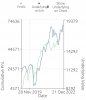 Nifty50 PNL curve in green, Nifty50 price chart in blue.
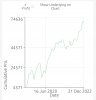 Nifty50 PNL curve in green.
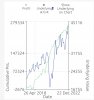 BankNifty PNL curve in green, BankNifty price chart in blue.
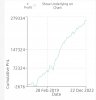 BankNifty PNL curve in green.
2. Why does such a strategy have a better performance on BankNifty than on Nifty50 even though BankNifty is usually more volatile?
Example: A stock currently trades at $100. The 30 days ATM call and put each cost $10. So the straddle price is $20. If the underlying goes up or down by $5, then we recenter the straddle. So if it goes to $105 or $95 we have to recenter. So we keep repeating this process.
Questions:
1. I know such a strategy would incur a lot of transaction costs. That aside, the backtest from 2017 till 2022 is positive on indexes like BankNifty. What do you think of such a strategy implemented on tight bid/ask indexes like SPY? Is it bad or a stupid idea?
Nifty50 PNL curve in green, Nifty50 price chart in blue. Nifty50 PNL curve in green. BankNifty PNL curve in green, BankNifty price chart in blue. BankNifty PNL curve in green.2. Why does such a strategy have a better performance on BankNifty than on Nifty50 even though BankNifty is usually more volatile?

 both options where puts, i shall recalculate the results